
Christos H. Papadimitriou
Author of Logicomix: An Epic Search for Truth
About the Author
Image credit: Professor Christos Papadimitriou giving a talk at the EPFL on 30 June 2009 By Rama - Own work, CC BY-SA 2.0 fr, https://commons.wikimedia.org/w/index.php?curid=7175470
Works by Christos H. Papadimitriou
Associated Works
Tagged
Common Knowledge
- Legal name
- Papadimitriou, Christos Harilaos
- Birthdate
- 1949-08-16
- Gender
- male
- Education
- Athens Polytechnic (BS|Electrical Engineering|1972)
Princeton University (MS|Electrical Engineering|1974)
Princeton University (PhD|Electrical Engineering Computer Science|1976) - Occupations
- professor
author
writer
novelist - Organizations
- University of California, Berkeley
ACM (Fellow, 2001)
National Academy of Engineering (Member)
National Academy of Sciences (Member) - Awards and honors
- Knuth Prize (2002)
Gödel Prize (2012)
EATCS Award (2015)
IEEE John von Neumann Medal (2016)
IEEE Computer Society Charles Babbage Award (2004)
Harvey Prize (2018) - Nationality
- Greece
- Birthplace
- Athens, Greece
- Places of residence
- Berkeley, California, USA
- Associated Place (for map)
- Greece
Members
Reviews
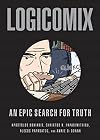
If not the most gripping graphic novel I've read, this is certainly on of the most intellectual. It tells a simplified and slightly dramatized life of Bertrand Russell, using the structure of a reflective lecture on logic's application to real life, given in the US in the early days of World War II when the debate about whether to enter the war was hot and heavy. Add yet another framing structure where the co-creators of the book debate the themes of logic and madness, and that Papadimitriou show more is invited to co-author because as a computer scientist he can explain exactly what Russell, Frege, Goedel, Hilbert, and the others were trying to do and whether they succeeded or not. As both a math major who focused on pure logic, and a computer scientist myself, I can't judge how well the explanation of theory works for others. For me, it felt sincere but incomplete, no pun intended.
Reommended. show less
Reommended. show less
Bertrand Russell and Principia Mathematica wouldn't be at the top of my list as candidates for graphic novels, but this is good, even provocative. You can quarrel with details of the depictions of personalities, theories, and proofs, but it's still as good a mix of entertainment and intellectual history as you could really hope for.
The story elevates Russell's (and Whitehead's) quest for a logical foundation to mathematics to the central tension of both Russell's life and the history of show more philosophy in the first half of the twentieth century. For Russell, it's a search for certainty in a life threatened by madness. For philosophy, it's a turning point not only in the philosophy of mathematics, but in the understanding of the relationship between reason and reality. And it is the link, via Von Neumann and Turing, between logic and the foundations of modern computing.
Virtually all of those themes are debatable -- in what sense Russell and Whitehead were seeking a "foundation" (e.g., an explanation vs. a justification), what role the successes and failures of Principia Mathematica played in the changing status of rationalism, and what debt computing theory owes specifically to the work of Russell and Whitehead and the controversies arising from it. The story places Russell firmly at the center, even putting him on a kind of odyssey, visiting and conversing in person with virtually all the major figures in mathematics and philosophy of the time.
The authors clearly present the work as at least partly fictional, inventing meetings for example between Russell and Frege and between Russell and Cantor, none of which ever happened. And Russell's story is told via an imagined lecture by Russell, attended in part by anti-war (World War II) protesters Russell has encountered on his way into the lecture. The entire story is framed by conversations among the authors, about Russell, Principia, and the story itself, lending a kind of post-modern effect to the whole thing.
If there's a flaw I would pick on, it wouldn't be the details of the biographies, theories, or proofs. This is a graphic novel, after all -- if you want academic precision, you should have gone in a different direction. On the other hand, I didn't find a lot of drama in Russell's message to the protesters. I think I get it -- "There's no royal road to truth", as he says, and you can't expect so much of "the role of logic in human affairs". You can't fall back on the dictates of certainty -- in the end, there is no escaping the responsibility to make judgements -- a profound recognition for sure, but the punch in its depiction here is lacking for me. show less
The story elevates Russell's (and Whitehead's) quest for a logical foundation to mathematics to the central tension of both Russell's life and the history of show more philosophy in the first half of the twentieth century. For Russell, it's a search for certainty in a life threatened by madness. For philosophy, it's a turning point not only in the philosophy of mathematics, but in the understanding of the relationship between reason and reality. And it is the link, via Von Neumann and Turing, between logic and the foundations of modern computing.
Virtually all of those themes are debatable -- in what sense Russell and Whitehead were seeking a "foundation" (e.g., an explanation vs. a justification), what role the successes and failures of Principia Mathematica played in the changing status of rationalism, and what debt computing theory owes specifically to the work of Russell and Whitehead and the controversies arising from it. The story places Russell firmly at the center, even putting him on a kind of odyssey, visiting and conversing in person with virtually all the major figures in mathematics and philosophy of the time.
The authors clearly present the work as at least partly fictional, inventing meetings for example between Russell and Frege and between Russell and Cantor, none of which ever happened. And Russell's story is told via an imagined lecture by Russell, attended in part by anti-war (World War II) protesters Russell has encountered on his way into the lecture. The entire story is framed by conversations among the authors, about Russell, Principia, and the story itself, lending a kind of post-modern effect to the whole thing.
If there's a flaw I would pick on, it wouldn't be the details of the biographies, theories, or proofs. This is a graphic novel, after all -- if you want academic precision, you should have gone in a different direction. On the other hand, I didn't find a lot of drama in Russell's message to the protesters. I think I get it -- "There's no royal road to truth", as he says, and you can't expect so much of "the role of logic in human affairs". You can't fall back on the dictates of certainty -- in the end, there is no escaping the responsibility to make judgements -- a profound recognition for sure, but the punch in its depiction here is lacking for me. show less
"When logic congeals into all-encompassing and perfect-seeming theories, then it can actually become a very evil con trick! Wittgenstein has a point, you see: 'All the facts of science are not enough to understand the world's meaning.' But hear this, too: like many in this hall, I still try, and very hard, to remain a pacifist. Yet . . . The thought of Hitler and Stalin taking over Europe is too hard to bear."
Logicomix: An Epic Search for Truth by Apostolos Doxiadis is an "adventure in show more ideas" and surprisingly fun to read. Caro was right (no surprise there): it's great. Bertrand Russell, Alfred Whitehead, Wittgenstein, Godel, and others show up and mingle - lots of folks who I knew "of" but not a lot "about." The story is broadly set up around a lecture Russell, a previously active pacifist, is giving in the U.S. in 1939 as Hitler extends the reach of his power. It is attended by pacifists who want Russell to denounce the war and any participation in it by the U.S. Periodically, the graphic novel's creators appear with commentary and "our time" perspective. Russell tells a personal tale that takes you through his unusual upbringing and liberal lifestyle, while also giving you the evolution of the thinking of the greatest minds of the time. There is a lot about logic and the shaky foundations of mathematics and the search for mathematical truths we can rely on (it reminds me of the physicists' frustrating pursuit of a "theory of everything" to unify the general theory of relativity and quantum physics and everything else: http://en.wikipedia.org/wiki/Theory_of_everything), but it's surprisingly painless, and even engrossing. It also reminded me that I want to read more about Alan Turing and "Enigma" in WWII.
I suspect someone more familiar with the players and their theories would get even more out of this, but I definitely feel more kindly and receptive toward these eggheads, having seen through this their human sides and their passionate struggles to reach truth. Their integrity requires ruefully accepting it time and again when the newest genius tears down the fortress of truth each thought he had built. The constant questioning of principles and fervent desire to locate truth has been associated with "madness', and that comes up in this, too. The drawing is engaging and witty. The story concludes, satisfyingly in an unexpected way, with a performance of the Orestia. Kudos to the author for coming up with such a well-executed and thought-expanding book. show less
Logicomix: An Epic Search for Truth by Apostolos Doxiadis is an "adventure in show more ideas" and surprisingly fun to read. Caro was right (no surprise there): it's great. Bertrand Russell, Alfred Whitehead, Wittgenstein, Godel, and others show up and mingle - lots of folks who I knew "of" but not a lot "about." The story is broadly set up around a lecture Russell, a previously active pacifist, is giving in the U.S. in 1939 as Hitler extends the reach of his power. It is attended by pacifists who want Russell to denounce the war and any participation in it by the U.S. Periodically, the graphic novel's creators appear with commentary and "our time" perspective. Russell tells a personal tale that takes you through his unusual upbringing and liberal lifestyle, while also giving you the evolution of the thinking of the greatest minds of the time. There is a lot about logic and the shaky foundations of mathematics and the search for mathematical truths we can rely on (it reminds me of the physicists' frustrating pursuit of a "theory of everything" to unify the general theory of relativity and quantum physics and everything else: http://en.wikipedia.org/wiki/Theory_of_everything), but it's surprisingly painless, and even engrossing. It also reminded me that I want to read more about Alan Turing and "Enigma" in WWII.
I suspect someone more familiar with the players and their theories would get even more out of this, but I definitely feel more kindly and receptive toward these eggheads, having seen through this their human sides and their passionate struggles to reach truth. Their integrity requires ruefully accepting it time and again when the newest genius tears down the fortress of truth each thought he had built. The constant questioning of principles and fervent desire to locate truth has been associated with "madness', and that comes up in this, too. The drawing is engaging and witty. The story concludes, satisfyingly in an unexpected way, with a performance of the Orestia. Kudos to the author for coming up with such a well-executed and thought-expanding book. show less

Geometry showed me the only way toward reality: Reason. In it, I encountered for the first time the delicious experience of knowing something with total certainty. Proof thus became my Royal Road to Truth.
That dialogue is attributed to Bertrand Russell in this graphic-format, quasi-fictionalized* biography of the man -- particularly the math, history and philosophy of his quest for an adequate representation of reality and source of absolute truth, and his struggle to prove that his found show more source (logic) begets the answer to every question.
Geometry was the first math I loved and while I admit to hovering over the math here (and the philosophy) more than fully understanding it, it was fun to be hovering over Wittgenstein (and sad to be connecting math-greatness with mental illness) both here and in my concurrent reading of D.T. Max's biography of David Foster Wallace. I enjoyed the introduction to so many historical philosophers and I enjoyed the storytelling -- watching the authors and illustrators break the “fourth wall” of the story to address the reader directly or talk amongst themselves about math/philosophy and how to best present the material.
*The authors have gotten some grief for choosing to “select, reduce, simplify, interpret, and, very often, invent” Russell’s life to better tell this story, but for me it worked in their quest for the “truth” (i.e. vs. the “facts”). On the other hand, does embellishment contradict the concept of “proof”? show less
That dialogue is attributed to Bertrand Russell in this graphic-format, quasi-fictionalized* biography of the man -- particularly the math, history and philosophy of his quest for an adequate representation of reality and source of absolute truth, and his struggle to prove that his found show more source (logic) begets the answer to every question.
Geometry was the first math I loved and while I admit to hovering over the math here (and the philosophy) more than fully understanding it, it was fun to be hovering over Wittgenstein (and sad to be connecting math-greatness with mental illness) both here and in my concurrent reading of D.T. Max's biography of David Foster Wallace. I enjoyed the introduction to so many historical philosophers and I enjoyed the storytelling -- watching the authors and illustrators break the “fourth wall” of the story to address the reader directly or talk amongst themselves about math/philosophy and how to best present the material.
*The authors have gotten some grief for choosing to “select, reduce, simplify, interpret, and, very often, invent” Russell’s life to better tell this story, but for me it worked in their quest for the “truth” (i.e. vs. the “facts”). On the other hand, does embellishment contradict the concept of “proof”? show less
Lists
Metafiction (1)
Awards


You May Also Like


Associated Authors
Statistics
- Works
- 9
- Also by
- 2
- Members
- 3,121
- Popularity
- #8,188
- Rating
- 3.9
- Reviews
- 118
- ISBNs
- 46
- Languages
- 14