
Janna Levin
Author of A Madman Dreams of Turing Machines
About the Author
Janna Levin is a professor of physics and astronomy at Barnard College of Columbia University.
Works by Janna Levin
How the Universe Got Its Spots: Diary of a Finite Time in a Finite Space (2002) 541 copies, 13 reviews
a música do universo 1 copy
Associated Works
Tagged
Common Knowledge
- Canonical name
- Janna Levin
- Other names
- LEVIN, Janna
- Birthdate
- 1967
- Gender
- female
- Education
- Massachusetts Institute of Technology (PhD|theoretical physics|1993)
Barnard College (BS|astronomy and physics|1988) - Occupations
- professor (Physics and Astronomy at Columbia University)
theoretical physicist - Organizations
- University of Cambridge
- Nationality
- USA
- Birthplace
- Texas, USA
- Associated Place (for map)
- Texas, USA
Members
Reviews

Do you believe that the universe is infinite? In this book Levin gives a compelling argument that may cause you to reexamine that belief. It begins with the question "Is the Universe Infinite or Just Really Big?" and launches into a fascinating topological exploration of very large-scale phenomena (particularly the cosmic microwave background). The style, cleverness, and clarity with which she writes is unmatched by most authors today. Reading this will not only cause you to laugh outloud show more but will also allow your mind to grasp some highly technical and theoretical concepts that when presented in most other texts are largly unintelligible. For anyone who is interested in the workings of the universe at large I highly recommend it. show less
I thought this little primer on physics was perfectly delightful. I've never seen anyone explain physics in quite this way before, but it was absolutely charming. The biggest points (for me) were on the topology of the universe. Geometry trumps General Relativity. For, as we know, neither General Relativity or Quantum Physics can describe the actual shape of the universe. No predictive power at all.
But then, even Einstein said there would have to be yet another comprehensive paradigm shift. show more
I personally like to think that all science will always have to do successive paradigm shifts as if it, too, followed the Marxian axiom. It means there will never be an end to learning, and THAT is something gorgeous to behold. :)
ANYWAY, back to this book. Levin's prose takes the highly unusual tack of posing as letters to her mom, being awesomely personal and revealing while also illustrating just how much she loves the science she does. The mix, far from being awkward, turns the whole struggle and acquisition of knowledge into an end that we can all admire greatly. It also makes it REAL in a way I rarely see in these kinds of non-fiction books. Or perhaps it's not all that rare, because I do get a very awesome sense of the people for whom the science is everything, but in her case, I just feel love, sympathy, and shared joy.
This is not your standard boilerplate introductory pop-sci text. Rather, it is a personal and gorgeous love-note to the ideas that shine so bright, always asking more questions, demanding more sacrifices, and, in the end, revealing even more of the universe.
Totes respect. show less
But then, even Einstein said there would have to be yet another comprehensive paradigm shift. show more
I personally like to think that all science will always have to do successive paradigm shifts as if it, too, followed the Marxian axiom. It means there will never be an end to learning, and THAT is something gorgeous to behold. :)
ANYWAY, back to this book. Levin's prose takes the highly unusual tack of posing as letters to her mom, being awesomely personal and revealing while also illustrating just how much she loves the science she does. The mix, far from being awkward, turns the whole struggle and acquisition of knowledge into an end that we can all admire greatly. It also makes it REAL in a way I rarely see in these kinds of non-fiction books. Or perhaps it's not all that rare, because I do get a very awesome sense of the people for whom the science is everything, but in her case, I just feel love, sympathy, and shared joy.
This is not your standard boilerplate introductory pop-sci text. Rather, it is a personal and gorgeous love-note to the ideas that shine so bright, always asking more questions, demanding more sacrifices, and, in the end, revealing even more of the universe.
Totes respect. show less

Black holes are complicated, largely because what we think we know is mostly extremely long distance observation, mixed with debatable quantum mechanics and a lot of plain old conjecture. Janna Levin, professor of Physics at Columbia, manages to explain it rationally, clearly and even excitingly in her microbook The Black Hole Survival Guide. Spoiler alert: there is no surviving a black hole.
Levin uses everyday objects to make understanding the process and the thing easy to follow. First of show more all, black holes are actually nothing. It takes her some time to get readers to understand that, but black holes contain nothing and are nothing. Yet they are fearsomely massive and dense. The old cliché is that they’re so dense even light cannot escape from them. But just because we can’t see light beyond the event horizon doesn’t mean black holes are dark on the other side. All the thrashing and smashing and tearing apart could well mean it is extremely bright on the other side as energy is released. We just can’t see it from our side. Plus, the event horizon is a hologram, not a window, she says. It contains all the information from everything that passes through, while the interior holds nothing. This kind of explanation makes the book a real page turner for me, and for sci-fi and astrophysics fans in general I would imagine.
First up for explanation is gravity. Gravitation is curved spacetime. The distortion of space means gravity fields around various bodies. Free-fall paths are curves in space, not straight lines. They trace an arc, much like throwing something across the room. Therefore the earth does not pull on the moon. Rather, it bends space and the moon falls freely along it, a very different concept. Levin says this was Einstein’s greatest finding.
A black hole, as everybody knows, is massively dense. A black hole with the same mass as our sun would be just six kilometers wide, if that puts it in perspective. It consumes everything that ventures near, and destroys it, instantly shredding it to its subatomic components. It destroys the information, the history that it carried with it for eons. Destroyed matter can reappear as flares, fairly vomited from the black hole, bearing no relation whatsoever to what came in through the event horizon.
A black hole warps time so much it basically stands still at the event horizon. Levin uses the example of two women in a mothership far from the black hole. If one leaves and ventures towards the black hole, her voyage would seem normal to her. But the woman in the mothership would die of old age watching her. The last moment, crossing the event horizon, would appear to take forever. From the event horizon looking out, the universe would advance billions of years in moments.
Meanwhile, back at wrapping your brain around incredible concepts, the black hole singularity that we naively think of as the center of a sphere within the black hole is really at a future point in time and not a point in space at all. She says light can no more travel toward you from the singularity than light can travel into the past. This is a further good reason why a black hole seems dark and no light escapes. It’s all in the past from our side of the event horizon.
There are contradictions to deal with as well. My favorite is that relativity’s prediction of the singularity means it cannot be.
Levin also has the best explanations through analogy of quantum mechanics that I have seen. She says as with a musical chord vs a single note, a quantum particle cannot be in a precise place and simultaneously have a precise motion. If a particle is in a precise location, it is in a superposition of motions. If it is moving at a precise speed, it is in a superposition of locations. Position and velocity are complementary observables in physics talk. Saying particles have precise motion and location is as silly as saying a note is the same as a chord in Levin’s description.
This comes closer to explaining it in plain English than anything I have yet reviewed, which is about ten other books on quantum mechanics now.
Bottom line: keep away from black holes. No great worry there, as the nearest one would take numerous lifetimes to reach, even at the speed of light. It’s a voyage that would end badly, unlike this fun little book.
David Wineberg show less
Levin uses everyday objects to make understanding the process and the thing easy to follow. First of show more all, black holes are actually nothing. It takes her some time to get readers to understand that, but black holes contain nothing and are nothing. Yet they are fearsomely massive and dense. The old cliché is that they’re so dense even light cannot escape from them. But just because we can’t see light beyond the event horizon doesn’t mean black holes are dark on the other side. All the thrashing and smashing and tearing apart could well mean it is extremely bright on the other side as energy is released. We just can’t see it from our side. Plus, the event horizon is a hologram, not a window, she says. It contains all the information from everything that passes through, while the interior holds nothing. This kind of explanation makes the book a real page turner for me, and for sci-fi and astrophysics fans in general I would imagine.
First up for explanation is gravity. Gravitation is curved spacetime. The distortion of space means gravity fields around various bodies. Free-fall paths are curves in space, not straight lines. They trace an arc, much like throwing something across the room. Therefore the earth does not pull on the moon. Rather, it bends space and the moon falls freely along it, a very different concept. Levin says this was Einstein’s greatest finding.
A black hole, as everybody knows, is massively dense. A black hole with the same mass as our sun would be just six kilometers wide, if that puts it in perspective. It consumes everything that ventures near, and destroys it, instantly shredding it to its subatomic components. It destroys the information, the history that it carried with it for eons. Destroyed matter can reappear as flares, fairly vomited from the black hole, bearing no relation whatsoever to what came in through the event horizon.
A black hole warps time so much it basically stands still at the event horizon. Levin uses the example of two women in a mothership far from the black hole. If one leaves and ventures towards the black hole, her voyage would seem normal to her. But the woman in the mothership would die of old age watching her. The last moment, crossing the event horizon, would appear to take forever. From the event horizon looking out, the universe would advance billions of years in moments.
Meanwhile, back at wrapping your brain around incredible concepts, the black hole singularity that we naively think of as the center of a sphere within the black hole is really at a future point in time and not a point in space at all. She says light can no more travel toward you from the singularity than light can travel into the past. This is a further good reason why a black hole seems dark and no light escapes. It’s all in the past from our side of the event horizon.
There are contradictions to deal with as well. My favorite is that relativity’s prediction of the singularity means it cannot be.
Levin also has the best explanations through analogy of quantum mechanics that I have seen. She says as with a musical chord vs a single note, a quantum particle cannot be in a precise place and simultaneously have a precise motion. If a particle is in a precise location, it is in a superposition of motions. If it is moving at a precise speed, it is in a superposition of locations. Position and velocity are complementary observables in physics talk. Saying particles have precise motion and location is as silly as saying a note is the same as a chord in Levin’s description.
This comes closer to explaining it in plain English than anything I have yet reviewed, which is about ten other books on quantum mechanics now.
Bottom line: keep away from black holes. No great worry there, as the nearest one would take numerous lifetimes to reach, even at the speed of light. It’s a voyage that would end badly, unlike this fun little book.
David Wineberg show less
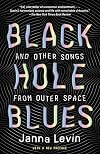
How could you detect a faint tremor in the very fabric of space-time itself? How could you possibly measure a tiny stretching and compression a mere one ten-thousandth of the diameter of a proton? And why would you want to? That’s what Black Hole Blues is all about.
Just over a century ago, Albert Einstein developed his General Theory of Relativity, which interprets gravity as a deformation of space-time caused by the presence of matter. One of the more obscure predictions of the theory was show more that the acceleration of a large mass should cause ripples in space-time: gravitational ‘waves’. No one at the time could have imagined that such tiny ripples could ever actually be detected. Einstein himself vacillated about whether such waves would indeed exist.
Nevertheless, in the mid–1970s the first evidence was gathered that accelerating masses did indeed emit such waves, though it was indirect evidence. A binary system of orbiting neutron stars was shown to be losing energy as the two stars spiralled closer to each other. Where was the energy going? Only gravitational waves seemed to fit the bill.
Knowing that gravitational waves exist is one thing: actually being able to ‘hear’ them is another.
This book, then, is about the decades-long struggle to find a way of detecting such waves. Only the most cataclysmic of astronomical events such as the collision of massive stars or the merging of black holes could be expected to generate ripples we might have a chance of detecting. Even then, the ripples would be almost unimaginably small. Yet a small group of scientists persisted in believing that there were ways it could be done.
Of course, a scientifically-literate reader today knows that it was done. Gravitational waves were first detected in 2015. But the bulk of Black Hole Blues was written before that detection. That doesn’t detract from the interest of the book, which details the individuals
3 involved in trying to build detectors, or at least in the early days, in figuring out what technology they would need to develop in order to build a detector.
The author introduces us to the many talented scientists involved in this drawn-out process, which started in the late 1960s. It is as much a story of the conflicts between genius-level personalities, and about the funding challenges and politics, as it is about the actual science. This is science in the raw, a struggle of human beings striving to understand the universe but also caught up in normal human concerns: about having and keeping a job; about dealing with difficult colleagues and bosses; about finding enough support and money to keep going; about the lure of prestige and honours.
It also demonstrates that science is a self-correcting endeavour, as it discusses the case of Joseph Weber, who convinced himself, and for a while the scientific community, that he was detecting gravitational waves in the harmonic ringing of a massive bar of metal. But others were unable to reproduce his results, and theorists showed that such a detector, even if it worked, would only detect astronomical events of an unlikely magnitude and frequency. This was not scientific fraud; merely an error of technique. But Weber would never accept that he had been wrong, and became a sad footnote to scientific history.
Though this setback tainted the study of gravitational waves for some years, a small group at Caltech and M.I.T. kept pushing on with an effort to achieve detection using laser interferometers. Eventually their efforts, and generous financial support from the U.S. National Science Foundation led to the building of two instruments called LIGO, one in Washington State, the other in Louisiana. It was these two instruments which, after achieving a high level of sensitivity, both registered the first gravitational waves in September 2015, as described in an Epilogue to the book.
Black Hole Blues is well worth reading if you are interested in how science is actually done, and particularly if you are interested in this facinating new window on the universe. show less
Just over a century ago, Albert Einstein developed his General Theory of Relativity, which interprets gravity as a deformation of space-time caused by the presence of matter. One of the more obscure predictions of the theory was show more that the acceleration of a large mass should cause ripples in space-time: gravitational ‘waves’. No one at the time could have imagined that such tiny ripples could ever actually be detected. Einstein himself vacillated about whether such waves would indeed exist.
Nevertheless, in the mid–1970s the first evidence was gathered that accelerating masses did indeed emit such waves, though it was indirect evidence. A binary system of orbiting neutron stars was shown to be losing energy as the two stars spiralled closer to each other. Where was the energy going? Only gravitational waves seemed to fit the bill.
Knowing that gravitational waves exist is one thing: actually being able to ‘hear’ them is another.
This book, then, is about the decades-long struggle to find a way of detecting such waves. Only the most cataclysmic of astronomical events such as the collision of massive stars or the merging of black holes could be expected to generate ripples we might have a chance of detecting. Even then, the ripples would be almost unimaginably small. Yet a small group of scientists persisted in believing that there were ways it could be done.
Of course, a scientifically-literate reader today knows that it was done. Gravitational waves were first detected in 2015. But the bulk of Black Hole Blues was written before that detection. That doesn’t detract from the interest of the book, which details the individuals
3 involved in trying to build detectors, or at least in the early days, in figuring out what technology they would need to develop in order to build a detector.
The author introduces us to the many talented scientists involved in this drawn-out process, which started in the late 1960s. It is as much a story of the conflicts between genius-level personalities, and about the funding challenges and politics, as it is about the actual science. This is science in the raw, a struggle of human beings striving to understand the universe but also caught up in normal human concerns: about having and keeping a job; about dealing with difficult colleagues and bosses; about finding enough support and money to keep going; about the lure of prestige and honours.
It also demonstrates that science is a self-correcting endeavour, as it discusses the case of Joseph Weber, who convinced himself, and for a while the scientific community, that he was detecting gravitational waves in the harmonic ringing of a massive bar of metal. But others were unable to reproduce his results, and theorists showed that such a detector, even if it worked, would only detect astronomical events of an unlikely magnitude and frequency. This was not scientific fraud; merely an error of technique. But Weber would never accept that he had been wrong, and became a sad footnote to scientific history.
Though this setback tainted the study of gravitational waves for some years, a small group at Caltech and M.I.T. kept pushing on with an effort to achieve detection using laser interferometers. Eventually their efforts, and generous financial support from the U.S. National Science Foundation led to the building of two instruments called LIGO, one in Washington State, the other in Louisiana. It was these two instruments which, after achieving a high level of sensitivity, both registered the first gravitational waves in September 2015, as described in an Epilogue to the book.
Black Hole Blues is well worth reading if you are interested in how science is actually done, and particularly if you are interested in this facinating new window on the universe. show less
Lists
At the Library (1)
Really awesome (1)
Awards


You May Also Like


Associated Authors
Statistics
- Works
- 7
- Also by
- 3
- Members
- 1,860
- Popularity
- #13,837
- Rating
- 3.8
- Reviews
- 68
- ISBNs
- 59
- Languages
- 10
- Favorited
- 3

