

Rebecca Goldstein
Author of Incompleteness: The Proof and Paradox of Kurt Gödel
About the Author
Rebecca Goldstein graduated summa cum laude from Barnard College and received her Ph.D. from Princeton University in the philosophy of science. She has taught philosophy at Barnard. She lives in Cambridge, Massachusetts. (Bowker Author Biography)
Works by Rebecca Goldstein
Betraying Spinoza: The Renegade Jew Who Gave Us Modernity (Jewish Encounters) (2006) 547 copies, 14 reviews
Associated Works
Seeing Further: The Story of Science, Discovery, and the Genius of the Royal Society (2010) — Contributor — 1,155 copies, 19 reviews
This Will Make You Smarter: New Scientific Concepts to Improve Your Thinking (Edge Question Series) (2012) — Contributor — 902 copies, 17 reviews
Me, My Hair, and I: Twenty-seven Women Untangle an Obsession (2015) — Contributor; Contributor — 151 copies, 35 reviews
Face to Face: Women Writers on Faith, Mysticism, and Awakening (2004) — Contributor — 39 copies, 1 review
The New Diaspora: The Changing Landscape of American Jewish Fiction (2015) — Contributor — 17 copies
Promised Lands: New Jewish American Fiction on Longing and Belonging (2010) — Contributor — 13 copies
Tagged
Common Knowledge
- Other names
- Newberger Goldstein, Rebecca
Newberger, Rebecca (birth name) - Birthdate
- 1950-02-23
- Gender
- female
- Education
- Princeton University (PhD|Philosophy|1977)
Barnard College (AB summa cum laude|1972) - Occupations
- philosopher
university professor
novelist - Organizations
- Harvard University
Dartmouth College
Trinity College
Brandeis University
New College of the Humanities [London, UK] - Awards and honors
- Fellow, American Academy of Arts and Sciences (2005)
Whiting Foundation Fellowship
MacArthur Fellowship (1996)
Guggenheim Fellowship
Radcliffe Fellowship
Humanist Laureate, International Academy of Humanism (2008) (show all 8)
Honorary Doctorate, Emerson College (2008)
National Humanities Medal (2015) - Relationships
- Nagel, Thomas (dissertation advisor)
Pinker, Steven (spouse)
Love, Yael Goldstein (daughter) - Nationality
- USA
- Birthplace
- White Plains, New York, USA
- Places of residence
- Cambridge, Massachusetts, USA
Truro, Massachusetts, USA - Associated Place (for map)
- Massachusetts, USA
Members
Reviews
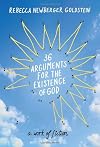
This is a real thinky book, kind of like [b:Sophie's World|10959|Sophie's World (Paperback)|Jostein Gaarder|http://ecx.images-amazon.com/images/I/21A6T5PH7YL._SL75_.jpg|4432325] but focusing on religion (and almost exclusively Judeo-Christian religion). The main character is a professor of psychology named Cass Seltzer. He's a nice guy who's just written a book called The Varieties of Religious Illusion (yes, there are a lot of William James references). Cass's book includes an appendix that show more lists out the 36 big arguments for the existence of God and then lists the flaws in each argument. Cass is now a famous atheist because of the success of the book, and we get to follow him around as he deals with his success, very often jumping way back in Cass's life to see how he got where he is. (Hint: he doesn't seem like a stereotypical atheist at all.)
In order to enjoy this book I had to learn to do one thing: every time Cass's mentor Jonas Elijah Klapper started talking I would skim. Yes, folks, that is the secret to enjoying this book. Cass may revere Klapper, but it's obvious that Klapper is an insane blowhard and his crazy complicated rants should not be read closely. If you try to understand what he's saying, you may end up throwing the book across the room. So don't. The book stands up without knowing what the hell Klapper is talking about, I think because he is not actually saying anything meaningful. And that may be the point.
Focus instead of some great characters: Azarya, Roz, and Cass himself. Azaraya is a mathematical genius who also happens to have the future of a rare Hasidic Jewish sect resting on this shoulders. Roz is a boisterous anthropologist who bounces in and out of Cass's life. Cass is so smart and yet really dumb about women. These three are the heart of the novel and you'll rush past the annoying characters (Klapper, Lucinda, Pascale) to read more about them.
This book is not for everyone, but if you like to laugh at academia and its ridiculousness, and are interested in the varieties of religious experience, then go for it. If you want to skip the novel and just read the appendix, do it. But I'd also find the chapters with the Harvard Agnostic Chaplaincy debate between Cass and Felix Findley and read it too. More than a debate about the existence of God, it's a defense of atheism, and even sort of makes you think that atheists like Cass can be filled with a sense of purpose, morality, and faith that is perhaps more meaningful than simply believing in God. show less
In order to enjoy this book I had to learn to do one thing: every time Cass's mentor Jonas Elijah Klapper started talking I would skim. Yes, folks, that is the secret to enjoying this book. Cass may revere Klapper, but it's obvious that Klapper is an insane blowhard and his crazy complicated rants should not be read closely. If you try to understand what he's saying, you may end up throwing the book across the room. So don't. The book stands up without knowing what the hell Klapper is talking about, I think because he is not actually saying anything meaningful. And that may be the point.
Focus instead of some great characters: Azarya, Roz, and Cass himself. Azaraya is a mathematical genius who also happens to have the future of a rare Hasidic Jewish sect resting on this shoulders. Roz is a boisterous anthropologist who bounces in and out of Cass's life. Cass is so smart and yet really dumb about women. These three are the heart of the novel and you'll rush past the annoying characters (Klapper, Lucinda, Pascale) to read more about them.
This book is not for everyone, but if you like to laugh at academia and its ridiculousness, and are interested in the varieties of religious experience, then go for it. If you want to skip the novel and just read the appendix, do it. But I'd also find the chapters with the Harvard Agnostic Chaplaincy debate between Cass and Felix Findley and read it too. More than a debate about the existence of God, it's a defense of atheism, and even sort of makes you think that atheists like Cass can be filled with a sense of purpose, morality, and faith that is perhaps more meaningful than simply believing in God. show less
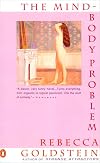
Even without having known much about the author before I started reading this, it was clear that it was both a first novel and based heavily on her own personal life. Goldstein is often quite funny at describing all the nuances of her "unequally yoked" relationship with a genius mathematician, and her chosen metaphor of the infamous Cartesian mind-body problem of the title is well-used and thematically satisfying in how it represents both her chosen philosophical field of study, and her show more chronic worries over whether men love her for her brain or her ass. Speaking as a guy, since this feels like one of those books that men and women tend to respond to in different ways, I thought she tended to ramble on about herself for a little bit too much of the book, as well as beat herself up to an often absurd degree, but when she started describing other characters, especially her husband, she had a very sharp eye for detail and was very perceptive about what made other people attractive to her. I didn't have much of a reaction to all the Jewish stuff, since it didn't seem to add much to the main "conflict" of the book, but I guess you can't really expect a relationship novel to avoid discussing the main character's background; that would be like expecting Mario Puzo to de-Italianize all his books. It's notable that she ended up staying with her husband in the book; that mirrors the chronology of Goldstein's real life, but check Wikipedia to see how that story ended.
Recommended if you enjoy reading an occasionally insightful, usually relatable book about a woman overanalyzing her marriage and affairs, with enough philosophy to keep your attention. Her renditions of philosophical debates at parties are spot-on. show less
Recommended if you enjoy reading an occasionally insightful, usually relatable book about a woman overanalyzing her marriage and affairs, with enough philosophy to keep your attention. Her renditions of philosophical debates at parties are spot-on. show less
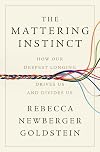
Sometimes, it seems all we do on the Internet and social media is argue about whose activities are most superior and most important. We all want to "matter," but we can develop elaborate defensive arguments about who gets there the best. Many times, our own need to matter gets in the way of recognizing what matters to other people. And yet needing to matter at something is one of the deepest human longings. We need to feel like we have a beneficial place in the universe. In this book, public show more intellectual Rebecca Newberger Goldstein analyzes the mattering instinct, how it moves us, and how it can divide or unite us.
She calls each person's drive to matter, their "mattering project." The ability - and the education - to find a good mattering project that benefits other people is a social privilege that borders on or even extends to being a right. When people embrace mattering projects that oppress other people, they end up being counterproductive. Good mattering projects counter the decay (entropy) inherent in the universe. In this sense, her naturalist analysis sounds kind of like Christian takes about the so-called fall, philosophically present centuries before we knew about entropy.
Different people have different "continents" of mattering projects, and just like cross-continental communications today, different continents have trouble understanding each other. One person's mattering might center around accomplishment while another's centers around doing for others. Another's might center around competition. Still another's, finding transcendence or God. Many of today's social conflicts can be explained by one person's mattering project fighting against another's mattering project.
This book offers a very deep analysis of what humans do to matter. It offers new language that might be used psychologically to understand human behavior, whether in the counseling office or dealing with the public. Importantly, it addresses what happens when people feel like they don't matter: A charismatic figure often takes advantage of them. This book posits an understanding that I hope becomes incorporated into our wider social vocabulary in the future. show less
She calls each person's drive to matter, their "mattering project." The ability - and the education - to find a good mattering project that benefits other people is a social privilege that borders on or even extends to being a right. When people embrace mattering projects that oppress other people, they end up being counterproductive. Good mattering projects counter the decay (entropy) inherent in the universe. In this sense, her naturalist analysis sounds kind of like Christian takes about the so-called fall, philosophically present centuries before we knew about entropy.
Different people have different "continents" of mattering projects, and just like cross-continental communications today, different continents have trouble understanding each other. One person's mattering might center around accomplishment while another's centers around doing for others. Another's might center around competition. Still another's, finding transcendence or God. Many of today's social conflicts can be explained by one person's mattering project fighting against another's mattering project.
This book offers a very deep analysis of what humans do to matter. It offers new language that might be used psychologically to understand human behavior, whether in the counseling office or dealing with the public. Importantly, it addresses what happens when people feel like they don't matter: A charismatic figure often takes advantage of them. This book posits an understanding that I hope becomes incorporated into our wider social vocabulary in the future. show less

This is the first book I’ve read by Rebecca Goldstein, a philosopher-novelist (a fascinating combination of professions). The title is interesting. It turns out that “betraying” Spinoza is the attempt to understand him in his biographical context, having grown up in the Sephardic community in Amsterdam, a group that shared a precarious identity as Jews after having lived for generations as “Christians” on the Iberian peninsula. Goldstein suggests that Spinoza’s “rebellion,” show more leading to the unusual step of life-long disfellowship from the synagogue, was that he sought to dismiss all personalized aspects that usually contribute to identity.
Goldstein not only places Spinoza’s philosophy in the context of his personal life, but she also draws a parallel between it and the mysticism of St. Teresa of Ávila, whose spirituality was an inward, private practice, albeit employing a different medium, prayer, instead of Spinoza’s mathematically rigorous reason. “It is intriguing to speculate how the Marrano psyche, necessarily oriented inward, found such different expression in these two spiritual geniuses” (p. 115).
I enjoyed reading this in parallel to Spinoza’s Ethics. Although Spinoza’s approach, which Goldstein terms “radical objectivity” differs from Goldstein’s own, that of analytic philosophy, she is a sympathetic commentator. It was helpful to me to have Goldstein explain two crucial terms in Spinoza’s project that had puzzled me, “nature” and “substance,” confirming my suspicion that he must mean something other than we conventionally do.
The prose is elegant and accessible. I particularly liked the author's recollection of her first exposure to Spinoza as a high school student in an Orthodox yeshiva in lower Manhattan at the hands of Mrs. Schoenfeld, whose condemnation of this “heretic” piqued young Goldstein’s interest. This, together with a recreation of Spinoza late in life in the final chapter, demonstrate how Goldstein’s two activities of philosophy and novel-writing join in a delightful way. An excellent book. show less
Goldstein not only places Spinoza’s philosophy in the context of his personal life, but she also draws a parallel between it and the mysticism of St. Teresa of Ávila, whose spirituality was an inward, private practice, albeit employing a different medium, prayer, instead of Spinoza’s mathematically rigorous reason. “It is intriguing to speculate how the Marrano psyche, necessarily oriented inward, found such different expression in these two spiritual geniuses” (p. 115).
I enjoyed reading this in parallel to Spinoza’s Ethics. Although Spinoza’s approach, which Goldstein terms “radical objectivity” differs from Goldstein’s own, that of analytic philosophy, she is a sympathetic commentator. It was helpful to me to have Goldstein explain two crucial terms in Spinoza’s project that had puzzled me, “nature” and “substance,” confirming my suspicion that he must mean something other than we conventionally do.
The prose is elegant and accessible. I particularly liked the author's recollection of her first exposure to Spinoza as a high school student in an Orthodox yeshiva in lower Manhattan at the hands of Mrs. Schoenfeld, whose condemnation of this “heretic” piqued young Goldstein’s interest. This, together with a recreation of Spinoza late in life in the final chapter, demonstrate how Goldstein’s two activities of philosophy and novel-writing join in a delightful way. An excellent book. show less
Lists
Read in 2014 (1)
Spirituality (1)
Awards


You May Also Like


Associated Authors
Statistics
- Works
- 15
- Also by
- 22
- Members
- 3,738
- Popularity
- #6,776
- Rating
- 3.8
- Reviews
- 113
- ISBNs
- 71
- Languages
- 11
- Favorited
- 8


