

Laura Bannon (1895–1963)
Author of Who walks the attic?
About the Author
Works by Laura Bannon
Whistle for a Pilot 3 copies
Billy and the Bear 3 copies
Big brother 3 copies
Hawaiian Coffee Picker 2 copies
Associated Works
Tagged
Common Knowledge
- Birthdate
- 1895
- Date of death
- 1963
- Gender
- female
- Education
- Art Institute of Chicago
Western Michigan State College - Occupations
- teacher
artist
illustrator - Organizations
- Chicago Society of Artists
- Awards and honors
- Children's Reading Round Table Award
- Nationality
- USA
- Places of residence
- Michigan, USA (birth)
- Associated Place (for map)
- Michigan, USA
Members
Reviews
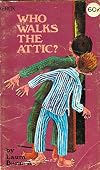
This is a mystery for a boy. He finds out who is walking the attic. He hears a noise when he is in bed, and wakes up his brother. His mom and dad come in six days. If he wants to figure out the mystery, he has to find it in six days. I like it a lot!

I paid $223.00 for The Wonderful Fashion Doll written and illustrated by Laura Bannon back in December of 2000, and considered myself lucky to get it for that price. I hadn't been able to read it in 20 years because it's long out of print and the local library didn't have it. The one I ordered online was an ex-library copy. The only reason I can figure that this very good 1953 book hasn't been reprinted in decades is because the wonderful fashion doll's name is "Gay Event".
Debby Moore first show more learns about Gay Event when she and her mother are packing up to move to the ancestral farm in New Hampshire, currently owned by Debby's Great-Uncle Nate, while Debby's dad is overseas. Mrs. Moore finds two letters written by Debby's great-great-great grandmother, Deborah Moore. One is from 1832 and the other from 1842. The letters are reproduced as cursive handwriting, complete with 19th century spelling. Deborah writes about the doll in both letters. In the first we read an enthusiastic description of Gay Event and her wardrobe. In the second, Deborah has moved to England and, expecting to come back, had left the doll in her special hiding place.
Of course Debby is enthusiastic about finding the doll, even though generations have looked for it. Two things stand out for me in the description of Moore Farm: the huge old elm with the hole in it and the fact that the old-fashioned stove has raised-up dragons on it. (I wish our stove did.) There are illustrations of both tree and stove. One of the nice things about a book illustrated by the author is that you can be sure the art is as close to what the author envisioned as s/he could make it.
Debby has an unusual encounter with a neighbor boy, Butch, who eventually helps her with her search. He also has an Aunt Ariel Simpson, who collects dolls. She meets Mrs. Simpson at the Goyette Museum. From her she learns more about fashion dolls, thanks to one on display that's named 'Pretty Please'. From what Debby is told, she knows that Gay Event must have been an even fancier doll.
We learn along with Debby as Great-Uncle Nate tells her what life was like for the settlers. There are lesser discoveries during some remodeling (more like restoration, really). I enjoyed them all, but none so much as the discovery of the wonderful fashion doll. The chapters describing Gay Event show less
Debby Moore first show more learns about Gay Event when she and her mother are packing up to move to the ancestral farm in New Hampshire, currently owned by Debby's Great-Uncle Nate, while Debby's dad is overseas. Mrs. Moore finds two letters written by Debby's great-great-great grandmother, Deborah Moore. One is from 1832 and the other from 1842. The letters are reproduced as cursive handwriting, complete with 19th century spelling. Deborah writes about the doll in both letters. In the first we read an enthusiastic description of Gay Event and her wardrobe. In the second, Deborah has moved to England and, expecting to come back, had left the doll in her special hiding place.
Of course Debby is enthusiastic about finding the doll, even though generations have looked for it. Two things stand out for me in the description of Moore Farm: the huge old elm with the hole in it and the fact that the old-fashioned stove has raised-up dragons on it. (I wish our stove did.) There are illustrations of both tree and stove. One of the nice things about a book illustrated by the author is that you can be sure the art is as close to what the author envisioned as s/he could make it.
Debby has an unusual encounter with a neighbor boy, Butch, who eventually helps her with her search. He also has an Aunt Ariel Simpson, who collects dolls. She meets Mrs. Simpson at the Goyette Museum. From her she learns more about fashion dolls, thanks to one on display that's named 'Pretty Please'. From what Debby is told, she knows that Gay Event must have been an even fancier doll.
We learn along with Debby as Great-Uncle Nate tells her what life was like for the settlers. There are lesser discoveries during some remodeling (more like restoration, really). I enjoyed them all, but none so much as the discovery of the wonderful fashion doll. The chapters describing Gay Event show less
Lists
You May Also Like


Associated Authors
Statistics
- Works
- 34
- Also by
- 8
- Members
- 257
- Popularity
- #89,244
- Rating
- 3.8
- Reviews
- 2
- ISBNs
- 11