
Geoffrey Grigson (1905–1985)
Author of The Faber Book of Love Poems
About the Author
Image credit: Wikipedia photo
Series
Works by Geoffrey Grigson
Ideas; a volume of ideas, notions & emotions, clear or confused, which have moved the minds of men (1956) 20 copies
People : a volume of the good, bad, great & eccentric who illustrate the admirable diversity of man (1954) 15 copies, 1 review
Places: a volume of travel in space and time; places which have delighted, intrigued, and intimidated men (1954) 14 copies
Things; a volume of objects devised by man's genius which are the measure of his civilization (1960) 12 copies
Looking and finding, and collecting and reading and investigating and much else (1958) 12 copies, 1 review
English Villages in Colour 6 copies
English romantic art 3 copies
The Shell guide to wild life 3 copies
Places of the Mind 2 copies
Poets in their pride 2 copies
About Britain. [Guidebooks] 2 copies
Village England 1 copy
William Barnes 1 copy
English Excursions 1 copy
The Three Kings 1 copy
New Verse: An anthology — Editor — 1 copy
Associated Works
Selected Fables of Jean de la Fontaine with 48 illustrations (1668) — Introduction, some editions — 555 copies, 7 reviews
Selected Poems of John Dryden (Crown Classics) — Editor — 1 copy
Tagged
Common Knowledge
- Legal name
- Grigson, Geoffrey Edward Harvey
- Birthdate
- 1905-03-02
- Date of death
- 1985-11-25
- Gender
- male
- Education
- University of Oxford (St Edmund Hall)
- Occupations
- poet
journalist
editor
literary critic - Organizations
- Yorkshire Post
Institute of Contemporary Art, London - Relationships
- Grigson, Jane (wife)
Grigson, Sophie (daughter)
Rayner, Mary (niece) - Nationality
- UK
- Birthplace
- Pelynt, Cornwall, England, UK
- Places of residence
- Pelynt, Cornwall, England (birth)
Broad Town, Wiltshire, England (death) - Place of death
- Broad Town, Wiltshire, England, UK
- Map Location
- England, UK
Members
Reviews

This is a book originally published in 1958 by poet, anthologist, naturalist, etc. Geoffrey Grigson to, evidently, evangelise the joys of antiquarianism to post-war British boys and girls. This is an expanded edition from 1970 (in its 1971 paperback impression). Already looking to the past, the passing of another half-century and more has turned the text, and the book, into things of antiquarian interest in their own right. For example, the addresses, to send off for maps and museum guides, show more seem more in tune than Dickens' London than post-swinging '60s London (as do the prices).
Styles change of course, and no one would write a book now the way Grigson does (would a modern author let him quote from Sir Thomas Browne's "Urne Burial"? and not only quote him but use hm as a kind of guiding star?)
If one can set aside the tone (academic uncle or friend of the family, genuinely engaged and engaging but talking down, somewhat) it rarely jarred as actually condescending (although of course I'm almost of an age to have had this 2nd edition new). Often, in fact, there was a story or nugget of information that was new to me, briskly and clearly explained. Nowhere more so than the outline of the geological changes to Britain since the last Ice Age, when it first became an island. The changes to the population are sketched in too, more clearly than I can recall seeing in any other introductory work. So it's still of practical value, I think. show less
Styles change of course, and no one would write a book now the way Grigson does (would a modern author let him quote from Sir Thomas Browne's "Urne Burial"? and not only quote him but use hm as a kind of guiding star?)
If one can set aside the tone (academic uncle or friend of the family, genuinely engaged and engaging but talking down, somewhat) it rarely jarred as actually condescending (although of course I'm almost of an age to have had this 2nd edition new). Often, in fact, there was a story or nugget of information that was new to me, briskly and clearly explained. Nowhere more so than the outline of the geological changes to Britain since the last Ice Age, when it first became an island. The changes to the population are sketched in too, more clearly than I can recall seeing in any other introductory work. So it's still of practical value, I think. show less
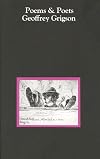
I picked this up for research: Grigson has two interesting and insightful essays on John Clare, one an overview of Clare's life, and the other focusing specifically on Clare's time in the asylums. Grigson is now almost forgotten as a critic, which I think is a shame - his is a very original and 'strong' voice, very idiosyncratic and original in his readings of a wide variety of poets. I liked all of the essays in this slim volume (even when I disagreed with Grigson), especially those about show more the lesser poets that I had only incidentally heard. These include William Barnes, who often wrote in a peculiar Dorset dialect, thereby lessening his appeal, though he was a friend of Hardy and Tennyson. Another interesting character is William Allingham, now known mostly for the opening lines of his The Faeries (Up the airy mountain/Down the rushy glen/We daren't go a-hunting/For fear of little men...), though he was also a protege of Tennyson. Barnes and Allingham may not be the greatest Victorian poets, but they led interesting lives that Grigson expertly delineates.
Grigson also writes about the Romantics other than Clare, and this is where I found myself disagreeing with him the most. He has good essays on Wordsworth, but he completely lacerates Shelley, based on what seemed to me the flimsy grounds of Shelley's generalities. I am simplifying here, but Grigson seems to share the animosity to Shelley which Eliot's 'school' of criticism espoused. His reaction seems merely personal, as he does not even quote much from Shelley to back his claims, merely mentioning Robert Graves's remarks on Shelley's Skylark, which supposedly 'ranks among the shoddiest poems ever wished on us as the product of genius.' Now, to be honest, this is not one of my favourite Shelley poems. I do, however, feel that Grigson (and Graves) should at least give more reasons for calling it 'shoddy'.
I say that Grigson's reaction seems merely personal. Perhaps my reaction to him is also personal. I've been steeped in the critical writings of Harold Bloom since I was in High school, so perhaps his love of Shelley has rubbed off on me. I candidly admit to not having read everything by Shelley. But what I have read convinces me that he is a great, if difficult, poet. Just think of the epic grandeur of such a poem as 'Ode to the West Wind'.
Well, that was a long polemic, especially considering that I actually like most of what Grigson has to say. He has very perceptive things to say about Walt Whitman, one of my favourite American poets, and DH Lawrence, whose poetry (at its best) seems to me unfairly neglected.
Edit | More show less
Grigson also writes about the Romantics other than Clare, and this is where I found myself disagreeing with him the most. He has good essays on Wordsworth, but he completely lacerates Shelley, based on what seemed to me the flimsy grounds of Shelley's generalities. I am simplifying here, but Grigson seems to share the animosity to Shelley which Eliot's 'school' of criticism espoused. His reaction seems merely personal, as he does not even quote much from Shelley to back his claims, merely mentioning Robert Graves's remarks on Shelley's Skylark, which supposedly 'ranks among the shoddiest poems ever wished on us as the product of genius.' Now, to be honest, this is not one of my favourite Shelley poems. I do, however, feel that Grigson (and Graves) should at least give more reasons for calling it 'shoddy'.
I say that Grigson's reaction seems merely personal. Perhaps my reaction to him is also personal. I've been steeped in the critical writings of Harold Bloom since I was in High school, so perhaps his love of Shelley has rubbed off on me. I candidly admit to not having read everything by Shelley. But what I have read convinces me that he is a great, if difficult, poet. Just think of the epic grandeur of such a poem as 'Ode to the West Wind'.
Well, that was a long polemic, especially considering that I actually like most of what Grigson has to say. He has very perceptive things to say about Walt Whitman, one of my favourite American poets, and DH Lawrence, whose poetry (at its best) seems to me unfairly neglected.
Edit | More show less

Geoffrey Grigson was a prolific writer and poet of note . I own a fair number of his books about the English countryside . He was an anthologist of note and wrote well on a number of subjects . He was evidently a hard working professional writer who could turn his well educated and widely read mind to a variety of subjects from classics to art , from topography to love themes and write books that had an appeal to readers not dissimilar to himself in background , a classical educstion and show more interests . His was the England before motorways and mass transportation when country lanes opened up onto enchanting scenic rural views. Grigson died in 1980 aged 80, so his peak decades for writing were from the 1930s to the 1970s. In a sense the book is dated. This book on Aphrodite (the Greek name) or Venus if you prefer the Roman version was published in 1976, covers the subject of the goddess of love and beauty from every angle . The research was based on secondary or published works of others . Poetry blends with art and archaeological evidence to shine a penetrating light on origins, myths, religion, and the symbolism of the goddess. The central question is why the goddess of love had such an enduring appeal to ordinary mortals inspiring art and statuary through the ages and across European and Mediterranean cultures . Grigson displays his scholarship and travel insights with a light but confident feel to inform and educate on the symbolism of apples, quinces and pomegranates and then into birds , scolloped shells , swans , goats, dolphins and stars. Grigson seeks to explain why we encounter Aphrodite and Venus in so many museums across the world, and why so adored. I recall my own enchantment on seeing the Venus of Villandorf in Vienna or the gold figurines in the Archaeological museum in Athens or the painting by Titian of the Venus of Urbino. This study places the museum artifacts and paintings into a context . Grigson asks how and why Aphrodite transformed into Venus in European art . The book is well written, scholarly in a classical way and enriched by the link between poetry and art. Grigson has translated many classical poems written in praise of the goddess. There is only one colour photo, and that is the frontis of the Benghazi Aphrodite from Cyrenaica, a Hellenistic marble statue today in the University Museum of Philadelphia . The best feature of the book are the 70 plus black and white illustrated images of the many very beautiful statues, mosaics and paintings of the goddess . The book has become a collectors item and retains a place in a corner of classical art history . It is not an easy read but worth the effort if you are interested in the history of art and the classical world. show less

I loved this book when I found it, and every time I read in it, I find reasons to love it more!
Awards

You May Also Like


Associated Authors
Statistics
- Works
- 112
- Also by
- 19
- Members
- 1,545
- Popularity
- #16,669
- Rating
- 3.6
- Reviews
- 8
- ISBNs
- 108
- Languages
- 1
- Favorited
- 1
