

Jerry Vines
Author of Power in the Pulpit: How to Prepare and Deliver Expository Sermons
About the Author
Jerry Vines (B. A. Mercer University. Th.D., Luther Rice Seminary) retired as pastor of First Baptist Church in Jacksonville, Florida in 2006, where he served for forty years. He served two terms as president of the Southern Baptist Convention Jerry is author of a number of books including Power in show more the Pulpit. How to Prepare and Deliver Expository Sermons and A Practical Guide to Sermon Preparation. He and his wife, Janet have four adult children and five grandchildren. Adam B. Dooley serves as the senior pastor of Sunnyvale First Baptist Church on the northeast side of Dallas. He is a two-time graduate of the Southern Baptist Theological Seminary, where he has also served as an adjunct professor. He is married to Heather, and they have three sons and one daughter. show less
Works by Jerry Vines
Power in the Pulpit: How to Prepare and Deliver Expository Sermons (1999) — Author — 736 copies, 4 reviews
Acts Alive 11 copies
The NKJV, Vines Expository Bible, Cloth over Board, Comfort Print: A Guided Journey Through the Scriptures with Pastor Jerry Vines (2018) 5 copies
Sex According to God 1 copy
Spirit Works 1 copy
Our Ascended Lord 1 copy
Sermon on John 3:16 1 copy
Baptist Battles 1 copy
Straight Talk about Tongues 1 copy
Associated Works
Whosoever Will: A Biblical-Theological Critique of Five-Point Calvinism (2010) — Contributor; Author, some editions — 200 copies
Tagged
Common Knowledge
There is no Common Knowledge data for this author yet. You can help.
Members
Reviews
Power in the Pulpit: How to Prepare and Deliver Expository Sermons (Electives Series) by Jerry Vines
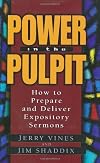
The cover alone of Jerry Vines and Jim Shaddix’s book, Power in the Pulpit thrilled me with their subtitle stating, “How to Prepare and Deliver Expository Sermons.” However, my enthusiasm was dampened a bit by its delayed arrival which forced me to rush through the material instead of taking the time to mark it up, reflect, and chew through some of Vines and Shaddix’s timeless work. Nevertheless, it has afforded enough time to share an overall synopsis of their work and offer my show more interactions with their material.
Book Synopsis
Power in the Pulpit provides helps for those tasked with weekly preaching on the preparation, process, and presentation of their sermons. A weighty task few take lightly, but Vines and Shaddix set out to “reduce the frustration and increase the fulfillment,” of those charged with doing so whether they are students like me or veteran preachers. The authors bring a wealth of experience to the table from which pastors can glean much practical wisdom.
In one sense Power in the Pulpit is a critique against those that might think preaching is little more than entering the pulpit and praying the Holy Spirit will fill our mouth with the words to say. No, the authors suggest the call to preach is just as much a call to prepare, as his introduction indicates, and this book is a guidebook or manual for what is a lifetime call to prepare sermon after sermon.
The authors seek to do so by organizing the content in three parts, along with appendixes offering four practical bits of help from how to structure the sermons to breathing exercises. The three primary parts of the book are split between the preparation, the process, and the presentation of expositions of Scripture. Each part therein has between three or five chapters teaching each part of preaching. Each chapter is, to some degree, written like a sermon on each topic with two to six sub-points, some even being alliterated! Finally, but selfishly, as a lover of quotes, each chapter begins with a quote to set the tone for the material to be covered.
Personal Interaction
Some of the most helpful content I find in Power in the Pulpit is how they define expository sermons. There are many different definitions, but the one Vines and Shaddix promote in their book on page 32 is to go “through books of the Bible—chapter by chapter and paragraph by paragraph—in a systematic fashion,” which goes against “general exposition,” where one seeks to “tie various texts together in a series” and “are not necessarily consecutive Bible passages,” as they differentiate on page 31. While they do not state this is necessarily wrong, they do state the better option is “systematic exposition,” which I previously defined. I find this helpful because while I have been in ministry for over 15 years, I have not had the tools, definitions, or parameters this books gives and have therefore simply started with a book and worked my way through the texts the best I could. Therefore, this it is encouraging, perhaps, because my past 15 years have not been wasted, and have perhaps even been done mostly right!
Chapter six, on “Designing the Structure,” coupled with their appendix offering, even more, helps therein, is also timely for this “novice” preacher of God’s Word. As I’ve stated, my approach has been merely to pick a book, work my way through it verse by verse, complete it, and begin another. I did not have any sort of structure or template to go by, so chapter six was exceedingly helpful, especially with how it breaks down into the structure’s various “phases.”
I feel like I have always appropriately exegeted the text, but have not always had a structure to serve it. Therefore, chapters like this will prove exceedingly helpful now and in the future. This is by far the most important section of the book review.
At first glance, I did not think I would come to appreciate chapter ten on “Playing the Voice” because I was afraid I was about to read how to perform or even act as a preacher. And while it certainly has some of those tones, the content proves to be more than mere acting, and more on the importance of the “marvelous instrument with which [we] may convey [God’s] Word to men: the voice,” they write on page 263. From tips on relaxing, proper breathing, and even caring for one’s voice, this chapter teaches me the value and practicality of how will they hear without a preacher?
Finally, chapter eleven on connecting with our congregation likely proves itself to be the timeliest in its helpfulness. As I have shared, I have not had the training in preaching that would help with such, so I tend to rely on manuscripts and see how it is incredibly easy to be disconnected from my church if I do not heed their words on visualizing, vitalizing, and communicating the sermons I deliver. If I do not connect with my people, the authors ultimately suggest I am doing them a disservice and much can be lost in my delivery.
Conclusion
To summarize and conclude, Power in the Pulpit has been and will continue to be a helpful addition to my library. It is organized clearly enough to go back and “rehearse” and rehash some of the helps I have already found, especially if I find myself in an expositional rut down the road. It seems like Vines and Shaddix want nothing more than for pastors to be able to effectively use their limited time to do the most faithful preaching of the text, and I believe they have done so splendidly. show less
Book Synopsis
Power in the Pulpit provides helps for those tasked with weekly preaching on the preparation, process, and presentation of their sermons. A weighty task few take lightly, but Vines and Shaddix set out to “reduce the frustration and increase the fulfillment,” of those charged with doing so whether they are students like me or veteran preachers. The authors bring a wealth of experience to the table from which pastors can glean much practical wisdom.
In one sense Power in the Pulpit is a critique against those that might think preaching is little more than entering the pulpit and praying the Holy Spirit will fill our mouth with the words to say. No, the authors suggest the call to preach is just as much a call to prepare, as his introduction indicates, and this book is a guidebook or manual for what is a lifetime call to prepare sermon after sermon.
The authors seek to do so by organizing the content in three parts, along with appendixes offering four practical bits of help from how to structure the sermons to breathing exercises. The three primary parts of the book are split between the preparation, the process, and the presentation of expositions of Scripture. Each part therein has between three or five chapters teaching each part of preaching. Each chapter is, to some degree, written like a sermon on each topic with two to six sub-points, some even being alliterated! Finally, but selfishly, as a lover of quotes, each chapter begins with a quote to set the tone for the material to be covered.
Personal Interaction
Some of the most helpful content I find in Power in the Pulpit is how they define expository sermons. There are many different definitions, but the one Vines and Shaddix promote in their book on page 32 is to go “through books of the Bible—chapter by chapter and paragraph by paragraph—in a systematic fashion,” which goes against “general exposition,” where one seeks to “tie various texts together in a series” and “are not necessarily consecutive Bible passages,” as they differentiate on page 31. While they do not state this is necessarily wrong, they do state the better option is “systematic exposition,” which I previously defined. I find this helpful because while I have been in ministry for over 15 years, I have not had the tools, definitions, or parameters this books gives and have therefore simply started with a book and worked my way through the texts the best I could. Therefore, this it is encouraging, perhaps, because my past 15 years have not been wasted, and have perhaps even been done mostly right!
Chapter six, on “Designing the Structure,” coupled with their appendix offering, even more, helps therein, is also timely for this “novice” preacher of God’s Word. As I’ve stated, my approach has been merely to pick a book, work my way through it verse by verse, complete it, and begin another. I did not have any sort of structure or template to go by, so chapter six was exceedingly helpful, especially with how it breaks down into the structure’s various “phases.”
I feel like I have always appropriately exegeted the text, but have not always had a structure to serve it. Therefore, chapters like this will prove exceedingly helpful now and in the future. This is by far the most important section of the book review.
At first glance, I did not think I would come to appreciate chapter ten on “Playing the Voice” because I was afraid I was about to read how to perform or even act as a preacher. And while it certainly has some of those tones, the content proves to be more than mere acting, and more on the importance of the “marvelous instrument with which [we] may convey [God’s] Word to men: the voice,” they write on page 263. From tips on relaxing, proper breathing, and even caring for one’s voice, this chapter teaches me the value and practicality of how will they hear without a preacher?
Finally, chapter eleven on connecting with our congregation likely proves itself to be the timeliest in its helpfulness. As I have shared, I have not had the training in preaching that would help with such, so I tend to rely on manuscripts and see how it is incredibly easy to be disconnected from my church if I do not heed their words on visualizing, vitalizing, and communicating the sermons I deliver. If I do not connect with my people, the authors ultimately suggest I am doing them a disservice and much can be lost in my delivery.
Conclusion
To summarize and conclude, Power in the Pulpit has been and will continue to be a helpful addition to my library. It is organized clearly enough to go back and “rehearse” and rehash some of the helps I have already found, especially if I find myself in an expositional rut down the road. It seems like Vines and Shaddix want nothing more than for pastors to be able to effectively use their limited time to do the most faithful preaching of the text, and I believe they have done so splendidly. show less
In Power in the Pulpit, Jim Shaddix has revised, updated, and edited the pivotal works of Jerry Vines, A Practical Guide to Sermon Preparation, and A Guide to Effecetive Sermon Delivery. Shaddix (former Dean of the Chapel at New Orleans Baptist Theological Seminary) and Vines (former pastor of First Baptist Church, Jacksonville, FL) bring decades of academic and practical insights regarding expository preaching to the table (the book has Vines’s voice with Shaddix’s redaction) and show more deliver what is commonly considered the preaching textbook for expository preachers.
The entirety of this project is written, “to give practical help specifically to the man who is faced with the responsibility of preaching weekly” (13). The book itself is divided into three primary sections. Part 1, “The Preparation for Exposition,” focuses on the theoretical and biblical foundation for preaching, as well as the preparation and requirements of the preacher himself. Part 2, “The Process of Exposition,” provides the real substance of the book, as it takes the hand of the reader and walks him through the step-by-step process from sermon text to sermon. Part 3, “The Presentation of the Exposition,” gives attention to sermon delivery, including communication style, a primer on vocalization, and the use of language.
Vines explains multiple sermon models and methods, but focuses his attention early in the book on the expository sermon. This sermon, he defines as, “a discourse that expounds a passage of Scripture, organizes it around a central them and main divisions which issue forth from the given text, and then decisively applies its message to the listeners” (29). This sermon type, he writes, may be used in the context of topical series, but is best utilized in what he defines to be systematic exposition, or, “the consecutive and exhaustive treatment of a book of the Bible or extended portions thereof, dividing the text into paragraphs and consecutively preaching from them” (31-32). This type of preaching, Vines writes, battles the biblical illiteracy faced in so many churches, demands the preacher to preach the full counsel of God as opposed to a pet theological topic or application, constantly challenges the preacher to adapt to the text rather than adapt the text to a pet sermonic style, and relieves the preacher of the panic of selecting a sermon text each week.
Critique
The strengths of Vines’ book are well-known and are the reason this text is still considered by many to be the seminal volume on preaching for those desiring to preach effective, expository sermons. He effectively invites the reader into his study and walks him through the process of exegesis, determining the central idea of the text, and crafting the sermon. This is by far the strongest and most important section in the book.
However, in his section that details the process of determining the application of the text, Vines instructs the reader to “do everything you can do to be a student of modern culture” (184). He recommends that they, “get outside of commentaries and lexicons and into the worlds where [their] people live” (184). While maintaining a sense of wisdom, this practice could possibly be perceived as a practical rejection of sola Scriptura.
God’s Word is not devoid of insights into the human condition and the state of man’s heart. In fact, one of the most incredible aspects of the Bible from an anthropological perspective is that it speaks to the human condition cross-culturally. There has never been a culture that is not addressed by Holy Scripture. One need only study the pages of God’s Word to know that the heart is deceitful and dark, full of malice and envy, covetousness and selfishness. What insight could be gained by the study of modern culture that cannot be known through God’s Word? However, when one makes note of Vines entire purpose of preaching, this development is not surprising.
The purpose of preaching, he writes, is, “to persuade the hearers to act upon the truth that was shared” (249). Thus for Vines, the end goal for preachers is the imperative. Vines wants his hearers to do something as a result of the text. In a similar fashion, Robinson declared that the goal of the sermon was to “secure some moral action” (Robinson, p. 107). An objection must be made at this point that this goal places too much emphasis on the preacher.
The goal of preaching must be the faithful proclamation of God’s Word, and through that proclamation the Holy Spirit moves in the hearts of the hearers and incites them to response. The preacher can do no such thing. He simply lacks such power.
One must be cautious, however, not to overstate the objection. Presented with this objection and the proposed alternate goal of preaching, Vines would not likely present a theological defense of his position. However, the nature of reviewing a book requires one to interact with what is written, not merely that which is perceived to be the belief of the author.
Jerry Vines’ Power in the Pulpit remains the premiere text for those seeking to sharpen their exegetical and homiletical skills for good reason. The objections noted are minor in comparison to the wealth of insight and wisdom to be found on each page. Vines writes in the introduction that, “the call to preach is also the call to prepare” (13). This book is a tremendous resource with which to begin that preparation. show less
The entirety of this project is written, “to give practical help specifically to the man who is faced with the responsibility of preaching weekly” (13). The book itself is divided into three primary sections. Part 1, “The Preparation for Exposition,” focuses on the theoretical and biblical foundation for preaching, as well as the preparation and requirements of the preacher himself. Part 2, “The Process of Exposition,” provides the real substance of the book, as it takes the hand of the reader and walks him through the step-by-step process from sermon text to sermon. Part 3, “The Presentation of the Exposition,” gives attention to sermon delivery, including communication style, a primer on vocalization, and the use of language.
Vines explains multiple sermon models and methods, but focuses his attention early in the book on the expository sermon. This sermon, he defines as, “a discourse that expounds a passage of Scripture, organizes it around a central them and main divisions which issue forth from the given text, and then decisively applies its message to the listeners” (29). This sermon type, he writes, may be used in the context of topical series, but is best utilized in what he defines to be systematic exposition, or, “the consecutive and exhaustive treatment of a book of the Bible or extended portions thereof, dividing the text into paragraphs and consecutively preaching from them” (31-32). This type of preaching, Vines writes, battles the biblical illiteracy faced in so many churches, demands the preacher to preach the full counsel of God as opposed to a pet theological topic or application, constantly challenges the preacher to adapt to the text rather than adapt the text to a pet sermonic style, and relieves the preacher of the panic of selecting a sermon text each week.
Critique
The strengths of Vines’ book are well-known and are the reason this text is still considered by many to be the seminal volume on preaching for those desiring to preach effective, expository sermons. He effectively invites the reader into his study and walks him through the process of exegesis, determining the central idea of the text, and crafting the sermon. This is by far the strongest and most important section in the book.
However, in his section that details the process of determining the application of the text, Vines instructs the reader to “do everything you can do to be a student of modern culture” (184). He recommends that they, “get outside of commentaries and lexicons and into the worlds where [their] people live” (184). While maintaining a sense of wisdom, this practice could possibly be perceived as a practical rejection of sola Scriptura.
God’s Word is not devoid of insights into the human condition and the state of man’s heart. In fact, one of the most incredible aspects of the Bible from an anthropological perspective is that it speaks to the human condition cross-culturally. There has never been a culture that is not addressed by Holy Scripture. One need only study the pages of God’s Word to know that the heart is deceitful and dark, full of malice and envy, covetousness and selfishness. What insight could be gained by the study of modern culture that cannot be known through God’s Word? However, when one makes note of Vines entire purpose of preaching, this development is not surprising.
The purpose of preaching, he writes, is, “to persuade the hearers to act upon the truth that was shared” (249). Thus for Vines, the end goal for preachers is the imperative. Vines wants his hearers to do something as a result of the text. In a similar fashion, Robinson declared that the goal of the sermon was to “secure some moral action” (Robinson, p. 107). An objection must be made at this point that this goal places too much emphasis on the preacher.
The goal of preaching must be the faithful proclamation of God’s Word, and through that proclamation the Holy Spirit moves in the hearts of the hearers and incites them to response. The preacher can do no such thing. He simply lacks such power.
One must be cautious, however, not to overstate the objection. Presented with this objection and the proposed alternate goal of preaching, Vines would not likely present a theological defense of his position. However, the nature of reviewing a book requires one to interact with what is written, not merely that which is perceived to be the belief of the author.
Jerry Vines’ Power in the Pulpit remains the premiere text for those seeking to sharpen their exegetical and homiletical skills for good reason. The objections noted are minor in comparison to the wealth of insight and wisdom to be found on each page. Vines writes in the introduction that, “the call to preach is also the call to prepare” (13). This book is a tremendous resource with which to begin that preparation. show less

This book is one of the most useful guides to effective sermon delivery you'll find anywhere. Learn the mechanical, mental, rhetorical, psychological, and spiritual aspects of sermon delivery in this one volume and watch your preaching improve.
Lists
You May Also Like


Associated Authors
Statistics
- Works
- 65
- Also by
- 1
- Members
- 2,164
- Popularity
- #11,870
- Rating
- 3.8
- Reviews
- 6
- ISBNs
- 43
- Favorited
- 1