
John Phillips (1) (1927–2010)
Author of Exploring Romans
For other authors named John Phillips, see the disambiguation page.
About the Author
John Phillips fue director asistente de la Escuela por correspondencia del Instituto Biblico Moody
Image credit: via Kregel Publications
Series
Works by John Phillips
Exploring the Gospel of Mark (John Phillips Commentary Series) (The John Phillips Commentary Series) (2004) 127 copies
Exploring People of the Old Testament (The John Phillips Bible Character Series), Volume 1 (2006) 57 copies
100 Devotions for Pastors and Church Leaders: Ideas and Inspiration for Your Sermons, Lessons, Church Events, Newsletters, and Web Sites (2007) 51 copies
Exploring the New Testament Book by Book: An Expository Survey (The John Phillips Commentary Series) (2009) 42 copies
Exploring the Old Testament Book by Book: An Expository Survey (The John Phillips Commentary Series) (2009) 38 copies
Exploring Here & There: Gleanings Over Many Years: 100 Sermon Starters & Devotional Studies (Vol. I) (2001) 24 copies
Exploring Old Testament History 2 copies
Contracts Signed by God: Part I 2 copies
The Annunciation 1 copy
Now that I'm a Christian 1 copy
Hebrews: Jesus and the Jews 1 copy
The Book of Romance: Ruth 1 copy
Paul's obscure Friends 1 copy
Tagged
Common Knowledge
Members
Reviews
Exploring the Gospel of Matthew (John Phillips Commentary Series) (The John Phillips Commentary Series) by John Phillips
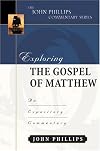
This is a commentary majoring on the application of the texts of Matthew. It sometimes applies and assumes more than it exegetes. The application being rather forced at times, it often seemed as though the insights were applied to, rather than derived from, the text(would that make them outsights?). I know that typification is practiced in many commentaries, but I guess that I just didn't expect this much from a person with dispensational views. For instance, in speaking of the Demoniac in show more Mathew 17,Phillips says that the boy is "a picture of the people in the world today who are in the grip of evil spirits and enslaving, tormenting lusts...he was his father's only son, a fact mentioned perhaps to remind us of the heavenly Father's only Son, who had just been acknowledged on high. The boy's father felt that the disciples (representing the church) ought to be able to help...The world ignores the church partly because of its evident lack of power in the face of the ever-worsening crises in human affairs..." (pg.359) Besides his typification of some of the historical accounts, I was quite taken back at Phillips viewing the mustard seed which becomes a tree, as representing an abnormal, unsanctioned, growth of the church(Roman Catholicism in particular is mentioned)(pgs 253-255). I just didn't quite see how he got to that conclusion. I would have appreciated it more if his speculations on various texts were not so dogmatic.
All of this is not to say that this commentary is no good, on the contrary, Mr. Phillips has several genuine insights. Speaking of John the Baptist he points out that, "No other prophet made the wilderness the scene of his preaching. No mass evangelist today would begin to preach far away from the haunts of men, but John did. He did not go to the people...the power and authority of his message were so great that the people came to him. " and commenting on Mathew 11:27("No man knoweth any man the Father, save the Son, and he to whomsoever the Son will reveal him."), "No one can know God apart from Christ. To seek for Him in the teachings of Hinduism, Buddhism, or Islam is to seek for Him in vain. Those teachings do not reveal the Father. To seek Him in creation is equally vain. Creation witnesses to God's eternal power and Godhead, but it does not reveal the Father in all the glories of His person....Only Jesus can do that. And He does." (pg.211)
I also like several of his other comments such as, "The genius of the gospel lies in the fact that as Christ once gave His life for us, He now gives His life to us. He lived the life Himself for thirty-three and a half years and now continues to live that life in the lives of surrendered believers."(pg. 85) and "The appeal of (Matthew)11:26-29 leads to the assurance of 11:30: 'My yoke is easy, and my burden is light.' The Lord will never tax us beyond our strength, never impose a task beyond the ability He gives. He is on the other side of the yoke and He carries all its weight. The responsibility is His. The results are His burden, not ours. The Lord is the kindest and most considerate Master in the world." (pg. 214).
I also like this quote, " "A faith founded on miracles rarely a robust faith. God normally shuts us up to His written Word."(pg. 84) I just wish that Mr. Phillips would have applied his last statement better in his writing of this commentary. He didn't have to focus on the boy who had the five loaves and two fishes in Matthew 14(paralleled in john 6) and tell us what a marvelous little boy he was and how he had a great story he might tell to his grandpa when he arrived home and other such things. These are things not found in the text, and actually , as far as I can tell, not even to be inferred from the text. What if the disciples took the food from the little boy and he left before he saw what happened to it and sat on his grandpa's knee and cried because he hadn't wanted to share? Focus on the text, stay within its boundaries and leave the rest as something that we do not need to know. As Phillips says elsewhere, "The silence between Christ's birth and baptism, broken only once, was absolute. There is something awesome about that silence, something that stamps the Gospel record with the signature of God. Man could not have kept silent about those thirty years in the life of Christ. In fact he hasn't. He has invented the apocryphal gospels and stuffed their worthless pages with prodigies and wonders." So why try to fill in the gaps in other accounts? If things could be inferred from various information that is given I'd feel better about it, but I don't see how the boy's response could even be inferred as we're really told nothing about him except that he had some food.
Thanks to Kregel Academic for the free review copy!(My review did not have to be favorable) show less
All of this is not to say that this commentary is no good, on the contrary, Mr. Phillips has several genuine insights. Speaking of John the Baptist he points out that, "No other prophet made the wilderness the scene of his preaching. No mass evangelist today would begin to preach far away from the haunts of men, but John did. He did not go to the people...the power and authority of his message were so great that the people came to him. " and commenting on Mathew 11:27("No man knoweth any man the Father, save the Son, and he to whomsoever the Son will reveal him."), "No one can know God apart from Christ. To seek for Him in the teachings of Hinduism, Buddhism, or Islam is to seek for Him in vain. Those teachings do not reveal the Father. To seek Him in creation is equally vain. Creation witnesses to God's eternal power and Godhead, but it does not reveal the Father in all the glories of His person....Only Jesus can do that. And He does." (pg.211)
I also like several of his other comments such as, "The genius of the gospel lies in the fact that as Christ once gave His life for us, He now gives His life to us. He lived the life Himself for thirty-three and a half years and now continues to live that life in the lives of surrendered believers."(pg. 85) and "The appeal of (Matthew)11:26-29 leads to the assurance of 11:30: 'My yoke is easy, and my burden is light.' The Lord will never tax us beyond our strength, never impose a task beyond the ability He gives. He is on the other side of the yoke and He carries all its weight. The responsibility is His. The results are His burden, not ours. The Lord is the kindest and most considerate Master in the world." (pg. 214).
I also like this quote, " "A faith founded on miracles rarely a robust faith. God normally shuts us up to His written Word."(pg. 84) I just wish that Mr. Phillips would have applied his last statement better in his writing of this commentary. He didn't have to focus on the boy who had the five loaves and two fishes in Matthew 14(paralleled in john 6) and tell us what a marvelous little boy he was and how he had a great story he might tell to his grandpa when he arrived home and other such things. These are things not found in the text, and actually , as far as I can tell, not even to be inferred from the text. What if the disciples took the food from the little boy and he left before he saw what happened to it and sat on his grandpa's knee and cried because he hadn't wanted to share? Focus on the text, stay within its boundaries and leave the rest as something that we do not need to know. As Phillips says elsewhere, "The silence between Christ's birth and baptism, broken only once, was absolute. There is something awesome about that silence, something that stamps the Gospel record with the signature of God. Man could not have kept silent about those thirty years in the life of Christ. In fact he hasn't. He has invented the apocryphal gospels and stuffed their worthless pages with prodigies and wonders." So why try to fill in the gaps in other accounts? If things could be inferred from various information that is given I'd feel better about it, but I don't see how the boy's response could even be inferred as we're really told nothing about him except that he had some food.
Thanks to Kregel Academic for the free review copy!(My review did not have to be favorable) show less

Genesis beings with creation and ends with a coffin. It begins with the vastness of eternity and ends with the shortness of time. It begins with a living God and ends with a dead man.
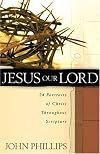
NCLA Review -How many times have we heard the statement, “Jesus is Lord”? Is the meaning of the word lost on most of us? What does lordship involve? These questions and more are answered in this latest book from John Phillips, author of more than fifty books including a complete set of New Testament Commentaries. This excellent devotional book shows all of us that we are never far from encountering the lordship of Jesus Christ in scripture. This work is a companion volume to The View show more from Mount Calvary. In Jesus Our Lord Phillips uses 24 portraits of Christ to explore how our Bible provides a way to encounter Jesus and discusses the myriad of biblical events, stories, and prophecies that reflect His lordship. This scholarly yet very readable book is for anyone desiring a closer relationship with Jesus. Rating: 3—MF show less
The great theme of Genesis is creation; the great theme of Exodus is redemption. Genesis begins with God and ends with man; Exodus begins with man and ends with God
You May Also Like


Statistics
- Works
- 102
- Members
- 6,697
- Popularity
- #3,652
- Rating
- 3.6
- Reviews
- 21
- ISBNs
- 254
- Languages
- 7
- Favorited
- 2