

Jean Louis Barrault (1910–1994)
Author of The Marriage of Figaro
About the Author
Image credit: Photo © ÖNB/Wien
Works by Jean Louis Barrault
Associated Works
Anton Chekhov's Selected Plays [Norton Critical Edition, 2nd ed.] (2005) — Contributor — 72 copies, 1 review
Blood on His Sword [1961 film] 2 copies
Tagged
Common Knowledge
- Birthdate
- 1910-09-08
- Date of death
- 1994-01-22
- Gender
- male
- Occupations
- actor
mime
film director
theatre director - Relationships
- Renaud, Madeleine (wife)
- Nationality
- France
- Associated Place (for map)
- France
Members
Reviews

I found this by chance at the library when I was looking for information on Kafka's novel. The process of adapting a story or literary work into another form -- whether through translation or producing it on stage -- fascinates me, so when I had a moment I picked this up.
As a written piece of work, it can't compare to the original novel. Plays are of course intended to be performed, not read, but some plays are captured better on the page than others. This one doesn't work quite so well in show more that form. It uses a lot of Kafka's original words, but for me, at least, with his text fresh in my mind, they lose something taken out of the context. Kafka's writing is descriptive and atmospheric, and stylistically fairly simple; his characters don't rise to great heights of eloquence. Which creates a challenge for anyone trying to adapt the text.
What it means is that a lot of the effectiveness depends on the presentation and staging, not on the dialogue, and that's harder (for me at least) to visualize with only the written text as a guide. I do have a sense for some of what is being attempted here: parts I understand and agree with, other parts I'm a bit dubious about. The action of the story is compressed, and at times the order of events is altered. This is logical enough; the dramatic requirements of the stage are different than in a novel. More interesting is the use of space, particularly the mingling of areas we expect to be kept separate, and the tendency of time to alter its normal patterns. Also the way in which the parable about the doorkeeper was worked into the main action of the play. This is very consistent with the themes and structure of Kafka's work -- it's simply less forcibly expressed in his novel.
Most of my reservations are about the interpretation of the meaning of the story. The novel can be read any number of ways. The play -- by necessity -- expresses the authors' ideas about Kafka's novel as much as (or more than) Kafka's own. This can be quite interesting, but sometimes it can also be distracting. At times I found the tension between the voice and vision of the original author and that of the adapters to be rather unsettling, although on the whole I think the play, taken for what it is, was probably well done. show less
As a written piece of work, it can't compare to the original novel. Plays are of course intended to be performed, not read, but some plays are captured better on the page than others. This one doesn't work quite so well in show more that form. It uses a lot of Kafka's original words, but for me, at least, with his text fresh in my mind, they lose something taken out of the context. Kafka's writing is descriptive and atmospheric, and stylistically fairly simple; his characters don't rise to great heights of eloquence. Which creates a challenge for anyone trying to adapt the text.
What it means is that a lot of the effectiveness depends on the presentation and staging, not on the dialogue, and that's harder (for me at least) to visualize with only the written text as a guide. I do have a sense for some of what is being attempted here: parts I understand and agree with, other parts I'm a bit dubious about. The action of the story is compressed, and at times the order of events is altered. This is logical enough; the dramatic requirements of the stage are different than in a novel. More interesting is the use of space, particularly the mingling of areas we expect to be kept separate, and the tendency of time to alter its normal patterns. Also the way in which the parable about the doorkeeper was worked into the main action of the play. This is very consistent with the themes and structure of Kafka's work -- it's simply less forcibly expressed in his novel.
Most of my reservations are about the interpretation of the meaning of the story. The novel can be read any number of ways. The play -- by necessity -- expresses the authors' ideas about Kafka's novel as much as (or more than) Kafka's own. This can be quite interesting, but sometimes it can also be distracting. At times I found the tension between the voice and vision of the original author and that of the adapters to be rather unsettling, although on the whole I think the play, taken for what it is, was probably well done. show less

https://nwhyte.livejournal.com/3048286.html
It shows I guess how times change. This was a huge hit in 1778, and it depends on the humour of improbable deceptions and misunderstandings. Two different characters hide behind the same chair in Act I. In Act II, the Count breaks into his wife's dressing room while his page jumps out the window and Figaro pretends it was him. In Act III, Figaro is about to be forcibly married to an older woman when it dramatically turns out that she is his show more long-lost mother. I really got lost in Act IV. In Act V the Countess and Figaro's girlfriend Suzanne pretend to be each other, with hilarious consequences (at one point the Count aims to hit the Countess, who he thinks is Suzanne, but accidentally hits Figaro instead without noticing). It would require some very ingenious staging to make the various antics of the cast appear in any way realistic, and even then the humour depends a lot on swallowing and digesting eighteenth-century norms of the regulation of sex. Still, I've always liked Mozart and maybe I'll give the opera a go some time. show less
It shows I guess how times change. This was a huge hit in 1778, and it depends on the humour of improbable deceptions and misunderstandings. Two different characters hide behind the same chair in Act I. In Act II, the Count breaks into his wife's dressing room while his page jumps out the window and Figaro pretends it was him. In Act III, Figaro is about to be forcibly married to an older woman when it dramatically turns out that she is his show more long-lost mother. I really got lost in Act IV. In Act V the Countess and Figaro's girlfriend Suzanne pretend to be each other, with hilarious consequences (at one point the Count aims to hit the Countess, who he thinks is Suzanne, but accidentally hits Figaro instead without noticing). It would require some very ingenious staging to make the various antics of the cast appear in any way realistic, and even then the humour depends a lot on swallowing and digesting eighteenth-century norms of the regulation of sex. Still, I've always liked Mozart and maybe I'll give the opera a go some time. show less
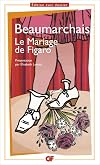
'Le Mariage De Figaro' is the second part of a theatrical trilogy by 18th century playwright Beaumarchais, but can also be read as a stand-alone work as one can just jump in and start reading without encountering any problems.
The central plot revolves around Figaro, a servant of Comte Almaviva, who wants to marry his beloved Suzanne. This, however, is not as simple as it sounds as Comte Almaviva has some interest in Suzanne himself. This marriage isn't the only romantic motive in the book show more though, seeing as each of the characters has their own love interest at heart, creating a complex but witty series of confrontations. To make things even more complicated, the characters also dress up as eachother, resulting in total confusion and some very funny scenes.
Overall, I'm not much of a play reader. I'd much prefer to see a reenactement, but there is no denying that 'Le Mariage De Figaro' is an excellent script and has certainly stood the test of time as a riveting and exhilarating comedy. show less
The central plot revolves around Figaro, a servant of Comte Almaviva, who wants to marry his beloved Suzanne. This, however, is not as simple as it sounds as Comte Almaviva has some interest in Suzanne himself. This marriage isn't the only romantic motive in the book show more though, seeing as each of the characters has their own love interest at heart, creating a complex but witty series of confrontations. To make things even more complicated, the characters also dress up as eachother, resulting in total confusion and some very funny scenes.
Overall, I'm not much of a play reader. I'd much prefer to see a reenactement, but there is no denying that 'Le Mariage De Figaro' is an excellent script and has certainly stood the test of time as a riveting and exhilarating comedy. show less

The Count was a horrible person in this story, cheating on his wife, betraying his faithful servant, trying to seduce an unwilling girl and I hated reading about it, because he was a positive hero in the previous play. Figaro and his girl were fine, but still I couldn't enjoy the book. Three and a half stars.
Lists
Awards

You May Also Like


Associated Authors
Statistics
- Works
- 23
- Also by
- 10
- Members
- 891
- Popularity
- #28,764
- Rating
- 3.8
- Reviews
- 10
- ISBNs
- 133
- Languages
- 14
- Favorited
- 1