
Scott Soames
Author of Philosophical Analysis in the Twentieth Century, Volume 1: The Dawn of Analysis
About the Author
Scott Soames is Distinguished Professor of Philosophy at the University of Southern California and the author of many books.
Series
Works by Scott Soames
Associated Works
Reading Philosophy of Language: Selected Texts with Interactive Commentary (2005) — Contributor — 12 copies
Tagged
Common Knowledge
- Gender
- male
- Occupations
- Professor of Philosophy, University of Southern California
Members
Reviews
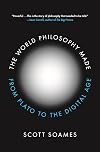
To say that philosophy made the world is no exaggeration; every historical advance in human knowledge was preceded or accompanied by philosophical thinking that laid the foundations for further scientific investigation or the practical implementation of some political or moral philosophy. In fact, it goes even deeper than that; you’d be hard pressed to identify any of your beliefs that did not have some origin in a philosophical work or intellectual movement of the past.
It’s about time show more someone approached the subject from this angle. Rather than writing a standard history of the subject, philosopher Scott Soames shows the reader how philosophy has and continues to make contributions (often unnoticed) to civilization. Far from being a purely academic or largely irrelevant subject, philosophy informs every aspect of how we think about the world and ourselves.
Soames takes the reader through the history of thought, beginning in ancient Greece, where the rigor and precision of Greek mathematics spilled over into the philosophical investigation of the material and social worlds. The Greeks “demonstrated the superiority of basing beliefs on evidence, argument, and rational examination, rather than on authority,” as Soames writes. The Greeks preferred naturalistic explanations of facts over the idea of divine intervention, and laid down the concepts of truth, proof, definition, matter, mind, motion, causation, and more that made it possible to think scientifically. Today, if you feel compelled to justify your beliefs with clearly defined and precise definitions and concepts, you can thank the ancient Greek mathematicians and philosophers who laid the groundwork for western rationalism.
Soames then moves on to the Middle Ages and the attempted reconciliation of the Christian faith with Greek philosophy. Today, if you believe that science and religion are compatible, you owe a debt of gratitude to Thomas Aquinas, William of Ockham, and the long list of medieval theologians and philosophers who laid the groundwork for the reconciliation and/or compartmentalization of faith and reason as two separate but non-overlapping spheres of knowledge.
Next, Soames tackles the Scientific Revolution. The idea that the universe is fully explicable in mathematical and natural terms is the result of the work of the “natural philosophers” of the 16th and 17th centuries, such as Copernicus, Kepler, Galileo, and Newton. Lest you think this belongs exclusively to the history of science, recognize that Newton considered himself to be a natural philosopher. He thoroughly studied the works of Aristotle and Descartes, and his universal laws of motion and gravity are largely conceptual and based on the philosophical notion of absolute space and time (to which Einstein would improve upon, but only after a change of philosophy that saw space-time as relative). Many physicists, such as Lee Smolin, believe the next advance in our understanding of quantum physics will be conceptual or philosophical (leading to the design of better experiments or to a better interpretation of existing data).
Soames next covers the Age of Enlightenment, the defining characteristic of which was the rejection of religious dogma and absolute monarchies maintained by belief in the “divine right of kings.” Rejecting revealed religion, the Enlightenment philosophers began to consider how to best establish the rules of morality and political organization from a rational perspective based on an understanding of human nature.
Today, if you believe in limited constitutional government, the separation of powers, and fundamental human rights like free thought, speech, and expression, you can thank the Enlightenment philosophers such as Baruch Spinoza, John Locke, David Hume, Montesquieu, and others who originally argued for these positions against a backdrop of strident political and religious conservatism.
If you’re conservative yourself, you owe a debt to the 18th century English philosopher Edmund Burke who articulated the philosophical foundations of the conservative position. And if you revere the founders of the United States and the US Constitution, you should recognize that the founders themselves were well-versed in the philosophy of John Locke, David Hume, Adam Smith, and others. The US founding is nothing if not the implementation of the political philosophy of the Enlightenment.
Even today, computer science and technology would not be possible without the work of Gottlob Frege and others who laid the foundations of philosophical logic that would lead to computer technology. Contemporary ideas of the cosmos, physics, evolution, language, psychology, economics, politics, education, and morality all find their origins somewhere within the history of philosophy. And any advances in our ideas concerning these fields will undoubtedly come from new philosophical frameworks that will create new scientific methods and disciplines or else guide our interpretations of existing data, including how we should solve political problems and how we can lead fulfilling lives.
While I fully agree with the main argument, the book is not without its limitations. First, Soames is an analytic philosopher and it shows. The logic, mathematics, and science sections are very dense and perhaps more detailed than the general reader would want. In fact, after the first four chapters, the direction of the book seems to shift from an analysis of how philosophy has contributed to the world to a textbook on analytical philosophy.
Even the later chapter on ethics is quite dense. Consider this extract from the book:
“For the slogan to have its intended force, the consequence relation must be conceptual, not merely logical—e.g., the relation must be necessary or a priori consequence. A proposition Q (expressed by a sentence) is a necessary consequence of a proposition P if and only if it is impossible for P to be true without Q being true—if and only if for any state of w that it is possible for the world to be in, if P would be true were the world in state w, then Q would also be true were the world in w.”
Granted, I took this quote out of the context of the chapter, making it all the more difficult to follow, but you get the point. It’s not that this is undecipherable, but you had better be prepared to invest the time. More than likely, this level of formal logical analysis is beyond the interest of most readers.
Soames also ignores most of what Enlightenment scholar Jonathan Israel would label the “radical Enlightenment.” Soames covers the moderate Enlightenment, led by Locke, but ignores the strain of thought led by Spinoza, Denis Diderot, and others that contributed the most to the campaign against superstition and ignorance and to the advance of the modern idea of freedom.
Overall, I would recommend the book but with a big caveat. After the first four chapters, the going gets tough; be prepared for a lot of detail, formal logic, and dense arguments. It’s not that it is impossible to decipher, but I don’t think Soames was as clear as he could have been in several spots. Nevertheless, this is a useful reminder that philosophy is everywhere and that a truly independent thinker cannot ignore it—and civilization cannot survive without it. show less
It’s about time show more someone approached the subject from this angle. Rather than writing a standard history of the subject, philosopher Scott Soames shows the reader how philosophy has and continues to make contributions (often unnoticed) to civilization. Far from being a purely academic or largely irrelevant subject, philosophy informs every aspect of how we think about the world and ourselves.
Soames takes the reader through the history of thought, beginning in ancient Greece, where the rigor and precision of Greek mathematics spilled over into the philosophical investigation of the material and social worlds. The Greeks “demonstrated the superiority of basing beliefs on evidence, argument, and rational examination, rather than on authority,” as Soames writes. The Greeks preferred naturalistic explanations of facts over the idea of divine intervention, and laid down the concepts of truth, proof, definition, matter, mind, motion, causation, and more that made it possible to think scientifically. Today, if you feel compelled to justify your beliefs with clearly defined and precise definitions and concepts, you can thank the ancient Greek mathematicians and philosophers who laid the groundwork for western rationalism.
Soames then moves on to the Middle Ages and the attempted reconciliation of the Christian faith with Greek philosophy. Today, if you believe that science and religion are compatible, you owe a debt of gratitude to Thomas Aquinas, William of Ockham, and the long list of medieval theologians and philosophers who laid the groundwork for the reconciliation and/or compartmentalization of faith and reason as two separate but non-overlapping spheres of knowledge.
Next, Soames tackles the Scientific Revolution. The idea that the universe is fully explicable in mathematical and natural terms is the result of the work of the “natural philosophers” of the 16th and 17th centuries, such as Copernicus, Kepler, Galileo, and Newton. Lest you think this belongs exclusively to the history of science, recognize that Newton considered himself to be a natural philosopher. He thoroughly studied the works of Aristotle and Descartes, and his universal laws of motion and gravity are largely conceptual and based on the philosophical notion of absolute space and time (to which Einstein would improve upon, but only after a change of philosophy that saw space-time as relative). Many physicists, such as Lee Smolin, believe the next advance in our understanding of quantum physics will be conceptual or philosophical (leading to the design of better experiments or to a better interpretation of existing data).
Soames next covers the Age of Enlightenment, the defining characteristic of which was the rejection of religious dogma and absolute monarchies maintained by belief in the “divine right of kings.” Rejecting revealed religion, the Enlightenment philosophers began to consider how to best establish the rules of morality and political organization from a rational perspective based on an understanding of human nature.
Today, if you believe in limited constitutional government, the separation of powers, and fundamental human rights like free thought, speech, and expression, you can thank the Enlightenment philosophers such as Baruch Spinoza, John Locke, David Hume, Montesquieu, and others who originally argued for these positions against a backdrop of strident political and religious conservatism.
If you’re conservative yourself, you owe a debt to the 18th century English philosopher Edmund Burke who articulated the philosophical foundations of the conservative position. And if you revere the founders of the United States and the US Constitution, you should recognize that the founders themselves were well-versed in the philosophy of John Locke, David Hume, Adam Smith, and others. The US founding is nothing if not the implementation of the political philosophy of the Enlightenment.
Even today, computer science and technology would not be possible without the work of Gottlob Frege and others who laid the foundations of philosophical logic that would lead to computer technology. Contemporary ideas of the cosmos, physics, evolution, language, psychology, economics, politics, education, and morality all find their origins somewhere within the history of philosophy. And any advances in our ideas concerning these fields will undoubtedly come from new philosophical frameworks that will create new scientific methods and disciplines or else guide our interpretations of existing data, including how we should solve political problems and how we can lead fulfilling lives.
While I fully agree with the main argument, the book is not without its limitations. First, Soames is an analytic philosopher and it shows. The logic, mathematics, and science sections are very dense and perhaps more detailed than the general reader would want. In fact, after the first four chapters, the direction of the book seems to shift from an analysis of how philosophy has contributed to the world to a textbook on analytical philosophy.
Even the later chapter on ethics is quite dense. Consider this extract from the book:
“For the slogan to have its intended force, the consequence relation must be conceptual, not merely logical—e.g., the relation must be necessary or a priori consequence. A proposition Q (expressed by a sentence) is a necessary consequence of a proposition P if and only if it is impossible for P to be true without Q being true—if and only if for any state of w that it is possible for the world to be in, if P would be true were the world in state w, then Q would also be true were the world in w.”
Granted, I took this quote out of the context of the chapter, making it all the more difficult to follow, but you get the point. It’s not that this is undecipherable, but you had better be prepared to invest the time. More than likely, this level of formal logical analysis is beyond the interest of most readers.
Soames also ignores most of what Enlightenment scholar Jonathan Israel would label the “radical Enlightenment.” Soames covers the moderate Enlightenment, led by Locke, but ignores the strain of thought led by Spinoza, Denis Diderot, and others that contributed the most to the campaign against superstition and ignorance and to the advance of the modern idea of freedom.
Overall, I would recommend the book but with a big caveat. After the first four chapters, the going gets tough; be prepared for a lot of detail, formal logic, and dense arguments. It’s not that it is impossible to decipher, but I don’t think Soames was as clear as he could have been in several spots. Nevertheless, this is a useful reminder that philosophy is everywhere and that a truly independent thinker cannot ignore it—and civilization cannot survive without it. show less
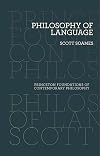
Take my rating with a grain of salt: this book just isn't suited for my purposes. It is focused very minutely on one tradition in p of l, to wit, the "let's get a theory of meaning from the application of formal logic to natural languages" tradition, which means none of those loose-talking Wittgensteinians, Austinians, Searlians, linguists, and so on.
It is further unsuited for my purposes in that, although I did some p of l at uni, and some logic, and have read most of the big names, I had show more nowhere near enough logic to deal with much of the text. A friend (a professional philosopher) suggests that this book is really designed for graduate students and professors in, e.g., phil of mind, who need some way to structure the p of l classes they're obliged to teach, and that seems about right. In other words: if you already know this stuff, you'll be glad to have Soames' book on hand so you can state it really, really, really precisely. If you don't already know it, though, he's not interested in teaching you.
So those are some problems specific to me. More generally, there's something very wrong when a book about language is so horrifically written. I don't just mean the reliance on unnecessary logical notation; I mean the fact that Soames' explanations of his own logical notation is often less clear than the notation itself. I mean that many of his sentences appear to be syntactically incomplete, and those that are complete are usually composed by him in the passive for no very good reason. It's a bit like reading a poorly put together statute, which aims for total clarity and precision and, for that precise reason, ends up incomprehensible.
Which fact is a lesson for p of l itself: *why* think that formal languages are the right road to a theory of meaning in natural languages? Natural languages *aren't* precise, or clear. And, to be fair, the logic people know that, and they are tweaking their systems to account for the fact that (most) language doesn't work as do the traditional "Socrates was a philosopher" philosophical statements (Soames' own work is in this area, and he describes it in the last chapter. At least, I think he describes it, it's hard to tell. Within the post-Tarski context he's set up, he seems right, but again, I can't really tell). Unfortunately, by the time you get to Soames' description of his own work, you just might have lost faith in the project, and be wishing that someone who actually used human languages in their work would take on the task of explaining how, exactly, language provides meanings to its users. show less
It is further unsuited for my purposes in that, although I did some p of l at uni, and some logic, and have read most of the big names, I had show more nowhere near enough logic to deal with much of the text. A friend (a professional philosopher) suggests that this book is really designed for graduate students and professors in, e.g., phil of mind, who need some way to structure the p of l classes they're obliged to teach, and that seems about right. In other words: if you already know this stuff, you'll be glad to have Soames' book on hand so you can state it really, really, really precisely. If you don't already know it, though, he's not interested in teaching you.
So those are some problems specific to me. More generally, there's something very wrong when a book about language is so horrifically written. I don't just mean the reliance on unnecessary logical notation; I mean the fact that Soames' explanations of his own logical notation is often less clear than the notation itself. I mean that many of his sentences appear to be syntactically incomplete, and those that are complete are usually composed by him in the passive for no very good reason. It's a bit like reading a poorly put together statute, which aims for total clarity and precision and, for that precise reason, ends up incomprehensible.
Which fact is a lesson for p of l itself: *why* think that formal languages are the right road to a theory of meaning in natural languages? Natural languages *aren't* precise, or clear. And, to be fair, the logic people know that, and they are tweaking their systems to account for the fact that (most) language doesn't work as do the traditional "Socrates was a philosopher" philosophical statements (Soames' own work is in this area, and he describes it in the last chapter. At least, I think he describes it, it's hard to tell. Within the post-Tarski context he's set up, he seems right, but again, I can't really tell). Unfortunately, by the time you get to Soames' description of his own work, you just might have lost faith in the project, and be wishing that someone who actually used human languages in their work would take on the task of explaining how, exactly, language provides meanings to its users. show less
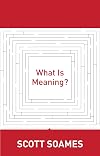
This is a book written for professional philosophers. Unfortunately it has little value for anyone else. Naturally we are all curious about meaning. What is it that enables our thoughts to have meaning? That is an intriguing issue, but not one covered by this book. Instead this book asks another question. How can sentences (like these I am writing) have intrinsic meaning? Of course a few squiggles on a page or screen do not. Thus the author decides that we (the reader and writer) attribute show more meaning through our cognitive processes. Sentences are just a code which we learn to communicate between ourselves. Of course the book was written for the argument not this shallow conclusion.
In presenting the argument the book conspicuously fails to define terms. The author doesn’t even attempt to give an explanation of the word, meaning. Furthermore the meanings of words undoubtedly meander with changing context throughout the book. Thus I could not recommend this book for students. show less
In presenting the argument the book conspicuously fails to define terms. The author doesn’t even attempt to give an explanation of the word, meaning. Furthermore the meanings of words undoubtedly meander with changing context throughout the book. Thus I could not recommend this book for students. show less
Awards

You May Also Like


Associated Authors
Statistics
- Works
- 18
- Also by
- 3
- Members
- 710
- Popularity
- #35,708
- Rating
- 4.0
- Reviews
- 3
- ISBNs
- 61
- Languages
- 1