
Paul Felix Lazarsfeld (1901–1976)
Author of Die Arbeitslosen von Marienthal. Ein soziographischer Versuch über die Wirkungen langandauernder Arbeitslosigkeit
About the Author
Paul F. Lazarsfeld was a Viennese-born American mathematician, psychologist, and sociologist who immigrated to the United States in 1933. In Vienna he had established an applied social research center, which became a model for others in the United States; the most famous product of the Vienna show more center is Marienthal (1933) a pioneering study of unemployment in an Austrian village. In the United States, Lazarsfeld became director of a Rockefeller Foundation-supported study of the impact of radio; through this study, communications research was established as a field of social science inquiry. In 1937 Lazarsfeld founded a research center, which became the Bureau of Applied Social Research at Columbia University; he taught at Columbia from 1940 until 1969. Lazarsfeld's research areas included mass communications, voting, latent structure analysis, mathematical models, the history of quantitative research, and the analysis of survey data. His major goal was to find intellectual convergences between the social sciences and the humanities, between concept formation and index construction, and between quantitative and qualitative research. His enthusiasm and originality had an enormous impact on colleagues and students; an annual evening lecture and reception at Columbia provided an opportunity for them to share both vivid memories and current experiences. (Bowker Author Biography) show less
Image credit: Image © ÖNB/Wien
Works by Paul Felix Lazarsfeld
Die Arbeitslosen von Marienthal. Ein soziographischer Versuch über die Wirkungen langandauernder Arbeitslosigkeit (1975) — Contributor — 50 copies, 1 review
Radio and the printed page : an introduction to the study of radio and its role in the communication of ideas (1976) 4 copies
Latent Structure Analysis 4 copies
Introduzione alla sociologia 2 copies
The academic mind 1 copy
A sociologia 1 copy
Associated Works
Tagged
Common Knowledge
- Legal name
- Lazarsfeld, Paul Felix
- Birthdate
- 1901-02-13
- Date of death
- 1976-08-30
- Gender
- male
- Education
- University of Vienna (Ph.D|1925)
- Occupations
- sociologist
professor - Organizations
- National Youth Administration
Newark Center
Bureau of Applied Social Research, Columbia University (founder)
Columbia University - Awards and honors
- Rockefeller Foundation Fellowship
National Academy of Sciences
National Academy of Education - Relationships
- Lazarsfeld, Robert (son)
Lazarsfeld, Sophie (mother)
Jahoda, Marie (ex-wife)
Herzog, Herta (wife)
Bailyn, Lotte (daughter) - Nationality
- Austria
USA - Birthplace
- Vienna, Austria
- Place of death
- Newark, New Jersey, USA
- Associated Place (for map)
- Newark, New Jersey, USA
Members
Reviews
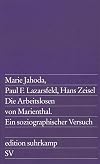
Living in Vienna 30 minutes away from Marienthal by public transport and having heard quite a bit about this classic at university, I picked it up in the bookstore and was pleasantly surprised both by its stylistic elegance and the warmth of its message in the dark times that were the 1930s.
The combination of statistic data with human reporting vividly paints the picture of a community in decline. The only part missing is a proper cconclusion. The report ends without summing up their show more findings or giving recommendations.
Suhrkamp should have added a modern commentary about what happened to Marienthal or Grammatneusiedl after the study. show less
The combination of statistic data with human reporting vividly paints the picture of a community in decline. The only part missing is a proper cconclusion. The report ends without summing up their show more findings or giving recommendations.
Suhrkamp should have added a modern commentary about what happened to Marienthal or Grammatneusiedl after the study. show less

Awards

You May Also Like


Associated Authors
Statistics
- Works
- 41
- Also by
- 1
- Members
- 260
- Popularity
- #88,385
- Rating
- 3.7
- Reviews
- 2
- ISBNs
- 43
- Languages
- 5