
About the Author
Susan Wise Bauer is the author of The Well-Educated Mind: A Guide to the Classical Education You Never Had (revised edition, Norton, 2016) and co-author with her mother, Jessie Wise, of The Well-Trained Mind: A Guide to Classical Education at Home (4th edition, Norton, 2016), a book which has show more become an educational standard. Susan has taught literature and writing at The College of William and Mary in Virginia. Visit her home page at susanwisebauer.com. show less
Image credit: William McEwan
Series
Works by Susan Wise Bauer
The Story of the World: History for the Classical Child, Volume 1: Ancient Times, From the Earliest Nomads to the Last Roman Empire (2007) 3,109 copies, 8 reviews
The Well-Educated Mind: A Guide to the Classical Education You Never Had (2003) 2,161 copies, 29 reviews
The History of the Ancient World: From the Earliest Accounts to the Fall of Rome (2007) 1,817 copies, 24 reviews
The Story of the World: History for the Classical Child, Volume 3: From Elizabeth the First to the Forty-Niners (2004) 1,642 copies, 2 reviews
The Story of the World: History for the Classical Child, Volume 2: The Middle Ages: From the Fall of Rome to the Rise of the Renaissance (2003) 1,551 copies, 4 reviews
The Story of the World: History for the Classical Child, Volume 4: The Modern Age: From Victoria's Empire to the End of the USSR (2005) 1,547 copies, 4 reviews
The Well-Trained Mind: A Guide to Classical Education at Home, Revised and Updated Edition (2004) 1,201 copies, 18 reviews
The Story of the World: History for the Classical Child: Volume 2: The Middle Ages (2007) 1,163 copies, 2 reviews
The History of the Medieval World: From the Conversion of Constantine to the First Crusade (2010) 1,161 copies, 11 reviews
The Story of the World, Activity Book 1: Ancient Times: From the Earliest Nomad to the Last Roman Emperor (2002) 913 copies
The Well-Trained Mind: A Guide to Classical Education at Home (Third Edition) (2009) 896 copies, 5 reviews
The Story of the World, Activity Book 2: The Middle Ages: From the Fall of Rome to the Rise of the Renaissance (2003) 647 copies, 1 review
The History of the Renaissance World: From the Rediscovery of Aristotle to the Conquest of Constantinople (2013) 581 copies, 4 reviews
The Well-Educated Mind: A Guide to the Classical Education You Never Had (Updated and Expanded) (2015) 429 copies, 2 reviews
The Story of the World, Activity Book 3: Early Modern Times: Early Modern Times from Elizabeth the First to the Forty Niners (2004) 383 copies
Story of the World, Vol. 4 Revised Edition: History for the Classical Child: The Modern Age (Story of the World, 4) (2021) 380 copies
Story of the World, Vol. 3 Revised Edition: History for the Classical Child: Early Modern Times (Story of the World, 11) (2020) 377 copies
The Story of the World, Activity Book 4: The Modern Age: From Victoria's Empire to the End of the USSR (2005) 287 copies
The Story of Western Science: From the Writings of Aristotle to the Big Bang Theory (2015) 245 copies, 4 reviews
Story of the World, Vol. 1 Test and Answer Key: History for the Classical Child: Ancient Times (2007) 175 copies
The Story of the World: History for the Classical Child: Ancient Times: From the Earliest Nomads to the Last Roman Emperor Volume 1: 0 170 copies, 1 review
Story of the World, Vol. 2 Test and Answer Key: History for the Classical Child: The Middle Ages (2007) 130 copies
The Complete Writer: Level Two Workbook for Writing with Ease (The Complete Writer) (2008) 129 copies
Story of the World, Vol. 3 Test and Answer Key, Revised Edition: History for the Classical Child: Early Modern Times (2007) 127 copies
The Complete Writer: Level Three Workbook for Writing with Ease (The Complete Writer) (2009) 92 copies
Story of the World, Vol. 4 Test and Answer Key, Revised Edition: History for the Classical Child: The Modern Age (2007) 80 copies
Story of the World, Vol. 3 Activity Book, Revised Edition: History for the Classical Child: Early Modern Times (Story of the World, 14) (2020) 61 copies
The Great Shadow: A History of How Sickness Shapes What We Do, Think, Believe, and Buy (2026) 61 copies, 1 review
The Story of the World: History for the Classical Child: The Modern Age: Tests and Answer Key (Vol. 4) (Story of the World) (2007) 53 copies
The Complete Writer: Level Four Workbook for Writing with Ease (The Complete Writer) (2009) 46 copies
Story of the World, Vol. 4 Activity Book, Revised Edition: The Modern Age: From Victoria's Empire to the End of the USSR (Story of the World, 6) (2021) 36 copies
Story of the World, Vol. 3 Audiobook, Revised Edition: History for the Classical Child: Early Modern Times (Story of the World, 13) (2020) 15 copies
Story of the World, Text Bundle, Paperback Revised Edition: History for the Classical Child: Ancient Times through The Modern Age (2021) 10 copies
How to Diagram Any Sentence: Exercises to Accompany The Diagramming Dictionary (Grammar for the Well-Trained Mind) (2022) 7 copies
The Story of the World, Volume 1: Ancient Times. From the Earliest Nomads to the Last Roman Emperor.: 25th Anniversary Expanded Edition (2026) 6 copies
A História do Mundo (volume 1): A Antiguidade: dos primeiros nômades ao último imperador romano (Portuguese Edition) (2022) 5 copies
Story of the World, Vol. 1 Bundle: History for the Classical Child: Ancient Times; Text, Activity Book, and Test & Answer Key (2019) 4 copies
Coloring the Story of the World: 60 Coloring Pages inspired by Susan Wise Bauer's The Story of the World (2022) 4 copies
History for the Classical Child: Early Modern Times (Revised Edition): Story of the World, Vol. 3 3 copies
Story of the World, Text Bundle Paperback: History for the Classical Child: Ancient Times through The Modern Age (Story of the World) (2020) 2 copies
Story of the World vols 1-2 1 copy
A Well Trained Mind - CD 1 copy
The Story of the World 1 copy
The Newberry Award 1 copy
STORY OF THE WORLD 1 1 copy
A História do Mundo – A Era Moderna: do Império de Vitória ao fim da União Soviética (Volume 4) 1 copy
Hostoria del Mundo Antiguo 1 copy
Associated Works
Wonderful Words of Life: Hymns in American Protestant History and Theology (2004) — Contributor — 111 copies
Tagged
Common Knowledge
- Canonical name
- Bauer, Susan Wise
- Birthdate
- 1968-08
- Gender
- female
- Education
- Liberty University (BA|1988)
Westminster Theological Seminary (M.Div.|1991)
College of William and Mary (M.A.|English Language and Literature|1996)
College of William and Mary (Ph.D.|American Studies|2007) - Occupations
- professor
historian
children's book author
editor
publisher - Organizations
- College of William and Mary (professor)
Peace Hill Press (editor-in-chief)
Books and Culture (contributing editor) - Agent
- Michael Carlisle
- Relationships
- Wise, Jessie (mother)
- Short biography
- Susan was born in 1968, grew up in Virginia, and was educated at home by pioneering parents, back when home education was still unheard of. She worked as a professional musician, wore a costume at Colonial Williamsburg, toured with a travelling drama group, galloped racehorses at a Virginia racetrack, taught horseback riding, worked in radio and newspaper ad sales, learned enough Korean to teach a Korean four-year-old Sunday school, and served as librarian and reading tutor for the Rita Welsh Adult Literacy Center in Williamsburg, Virginia.
In her less haphazard adult life, she earned an M.A., M.Div., and Ph.D. She has taught at the College of William & Mary in Virginia for the last sixteen years. Susan is married and the mother of four.
Susan's most recent book for Norton, The Story of Western Science: From the Writings of Aristotle to the Big Bang Theory (2015), guides us back to the original texts that have changed the way we think about our world, our cosmos, and ourselves.!
Her previous book, The Well-Educated Mind: A Guide to the Classical Education You Never Had (2003), is a guide to reading the classic works of fiction, poetry, history, autobiography, and drama. Norton also published The Well-Trained Mind: A Guide to Classical Education at Home (with co-author Jessie Wise); originally published in 1999, this bestselling guide to education in the classical tradition was revised and updated in 2004 and again in 2009.
For Peace Hill Press, Susan has written a four-volume world history series for children, The Story of the World, for Peace Hill Press. Volume 1, Ancient Times, was published in 2002 (revised edition 2006); Volume 2, The Middle Ages, in 2003 (revised edition 2007); and Volume 3, Early Modern Times, in 2004. The final volume, The Modern Age, was published in 2006. She has also written a best-selling elementary writing program, Writing With Ease.
Susan is also the author of The Art of the Public Grovel (Princeton University Press) and many articles and reviews. Visit her blog at http://www.susanwisebauer.com/blog. - Nationality
- USA
- Birthplace
- Chelsea, Massachusetts, USA
- Places of residence
- Virginia, USA
- Associated Place (for map)
- USA
Members
Discussions
How is Everyone Doing on their Well-Educated Mind reading? in The Well-Educated Mind by Susan Wise-Bauer (February 2025)
Just starting out in The Well-Educated Mind by Susan Wise-Bauer (July 2024)
The Well-Educated Mind List in The Well-Educated Mind by Susan Wise-Bauer (September 2021)
New to the Group in The Well-Educated Mind by Susan Wise-Bauer (October 2014)
The History of the Ancient World by Susan Wise Bauer in Ancient History (October 2011)
Ack! I started this group. Then, I forgot about it. in The Well-Educated Mind by Susan Wise-Bauer (September 2011)
Reviews
The great shadow : a history of how sickness shapes what we do, think, believe, and buy by Susan Wise Bauer
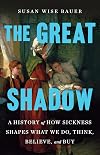
Rating: 4.5* of five
The Publisher Says: From alchemy to wellness culture, from antisemitism to disposable plastic, a gripping account of how getting sick has shaped humanity.
Anti-science, anti-vaccine, anti-reason beliefs seem to be triumphing over common sense today. How did we get here? The Great Shadow brings a huge missing piece to this puzzle—the experience of actually being ill. What did it feel like to be a woman or man struggling with illness in ancient times, in the Middle Ages, show more in the seventeenth century, or in 1920? And how did that shape our thoughts and convictions?
The Great Shadow uses extensive historical research and first-person accounts to tell a vivid story about sickness and our responses to it, from very ancient times until the last decade. In the process of writing, historian Susan Wise Bauer reveals just how many of our current fads and causes are rooted in the moment-by-moment experience of sickness—from the search for a balanced lifestyle to plug-in air fresheners and bare hardwood floors. We can’t simply shout facts at people who refuse vaccinations, believe that immigrants carry diseases, or insist that God will look out for them during a pandemic. We have to enter with imagination, historical perspective, and empathy into their world. The Great Shadow does just that with page-turning flair.
I RECEIVED A DRC FROM THE PUBLISHER VIA NETGALLEY. THANK YOU.
My Review: It is unbelievably apt that this book was contracted for in 2019. I don't think I need to discuss what happened in 2020. What COVID did was to point up the absolutely amazing progress in medical treatment of disease that we've made...vaccines that have saved tens of millions of lives in the past six years developed in months not years...and how ingrained fallacies are in our species...the social distancing farrago is just miasma theory written in Times New Roman. COVID also caused the author to forego doing in-person research in favor of extensive online research. (If, like me, your eyebrows went up at the mere notion of suchlike in a serious work of nonfiction, cool your jets until you've looked through the over 400 notes and citations that make up a literal quarter of the text.)
As a narrative technique, reconstructions of past actions and attitudes work only as well as the author's ability to convey evidence from the records in appropriate prose. It's a technique I think adds some immediacy to history that otherwise is often dry and tedious. I'm happy to say Author Bauer convinced me to follow her as different events were interpreted as diving wrath, moral turpitude, and individual punishment when most twenty-first century people would see the disease process for the impersonal force it is.
It does lend itself, however, to a discontinuity of time. I followed Author Bauer's conceptual links between topics and strands of evidence without much conscious effort, often thinking "...but what about...?" mere words before she addressed the very question I was still formulating. Others might not find that to be their experience. I mention it as information only. You'll resonate with a less linear presentation in your own way. I can't offer a perfect five because even I was occasionally thrown off the scent of the idea being pursued.
I'm here to tell you I want you to read this book, no matter your beliefs about medicine or science. It is not chiding or minatory to people not in the tent with the believers on either side. It is tendentious; it is not disrespectful. Of course I can say that without hesitation because I agree with Author Bauer. I will offer my main evidence in favor of reading it by saying I was highly resistant to her take on social distancing being modern miasma theory until I read her points about the science for and against it. My mind, in the face of cogently presented and logically mustered evidence, changed.
An author who can get in under my well-entrenched, heavily undergirded arrogant illusion of knowledge deserves your treasure and your eyeblinks. show less
The Publisher Says: From alchemy to wellness culture, from antisemitism to disposable plastic, a gripping account of how getting sick has shaped humanity.
Anti-science, anti-vaccine, anti-reason beliefs seem to be triumphing over common sense today. How did we get here? The Great Shadow brings a huge missing piece to this puzzle—the experience of actually being ill. What did it feel like to be a woman or man struggling with illness in ancient times, in the Middle Ages, show more in the seventeenth century, or in 1920? And how did that shape our thoughts and convictions?
The Great Shadow uses extensive historical research and first-person accounts to tell a vivid story about sickness and our responses to it, from very ancient times until the last decade. In the process of writing, historian Susan Wise Bauer reveals just how many of our current fads and causes are rooted in the moment-by-moment experience of sickness—from the search for a balanced lifestyle to plug-in air fresheners and bare hardwood floors. We can’t simply shout facts at people who refuse vaccinations, believe that immigrants carry diseases, or insist that God will look out for them during a pandemic. We have to enter with imagination, historical perspective, and empathy into their world. The Great Shadow does just that with page-turning flair.
I RECEIVED A DRC FROM THE PUBLISHER VIA NETGALLEY. THANK YOU.
My Review: It is unbelievably apt that this book was contracted for in 2019. I don't think I need to discuss what happened in 2020. What COVID did was to point up the absolutely amazing progress in medical treatment of disease that we've made...vaccines that have saved tens of millions of lives in the past six years developed in months not years...and how ingrained fallacies are in our species...the social distancing farrago is just miasma theory written in Times New Roman. COVID also caused the author to forego doing in-person research in favor of extensive online research. (If, like me, your eyebrows went up at the mere notion of suchlike in a serious work of nonfiction, cool your jets until you've looked through the over 400 notes and citations that make up a literal quarter of the text.)
As a narrative technique, reconstructions of past actions and attitudes work only as well as the author's ability to convey evidence from the records in appropriate prose. It's a technique I think adds some immediacy to history that otherwise is often dry and tedious. I'm happy to say Author Bauer convinced me to follow her as different events were interpreted as diving wrath, moral turpitude, and individual punishment when most twenty-first century people would see the disease process for the impersonal force it is.
It does lend itself, however, to a discontinuity of time. I followed Author Bauer's conceptual links between topics and strands of evidence without much conscious effort, often thinking "...but what about...?" mere words before she addressed the very question I was still formulating. Others might not find that to be their experience. I mention it as information only. You'll resonate with a less linear presentation in your own way. I can't offer a perfect five because even I was occasionally thrown off the scent of the idea being pursued.
I'm here to tell you I want you to read this book, no matter your beliefs about medicine or science. It is not chiding or minatory to people not in the tent with the believers on either side. It is tendentious; it is not disrespectful. Of course I can say that without hesitation because I agree with Author Bauer. I will offer my main evidence in favor of reading it by saying I was highly resistant to her take on social distancing being modern miasma theory until I read her points about the science for and against it. My mind, in the face of cogently presented and logically mustered evidence, changed.
An author who can get in under my well-entrenched, heavily undergirded arrogant illusion of knowledge deserves your treasure and your eyeblinks. show less
The History of the Ancient World: From the Earliest Accounts to the Fall of Rome by Susan Wise Bauer
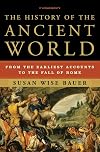
Susan Wise Bauer writes well, but this overview of ancient history is depressing. She sticks to history, that is written accounts, so people who didn't have the ability to write, or didn't sufficiently annoy someone who did, don't get much mention. Those who do make it into this account of history lived in the Middle East, North Africa, Europe, India, and Asia. What's depressing (at least to me) is that in the roughly 4,000 years, and across all the real estate covered by the book, people show more don't seem to have made much progress. The big achievement was writing. After that what they did mostly was wage war and engage in brutal internal squabbles for power. It's as if the entire human species (with very few exceptions) was infected with a virus that made them paranoid sociopaths. Maybe only the leaders were truly insane, but pretty much every king, general, or anyone else who obtained a position of power did so through deception, betrayal, and murder; and then they went about enslaving, maiming, and killing people ostensibly ruled by other psychopaths and stealing whatever they had. If you think modern politics are nasty or that the world today is a violent place, read this book. We've go it good. show less
The Story of the World: History for the Classical Child: Volume 1: Ancient Times: From the Earliest Nomads to the Last Roman Emperor, Revised Edition by Susan Wise Bauer
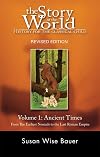
This book is basically a history and culture textbook written for homeschoolers who are short on time and culture and need to get everything from just one book. It has to simplify and shorten, to be accessible to children. In its three pages on Alcibiades, it goes too far and actually misleads; every other sentence is completely false. What did the same author do with Alcibiades in her history for adults? I'm actually curious now.
I tried listening to the book, instead of reading. It seems to show more go really awry with most of Greek history. Its big virtue is that it goes around and around the world, picking up the threads on one continent after another. show less
I tried listening to the book, instead of reading. It seems to show more go really awry with most of Greek history. Its big virtue is that it goes around and around the world, picking up the threads on one continent after another. show less
The History of the Ancient World: From the Earliest Accounts to the Fall of Rome by Susan Wise Bauer
"The History of the Ancient World" by Susan Bauer covers ancient civilizations prior to the fall of the Roman Empire. The book explores civilizations in Mesopotamia, Egypt, India, China, and the Mediterranean, offering a global perspective of the ancient world. Bauer's comparisons between civilizations are insightful, and the book's organization makes it easy to follow these stories chronologically. I found the included PDF, which provided a timeline and maps for every chapter, very useful. show more Overall, The History of the Ancient World is a comprehensive and well-researched work that I thoroughly enjoyed. show less
Lists
Awards


You May Also Like


Associated Authors
Statistics
- Works
- 115
- Also by
- 1
- Members
- 24,647
- Popularity
- #851
- Rating
- 4.1
- Reviews
- 131
- ISBNs
- 189
- Languages
- 6
- Favorited
- 17