
Joan Steiner (1943–2010)
Author of Look-Alikes
About the Author
Joan Steiner was born in New Brunswick, New Jersey. After receiving degrees at Barnard College and the University of Chicago, she began her art career by creating one-of-a-kind wearable art pieces. She was the illustrator and creator of the Look-Alikes series. Her first book, Look-Alikes, was show more published in 1998. The book, and the other books in the series, featured three-dimensional collages that turned everyday objects like razors, coffeepots, or vegetables into everyday scenes such as a train station, city street, general store, park, and zoo. Her other works include Look-Alikes Jr., Look-Alikes Christmas, and Look-Alikes Around the World. She won numerous art and design awards including a Society of Illustrators Award and a National Endowment for the Arts fellowship. She died of cancer on September 8, 2010. (Bowker Author Biography) show less
Series
Works by Joan Steiner
Tagged
Common Knowledge
- Canonical name
- Steiner, Joan
- Birthdate
- 1943-10-10
- Date of death
- 2010-09-08
- Gender
- female
- Education
- Barnard College
- Occupations
- children's book author
illustrator - Nationality
- USA
- Birthplace
- New Brunswick, New Jersey, USA
- Place of death
- Claverack, New York, USA
- Associated Place (for map)
- USA
Members
Reviews
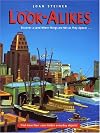
Undeniably creative. Judging by the (unworn) condition of the library copy I read, though, I'm not the only reader who just doesn't get it. It is hallucinatory & surreal - I dunno, maybe it helps to be on something, or to be able to achieve an altered state of mind through exhaustion or meditation or inner fire of creativity?
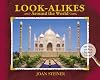
Looking at Joan Steiner’s book Look-Alikes Around the World is like looking at a scrapbook of a world traveler. Is that a postcard of Holland with a windmill in a field of tulips? Look closer and you will see that the windmill is really a metronome with chopsticks and combs attached. The tulips are: corn kernels, jelly beans, pistachios, wooden matchsticks and fake fingernails!
As you go through the pages you get to travel to Europe and view such sites as Big Ben made with clothespins and show more a compass or The Leaning Tower of Pisa made of cookies and staples. You can travel to Africa and see huts made of muffins. In India you find the Taj Mahal made of onions and ballet slippers! Travel to the Far East and find a Japanese garden made of pretzels and the Great Wall of China made of zippers. Traveling to the South Pacific you find the Sydney Opera House made of pistachios. South America shows the terraced landscape of Peru made (good to eat?) out of peanut butter and bread. We then come to North America and see the Golden Gate bridge made of paper clips and a level. An image of the state of Florida is a maple seed.
This book would be an excellent one for the classroom and is good for ages 4-8 (preschool to grade 3). It can be used to study different structures and terrains. This book shows the many contributions of different cultures to science, technology and engineering. The use of objects of different sizes and textures allows the reader to explore the images of the places around the world. Even though this book does not portray actual accurate images of the various structures and images of these places throughout the world, it does provide an adventure to enjoy and learn about the places portrayed in this book. This book is gear to ages 4-6, but older children (and many adults) will enjoy looking closer at the images to find the many surprises found inside. Older children will be able to recognize more of the items on the pages as they have more experiences with life. The back of this book identifies all the different items in the pictures. I found this book to be a fun adventure exploring the lands around the world through recognizable everyday items. show less
As you go through the pages you get to travel to Europe and view such sites as Big Ben made with clothespins and show more a compass or The Leaning Tower of Pisa made of cookies and staples. You can travel to Africa and see huts made of muffins. In India you find the Taj Mahal made of onions and ballet slippers! Travel to the Far East and find a Japanese garden made of pretzels and the Great Wall of China made of zippers. Traveling to the South Pacific you find the Sydney Opera House made of pistachios. South America shows the terraced landscape of Peru made (good to eat?) out of peanut butter and bread. We then come to North America and see the Golden Gate bridge made of paper clips and a level. An image of the state of Florida is a maple seed.
This book would be an excellent one for the classroom and is good for ages 4-8 (preschool to grade 3). It can be used to study different structures and terrains. This book shows the many contributions of different cultures to science, technology and engineering. The use of objects of different sizes and textures allows the reader to explore the images of the places around the world. Even though this book does not portray actual accurate images of the various structures and images of these places throughout the world, it does provide an adventure to enjoy and learn about the places portrayed in this book. This book is gear to ages 4-6, but older children (and many adults) will enjoy looking closer at the images to find the many surprises found inside. Older children will be able to recognize more of the items on the pages as they have more experiences with life. The back of this book identifies all the different items in the pictures. I found this book to be a fun adventure exploring the lands around the world through recognizable everyday items. show less
6. This was a fun book to look through. The text wasn't overly stimulating, taking you on a journey throughout the world. The illustrations, on the other hand, were the main feature. The postcard theme of the book makes it look like a run of the mill world site book at first but upon further inspection, you realize there is a lot to see in each picture.
7. This would be a great book to use with social studies and world geography. Another cross-curricular connection could be with art. I could show more envision using this book as a mentor text for teaching students to use everyday objects to create art that looks like something else (a building, a land feature, etc.) show less
7. This would be a great book to use with social studies and world geography. Another cross-curricular connection could be with art. I could show more envision using this book as a mentor text for teaching students to use everyday objects to create art that looks like something else (a building, a land feature, etc.) show less
An incredible book to pore over. This book can entertain a child for hours. The superior creations are made out of an enormous collection of items listed in the back of the book. The look-alikes are amazing, even for adults. Great art connection, especially before doing 3-D art projects/pieces.
Awards


You May Also Like


Associated Authors
Statistics
- Works
- 15
- Members
- 1,573
- Popularity
- #16,417
- Rating
- 4.4
- Reviews
- 18
- ISBNs
- 45
- Languages
- 8