
Ludwig Bemelmans (1898–1962)
Author of Madeline
About the Author
Ludwig Bemelmans, April 27, 1898 - October 1, 1962 Ludwig Bemelmans was born on April 27, 1898 in Meran, then Austria. At the age of eight, his parents divorced and he moved with his mother to Regensburg, Germany. He was enrolled into various public and private schools and failed out of most of show more them. At the age of twelve, unsure of what else to do with him, Bemelmans was apprenticed to an uncle in the hotel business and proceeded to go through many jobs, being repeatedly dismissed. After supposedly shooting and almost killing a waiter, his family gave him the ultimatum of reform school or emigration to the United States. He arrived in America in 1914 with reference letters from his uncle to various hotel managers in New York. Bemelmans obtained a job as a waiter in the Ritz-Carlton, but left that job to join the Army in 1917. In the Army, he worked with German speaking recruits and as a military hospital guard. In 1918, Bemelmans became a naturalized citizen, returning to hotel and restaurant work a year later, eventually opening his own restaurant. In the 1934, at the suggestion of one of his friends, Bemelmans began to write, producing his first children's book, "Hansi." He was best known though, for his series of books about the little french girl, "Madeline," which is still a childhood favorite. "Madeline's Rescue," the second book in the series, won the Caldecott Medal in 1953. His first book for adults was entitled, "My War with the United States" and was a diary of his experiences in the service during World War I. In fact, Bemelmans usually wrote his books based on his life experiences, such as "Life Class" and "Hotel Splendide," about his life as a restaurateur, his travels to Ecuador and Italy appeared in "The Donkey Inside" and "Italian Holiday," and his brief stint as a screenwriter in Hollywood was the basis for "Dirty Eddie." Bemelmans wrote about a book or two a year and was a contributor to Town and Country and Horizon, as well as a cover illustrator for The New Yorker. In his later years, Bemelmans enjoyed some small fame from painting, with some of his work appearing in various galleries. Ludwig Bemelmans died of pancreatic cancer in New York on October 1, 1962. (Bowker Author Biography) show less
Image credit: Ludwig Bemelmans, 1946
Series
Works by Ludwig Bemelmans
Madeline Quartet: Madeline / Madeline's Rescue / Madeline and the Bad Hat / Madeline in London (1967) 98 copies
Madeline [1988 TV movie] — Director — 3 copies
Putzi 2 copies
How to have Europe all to yourself 2 copies
Construction 1 copy
Madeleine 1 copy
להציל את מדלן 1 copy
Cochon d'Eddie ! 1 copy
The Madeline Classic Storybook Library Box Set (Madeline, Madeline In London, Madeline's Rescue) (1989) 1 copy
Madeline Collection 1 copy
The Borrowed Christmas 1 copy
CD MADELINE Puffin Storytime 1 copy
Sacre du Printemps 1 copy
Мадлен в воздухе 1 copy
Associated Works
The 20th-Century Children's Book Treasury: Picture Books and Stories to Read Aloud (1998) — Contributor — 1,840 copies, 14 reviews
Fierce Pajamas: An Anthology of Humor Writing from The New Yorker (2001) — Contributor — 790 copies, 5 reviews
The Illustrated Treasury of Children's Literature, Volumes 1-2 (1955) — Contributor — 524 copies, 4 reviews
Choice Cuts: A Savory Selection of Food Writing from Around the World and Throughout History (2002) — Contributor — 369 copies, 2 reviews
The Best of Both Worlds: An Anthology of Stories for All Ages (1968) — Contributor — 25 copies, 1 review
Shirley Temple Storybook Collection: The Princess and the Goblins / Madeline (2008) — Original story — 4 copies, 1 review
A Caravan of Music Stories by the World's Great Authors — Contributor — 1 copy
Tagged
Common Knowledge
- Birthdate
- 1898-04-27
- Date of death
- 1962-10-01
- Gender
- male
- Occupations
- hotel work
artist
writer
illustrator
restaurateur - Organizations
- U.S. Army
- Awards and honors
- Caldecott Medal
Bemelmans Bar (Carlyle Hotel, Manhattan, New York City, New York, USA) - Relationships
- Marciano, John Bemelmans (grandson)
- Cause of death
- pancreatic cancer
- Nationality
- Austria-Hungary (birth)
Germany (mother's nationality)
Belgium (father's nationality)
USA (naturalised 1918) - Birthplace
- Meran, Austria-Hungary
- Places of residence
- Merano, Austria
Regensburg, Germany
New York, New York, USA
Gmunden, Upper Austria, Austria - Place of death
- New York, New York, USA
- Burial location
- Arlington National Cemetery, Arlington, Virginia, USA
- Map Location
- USA
Members
Reviews

I approached this book with some diffidence, humour, and the appropriate subjects of humour, often being very much of their time. The opening anecdotes were lightheartedly funny sketches of workers and patrons of the hotel, though there were parts that justified my reservations. Then, about ⅓ in, without losing the bantering tone, Bemelmans introduced some darker, even sinister, characters and situations, that might have raised eyebrows in polite society: Professor Gorylescu, the table show more magician, smoulders with a seedy loucheness that hints of more troubling proclivities.
Kalakobé, the one Black character, could have been a problem, and while Bemelmans does exoticise him somewhat, he presents him with dignity, noting that Kalakobé refuses the description "negro" and insists on his being "African".
There's a nasty incident at the end of the first anecdote which had raised my hackles, however, Bemelmans deftly weaves this into his final story: very satisfying. "Raconteur" fits Bemelmans well, and I had the feeling of hearing these stories in a corner of a dimly-lit dining hall after all the patrons have left, around a littered table with a stained cloth, waiters in shirt sleeves with unbuttoned collars, smoking cigar stubs and finishing off the opened wine and brandy bottles, regaling each other with the petty demands of diners and unwarranted tyrannies of the maître d'hôtel. show less
Kalakobé, the one Black character, could have been a problem, and while Bemelmans does exoticise him somewhat, he presents him with dignity, noting that Kalakobé refuses the description "negro" and insists on his being "African".
There's a nasty incident at the end of the first anecdote which had raised my hackles, however, Bemelmans deftly weaves this into his final story: very satisfying. "Raconteur" fits Bemelmans well, and I had the feeling of hearing these stories in a corner of a dimly-lit dining hall after all the patrons have left, around a littered table with a stained cloth, waiters in shirt sleeves with unbuttoned collars, smoking cigar stubs and finishing off the opened wine and brandy bottles, regaling each other with the petty demands of diners and unwarranted tyrannies of the maître d'hôtel. show less

This has to be one of the most bizarre, yet gorgeous, bits of PR ever produced. CBS, in the post-war era, attempted to develop its own system of colour television broadcasting, in competition with RCA. There was a long series of hearings held before the FCC, and CBS attempted to persuade the public, and the regulators, that its system was superior to black-and-white television and other, competing systems. Enter Bemelmans, who produces this little story. The glimps (who look like rabbits) show more live near each other. The lady (very charming in design) enjoys colour television. The gentlefur has black-and-white television, and he sees, gradually, that the lady has the better of the bargain. He even tries his own system of colour, and it doesn't work. Eventually, he joins the lady, and they live quite happily ever after. CBS eventually lost the fight with RCA, and this book seems to be virtually forgotten. It's not mentioned in most catalogues of Bemelmans' work. But it has his charm and wit in abundance. show less

Madeline and Pepito find themselves left behind when Miss Clavel and her class visit the local carnival one day, and are taken in by the gypsies, who feed them strong drugs and incorporate them into their circus act. As Miss Clavel agonizes about their fate, the two friends lead a carefree, adventure-filled life, one with few annoying chores or obligations - no brushing of teeth! no going to bed on time! - and plenty of fun. Every new experience palls eventually, however, and the two show more eventually contact Miss Clavel, who immediately sets out to collect them. The gypsy mother, on the other hand, being determined to keep them, decides to disguise them (together) as a lion...
I sometimes find it a little difficult to credit that, although other maliciously destructive myths about various racial, ethnic and religious minorities - Jews kill Christian babies (the Blood Libel) in esoteric blood rites! Africans are black because they are the descendents of Ham (the Curse of Ham), and naturally fit for slavery! - have been rejected, the idea of Gypsies (Romani) as dirty, carefree vagrants who kidnap non-Rom children persists as an "entertaining" trope in our literature, with few questions asked. I feel certain that, if a children's picture-book promoted either of the other two ideas mentioned above, there would be an instant outcry. Here, however, reviewers speak of the "charm" of the artwork, and the "fun" of the story. Absolute Piffle! Leaving aside the lunacy of the stereotype itself - how and why a group of people who, throughout their long and troubled history in Europe, in which they have variously been enslaved, forbidden from owning land or participating in specific professions, and deliberately targeted for extermination in the Nazi Final Solution, would have the desire (let alone the means) to take on other people's children, has never been clear to me - and ignoring all ethical concerns, Madeline and the Gypsies is just a poor story, with a clunky, awkward text (as with its predecessors, I found many of the rhymes here rather forced, and the rhythm somewhat off), and rather drab artwork.
Although I'm not really a fan of the Madeline books, this is the first one I've actively disliked. Utter dreck. show less
I sometimes find it a little difficult to credit that, although other maliciously destructive myths about various racial, ethnic and religious minorities - Jews kill Christian babies (the Blood Libel) in esoteric blood rites! Africans are black because they are the descendents of Ham (the Curse of Ham), and naturally fit for slavery! - have been rejected, the idea of Gypsies (Romani) as dirty, carefree vagrants who kidnap non-Rom children persists as an "entertaining" trope in our literature, with few questions asked. I feel certain that, if a children's picture-book promoted either of the other two ideas mentioned above, there would be an instant outcry. Here, however, reviewers speak of the "charm" of the artwork, and the "fun" of the story. Absolute Piffle! Leaving aside the lunacy of the stereotype itself - how and why a group of people who, throughout their long and troubled history in Europe, in which they have variously been enslaved, forbidden from owning land or participating in specific professions, and deliberately targeted for extermination in the Nazi Final Solution, would have the desire (let alone the means) to take on other people's children, has never been clear to me - and ignoring all ethical concerns, Madeline and the Gypsies is just a poor story, with a clunky, awkward text (as with its predecessors, I found many of the rhymes here rather forced, and the rhythm somewhat off), and rather drab artwork.
Although I'm not really a fan of the Madeline books, this is the first one I've actively disliked. Utter dreck. show less
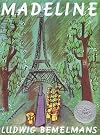
This absolutely adorable book stars Madeline, who's basically the tiniest and most fearless little French girl you'll ever meet! She lives in this old house in Paris with eleven other little girls, all lined up in perfect rows with their matching yellow hats, but not Madeline, she stands out with her bright red hair and no fear! The story really takes off when poor Madeline gets an appendicitis in the middle of the night. But she doesn't freak out! She's is brave and cool about it, even when show more she has to go to the hospital. The best part is how all the other girls get jealous of her hospital room and all the attention she gets. What makes this book so special is how it takes what could be a pretty scary situation for kids (going to the hospital) and turns it into this amazing adventure. Madeline is tiny but mighty. show less
Lists
Five star books (1)
Five in a Row (1)
Overdue Podcast (1)
Five in a Row (1)
Christmas Books (1)
A Novel Cure (1)
French Books (2)
1950s (2)
Sonlight Books (1)
1930s (1)
al.vick-series (1)
Newbery Adjacent (1)
Childhood books (1)
Youth: Poetry (1)
Awards


You May Also Like


Associated Authors
Statistics
- Works
- 96
- Also by
- 39
- Members
- 31,116
- Popularity
- #636
- Rating
- 4.1
- Reviews
- 509
- ISBNs
- 398
- Languages
- 11
- Favorited
- 11

