
Mark Budz
Author of Clade
Series
Works by Mark Budz
The War Inside 2 copies
Zinnias on the Moon 1 copy
Faceless In Gethsemane 1 copy
Roatán {short story} 1 copy
Associated Works
High Fantastic: Colorado's Fantasy, Dark Fantasy and Science Fiction (1995) — Contributor — 7 copies
Tagged
Common Knowledge
- Birthdate
- 1960-11-01
- Gender
- male
- Relationships
- Fitch, Marina (wife)
- Nationality
- USA
- Birthplace
- Cherry Hills, New Jersey, USA
- Places of residence
- Ben Lomond, California, USA
Cherry Hills, New Jersey, USA (born) - Associated Place (for map)
- USA
Members
Reviews
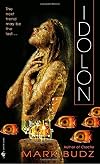
Budz applies the "if this goes on" motif to video screens, leading to a technology called "philm" that can coat walls and even human skin. His depiction of a world where cosmetic changes can occur in moments is interesting; I never developed enough sympathy for the characters caught up in the intrigue surrounding a new development of philm technology to really like the book.
I really liked this book. Butz managed to do a near-future setting without it feeling a) dated or b) overly disconnected; I am not a big fan of antiheroes, acrimony, and angst. I like to have at least one character I can root for.
Budz was remarkably successful in creating a world that was gritty without being depressing, and I liked that. But the really interesting thing about Idolon was the philm. Philm, the book's central conceit, is downloadable imagery which can be displayed on, well, show more pretty much anything -- your house, your floor, yourself. Budz has a lot of fun talking about the high-tech skin grafts people get, the "casts" of identical philms people join, the various identity issues implied by the need to constantly change your looks, and so on. It's a great conceit. My only complaint is that he doesn't stick with it through the ending and instead goes and visits transcendent-land for a while, which leaves me sitting on the landing drumming my nails and checking my watch. But it was still a damned good tale overall. show less
Budz was remarkably successful in creating a world that was gritty without being depressing, and I liked that. But the really interesting thing about Idolon was the philm. Philm, the book's central conceit, is downloadable imagery which can be displayed on, well, show more pretty much anything -- your house, your floor, yourself. Budz has a lot of fun talking about the high-tech skin grafts people get, the "casts" of identical philms people join, the various identity issues implied by the need to constantly change your looks, and so on. It's a great conceit. My only complaint is that he doesn't stick with it through the ending and instead goes and visits transcendent-land for a while, which leaves me sitting on the landing drumming my nails and checking my watch. But it was still a damned good tale overall. show less
I picked this up thinking "wow, seems like yet another stephenson/gibson clone" but was intrigued enough by the idea of a world where everyone wears electronic skins and can redefine what they look like with little more than a thought.
As such, I stepped into the novel expecting to be disappointed... but I wasn't. While the pacing wasn't quite as gripping as some of the cyberpunk I've read, the story was compelling, the world interesting, the "science" more believable than most, and I quickly show more grew to like the characters enough that I was reasonably happy following any of the threads even before it was apparent how they linked together. And surprisingly for cyberpunk, the ending didn't feel disappointing.
Overall, better than the last Gibson novel I read! show less
As such, I stepped into the novel expecting to be disappointed... but I wasn't. While the pacing wasn't quite as gripping as some of the cyberpunk I've read, the story was compelling, the world interesting, the "science" more believable than most, and I quickly show more grew to like the characters enough that I was reasonably happy following any of the threads even before it was apparent how they linked together. And surprisingly for cyberpunk, the ending didn't feel disappointing.
Overall, better than the last Gibson novel I read! show less
http://www.strangehorizons.com/reviews/2007/04/the_2007_philip.shtml
Our setting is Santa Cruz, California, about a hundred years from now; everyone (at least everyone we meet) has had their skin covered with a nanotechnology gimmick called "philm" which allows its wearer to look like anybody they please. Our viewpoint characters are a detective trying to solve a murder, a man who tests out experimental new philms, his cousin who has got more involved with the seedy side of the philm business show more than she would like, and an illegal immigrant who appears to have become impregnated by her philm. Appropriately enough for a Dick nominee, the backdrop is very reminiscent of Blade Runner, which is not to accuse Budz of unoriginality: the ideas in here fizz and pop.
They fizz and pop just enough to help you through the many neologisms (you don't "wear" philm, you "ware" it; anyone fancy a fajizza take-away? - in fairness I found this aspect of the book much less intrusive than the neologisms in Living Next Door to the God of Love or Spin Control), and to distract from the fact that several important questions in the plot are not very satisfactorily resolved - what are the virgin pregnancies all about? What are the mysterious images of fish and dragonflies generated by the expermiental philm meant to be? Is the religious cult of the Transcendental Vibrationists actually meant to be a serious statement about belief (as Budz has hinted in interviews) or just a front for unscrupulous philm developers (as it seemed to me reading the book)? And while the characters were all credible and believable, I didn't find any of them truly engaging. I finished Idolon feeling that it was a very good book, but not quite a great one. show less
Our setting is Santa Cruz, California, about a hundred years from now; everyone (at least everyone we meet) has had their skin covered with a nanotechnology gimmick called "philm" which allows its wearer to look like anybody they please. Our viewpoint characters are a detective trying to solve a murder, a man who tests out experimental new philms, his cousin who has got more involved with the seedy side of the philm business show more than she would like, and an illegal immigrant who appears to have become impregnated by her philm. Appropriately enough for a Dick nominee, the backdrop is very reminiscent of Blade Runner, which is not to accuse Budz of unoriginality: the ideas in here fizz and pop.
They fizz and pop just enough to help you through the many neologisms (you don't "wear" philm, you "ware" it; anyone fancy a fajizza take-away? - in fairness I found this aspect of the book much less intrusive than the neologisms in Living Next Door to the God of Love or Spin Control), and to distract from the fact that several important questions in the plot are not very satisfactorily resolved - what are the virgin pregnancies all about? What are the mysterious images of fish and dragonflies generated by the expermiental philm meant to be? Is the religious cult of the Transcendental Vibrationists actually meant to be a serious statement about belief (as Budz has hinted in interviews) or just a front for unscrupulous philm developers (as it seemed to me reading the book)? And while the characters were all credible and believable, I didn't find any of them truly engaging. I finished Idolon feeling that it was a very good book, but not quite a great one. show less
Awards


You May Also Like


Associated Authors
Statistics
- Works
- 9
- Also by
- 5
- Members
- 407
- Popularity
- #59,757
- Rating
- 3.4
- Reviews
- 11
- ISBNs
- 8
