
Albert Borgmann (1937–2023)
Author of Technology and the Character of Contemporary Life: A Philosophical Inquiry
About the Author
Albert Borgmann is professor of philosophy at the University of Montana
Image credit: University of Montana
Works by Albert Borgmann
Holding On to Reality: The Nature of Information at the Turn of the Millennium (1999) 135 copies, 2 reviews
Associated Works
Postphenomenological Investigations: Essays on Human-Technology Relations (Postphenomenology and the Philosophy of Technology) (2015) — Contributor — 7 copies
Tagged
Common Knowledge
- Canonical name
- Borgmann, Albert
- Birthdate
- 1937-11-23
- Date of death
- 2023-05-07
- Gender
- male
- Education
- University of Munich (Ph.D)
University of Illinois (MA)
University of Texas (BA)
University of Freiburg - Occupations
- philosopher
professor - Organizations
- University of Montana
University of Hawaii
DePaul University - Awards and honors
- Golden Eurydice Award (2013)
- Nationality
- Germany (birth)
USA (naturalized) - Birthplace
- Freiburg im Breisgau, Germany
- Places of residence
- Missoula, Montana, USA
- Place of death
- Missoula, Montana, USA
- Associated Place (for map)
- Missoula, Montana, USA
Members
Reviews

This is a different kind of a book by Albert Borgmann. Although he has previously written about contemporary issues (see esp., Crossing the Postmodern Divide or Holding Onto Reality), this book is a very direct and personal statement about the direction he believes American politics and personal ethics should go.
Borgmann's book takes its guidance from a 1943 quote from Winston Churchill: "We shape our buildings, and afterward our buildings shape us." Borgmann believes that, in contemporary show more American culture, we haven't taken Churchill's point sufficiently to heart. American ideology is nothing if not individualistic, but morality, in Borgmann's interpretation of Churchill's point, is inescapably public. The environment we build for ourselves together -- our physical environment, our environment of cultural and political institutions, our economic structures, the structures of our communities -- shape the kinds of persons we can become. Our individualistic ideology tends to discard that environment as a kind of neutral basis for our ethical and political choices, failing to deliberate about how to design and build an environment that will best afford our living good lives, lives of virtue.
Paying proper attention to how we together shape the lives that we can live places a much brighter light on the public -- not only public politics, but also community practices, family structures and practices, and many other environmental variables that are more informal than formal. Borgmann's critiques of technology in his other works, strongly influenced by Heidegger, have always carried this emphasis on the life of the community. Clearly, Borgmann has personally taken a great interest in the community in which he lives, Missoula, Montana, and the potential that community has for fostering good lives.
Another strong influence is Rawls' combination of liberal individualism with a very public, communal sense of justice. The ideal that both Rawls and Borgmann pursue is one in which individualism thrives on the basis of a strong sense of the common good -- the availability to all of the wherewithal for a good life, no matter what choices individuals then make for their personal pursuit of the good life, what virtues are most important to them, what goals and means they choose for themselves. Both are clear that those individualistic choices must be enabled by that strong and just conception of the public good, contrary to a purist ideology of individualism.
I suspect that Borgmann's understanding of "real" owes something to Hegel. His conception of ethics has much in common with Hegel's insistence that ethics is neither private nor in some sense an "internal" matter of conscience -- an ethical life is inherently "real" in the institutions and practices of a community.
I've always liked Borgmann. He does come off as a bit of a curmudgeon here, though, casting a negative light on commercialism, "commodification", and other waves of modern culture. Resisting those waves is critical, though, in his eye, as those are exactly the "buildings" that shape us, such that the lives we pursue become constrained to the lives of consumers.
The book is very readable, probably the most readable of Borgmann's books. It's pretty impressive that he can write in both the technical style required by contemporary philosophy and in this much more accessible style required to make a statement to all of us within contemporary culture. It's a good book, probably not given the notice it deserves. show less
Borgmann's book takes its guidance from a 1943 quote from Winston Churchill: "We shape our buildings, and afterward our buildings shape us." Borgmann believes that, in contemporary show more American culture, we haven't taken Churchill's point sufficiently to heart. American ideology is nothing if not individualistic, but morality, in Borgmann's interpretation of Churchill's point, is inescapably public. The environment we build for ourselves together -- our physical environment, our environment of cultural and political institutions, our economic structures, the structures of our communities -- shape the kinds of persons we can become. Our individualistic ideology tends to discard that environment as a kind of neutral basis for our ethical and political choices, failing to deliberate about how to design and build an environment that will best afford our living good lives, lives of virtue.
Paying proper attention to how we together shape the lives that we can live places a much brighter light on the public -- not only public politics, but also community practices, family structures and practices, and many other environmental variables that are more informal than formal. Borgmann's critiques of technology in his other works, strongly influenced by Heidegger, have always carried this emphasis on the life of the community. Clearly, Borgmann has personally taken a great interest in the community in which he lives, Missoula, Montana, and the potential that community has for fostering good lives.
Another strong influence is Rawls' combination of liberal individualism with a very public, communal sense of justice. The ideal that both Rawls and Borgmann pursue is one in which individualism thrives on the basis of a strong sense of the common good -- the availability to all of the wherewithal for a good life, no matter what choices individuals then make for their personal pursuit of the good life, what virtues are most important to them, what goals and means they choose for themselves. Both are clear that those individualistic choices must be enabled by that strong and just conception of the public good, contrary to a purist ideology of individualism.
I suspect that Borgmann's understanding of "real" owes something to Hegel. His conception of ethics has much in common with Hegel's insistence that ethics is neither private nor in some sense an "internal" matter of conscience -- an ethical life is inherently "real" in the institutions and practices of a community.
I've always liked Borgmann. He does come off as a bit of a curmudgeon here, though, casting a negative light on commercialism, "commodification", and other waves of modern culture. Resisting those waves is critical, though, in his eye, as those are exactly the "buildings" that shape us, such that the lives we pursue become constrained to the lives of consumers.
The book is very readable, probably the most readable of Borgmann's books. It's pretty impressive that he can write in both the technical style required by contemporary philosophy and in this much more accessible style required to make a statement to all of us within contemporary culture. It's a good book, probably not given the notice it deserves. show less
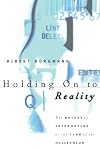
Borgmann presents an historical overview of information, how it has been transformed through time by the introduction of new technology, and especially digital technology. Borgmann shows what this development means to our contemporary society. He argues that when we enter a world that is becoming more virtual, we will lose our close connection with reality, which in turn will lead to a deprivation of our life experiences. This is a must-read for anyone concerned with the information society.
I set the thing down for months, and then picked it back up again. Its not especially interesting, but it has its moments.
It took me 180 pages to truly appreciate the main theme of the book, that there are 3 kinds of information:
Natural, what is around us. The signs that preliterates use to understand what nature brings us.
Cultural: Man's first step into the recording of information and Instructions, which puts a premium on literacy.
Technical: Copies of some aspect of reality that is show more captured and replayed by technical devices. show less
It took me 180 pages to truly appreciate the main theme of the book, that there are 3 kinds of information:
Natural, what is around us. The signs that preliterates use to understand what nature brings us.
Cultural: Man's first step into the recording of information and Instructions, which puts a premium on literacy.
Technical: Copies of some aspect of reality that is show more captured and replayed by technical devices. show less
You May Also Like


Associated Authors
Statistics
- Works
- 8
- Also by
- 6
- Members
- 604
- Popularity
- #41,610
- Rating
- 3.8
- Reviews
- 3
- ISBNs
- 16