

Mary Robison
Author of Why Did I Ever
About the Author
Mary Robison was born in Washington, D.C. She is the recipient of a Guggenheim Fellowship, two Pushcart Prizes, an O. Henry Award, the Los Angeles Times Book Prize for Fiction, and the 2018 Arts and Letters Award in Literature. She is the author of four novels and four story collections. She lives show more in Gainesville, Florida. show less
Image credit: Photo by Pier Rodelon. Courtesy Counterpoint Press.
Works by Mary Robison
Quello che sento (in Dimmi) 1 copy
I gemelli Wellman (in Dimmi) 1 copy
Lo specchio (in Dimmi) 1 copy
Preoccupazioni (in Dimmi) 1 copy
Le tue (in Dimmi) 1 copy
Geniale (in Dimmi) 1 copy
Sorelle (in Dimmi) 1 copy
Likely Lake (in Dimmi) 1 copy
Per davvero (in Dimmi) 1 copy
Robison Mary 1 copy
Yours — Author — 1 copy
A Jewel (in Dimmi) 1 copy
Apostasia (in Dimmi) 1 copy
Figlie (in Dimmi) 1 copy
Il Mister (in Dimmi) 1 copy
Fumo (in Dimmi) 1 copy
Nel bosco (in Dimmi) 1 copy
L'aiuto (in Dimmi) 1 copy
Tirare avanti (in Dimmi) 1 copy
Padre, nonno (in Dimmi) 1 copy
Tentativi (in Dimmi) 1 copy
Ghiaccio carino (in Dimmi) 1 copy
Un periodo a casa (in Dimmi) 1 copy
Ho ventun anni (in Dimmi) 1 copy
Associated Works
Object Lessons: The Paris Review Presents the Art of the Short Story (2012) — Contributor — 253 copies, 9 reviews
Tagged
Common Knowledge
- Other names
- Robison, Mary Cennamo
- Birthdate
- 1949-01-14
- Gender
- female
- Education
- Johns Hopkins University
Ohio State University - Occupations
- short story writer
novelist
professor - Relationships
- Robison, James (former husband)
- Short biography
- Mary Robison, née Cennamo, was born in Washington, D.C. to F. Elizabeth (Cennamo) Reiss, a child psychologist, and Anthony Cennamo, a patent attorney, and grew up in Columbus, Ohio. She started writing as a child and. She attended Ohio State University and earned an M.A. from Johns Hopkins University, where she studied with John Barth. She taught creative writing at numerous colleges and universities, including Oberlin and Harvard before becoming a professor at the University of Florida. She began publishing her work in The New Yorker magazine in 1977 with the short story "Sisters." The New Yorker has since published two dozen of her stories, many of which also appear in anthologies. Her first collection of short stories, Days: Stories, was published in 1979. Her novel Oh!, published in 1981, was adapted into the 1989 film Twister. Her other works include the short story collections An Amateur's Guide to the Night (1983) and Believe Them (1988). In the 1990s she suffered from severe writer's block and, in an effort to overcome it, scribbled her thoughts on thousands of index cards. These cards were the basis of her novel Why Did I Ever (2001). Her novel One DOA, One on the Way (2009) was chosen by Oprah Winfrey's Book Club. Robison has two daughters and has been married twice. Her second husband was author James Robison.
- Nationality
- USA
- Birthplace
- Washington, D.C., USA
- Associated Place (for map)
- D.C., USA
Members
Reviews
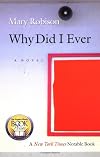
Before I get going, it's worth pointing out that I read this almost entirely because a friend of mine, who is a writer, was very influenced by this book. Left to my own devices, I likely wouldn't have picked it up. So be aware that I'm not Robison's audience.
That said, I'm concerned that there are very serious things wrong with me, and that this book brought them all out.
I don't care very much about 'consistent characters' or verisimilitude or realism or whatever. That said, this book show more seems to be reaching for verisimilitude at least, and I'm more than a little confused about the main character, who was married to a Latin Professor, has read Melville's 'Pierre,' and often makes off-the-cuff references to John Ashbery, but apparently does not know what the word 'tort' means.
ii) That doesn't matter at all, provided you get something else from the book, and I should be able to get something from this, since our narrator is very flippant and I like flippancy. But I'm not sure what I was meant to get out of this: there's a woman. She's writing a script for Hollywood big-wigs (this is clearly meant to be satire). She's got a new boyfriend who is rich and a moron. She's trying to deal with the fact that her son has been raped and tortured, and the criminal is coming up for trial. Also, her daughter is overcoming heroin addiction. But I don't care about any of these things, and I suspect many readers will feel the same way. All of the events are reported in the same voice, whether it's someone looking up the word 'tort' or the horrific assault.
iii) There's a nice level of reflexivity early on: our narrator has painted a fake Rothko. Her friend complains that there's no "focal point. Something for our eyes to fix on, finally, and rest upon. Something we end up gazing at." The narrator responds, "It's! A! Copy!" Of course, the same can be said about this book; it lacks a focal point, lacks anything for us to fix on, finally. The implication here is that we shouldn't look for that one thing to fix on, finally. That's a good point.
So this book gives me at least two of the things I really value in fiction, but also makes me complain about things I don't really care about. That's an odd mix.
So, the content being more or less boring, the most important aspect of the book is its fragmentary form (the part of the book that has most influenced my friend). And it is nicely done, and a nice way to stick to garden variety realism while avoiding some of that mode's worst flaws (most obviously, Robison doesn't need to join everything together, so the book is compact and engaging). On the other hand, the brevity of the fragments forces the author to restrict herself, I fear, for the worse. There's not all that much that can be said in half a dozen lines to one page, and although there are few dud fragments here, there's also very little that sticks in my mind. A lot of people are writing like this now. The form is in a pretty obviously dialectical relationship, the other tendency being very, very long sentences, an absence of paragraph or chapter breaks, and, at the most extreme, books comprising only one sentence (Vanessa Place; Laszlo Krasznahorkai). We can all learn from both forms; the best books of the next generation will, I hope, take the best of the minimalist, fragmentary approach and the best of the maximalist. show less
That said, I'm concerned that there are very serious things wrong with me, and that this book brought them all out.
I don't care very much about 'consistent characters' or verisimilitude or realism or whatever. That said, this book show more seems to be reaching for verisimilitude at least, and I'm more than a little confused about the main character, who was married to a Latin Professor, has read Melville's 'Pierre,' and often makes off-the-cuff references to John Ashbery, but apparently does not know what the word 'tort' means.
ii) That doesn't matter at all, provided you get something else from the book, and I should be able to get something from this, since our narrator is very flippant and I like flippancy. But I'm not sure what I was meant to get out of this: there's a woman. She's writing a script for Hollywood big-wigs (this is clearly meant to be satire). She's got a new boyfriend who is rich and a moron. She's trying to deal with the fact that her son has been raped and tortured, and the criminal is coming up for trial. Also, her daughter is overcoming heroin addiction. But I don't care about any of these things, and I suspect many readers will feel the same way. All of the events are reported in the same voice, whether it's someone looking up the word 'tort' or the horrific assault.
iii) There's a nice level of reflexivity early on: our narrator has painted a fake Rothko. Her friend complains that there's no "focal point. Something for our eyes to fix on, finally, and rest upon. Something we end up gazing at." The narrator responds, "It's! A! Copy!" Of course, the same can be said about this book; it lacks a focal point, lacks anything for us to fix on, finally. The implication here is that we shouldn't look for that one thing to fix on, finally. That's a good point.
So this book gives me at least two of the things I really value in fiction, but also makes me complain about things I don't really care about. That's an odd mix.
So, the content being more or less boring, the most important aspect of the book is its fragmentary form (the part of the book that has most influenced my friend). And it is nicely done, and a nice way to stick to garden variety realism while avoiding some of that mode's worst flaws (most obviously, Robison doesn't need to join everything together, so the book is compact and engaging). On the other hand, the brevity of the fragments forces the author to restrict herself, I fear, for the worse. There's not all that much that can be said in half a dozen lines to one page, and although there are few dud fragments here, there's also very little that sticks in my mind. A lot of people are writing like this now. The form is in a pretty obviously dialectical relationship, the other tendency being very, very long sentences, an absence of paragraph or chapter breaks, and, at the most extreme, books comprising only one sentence (Vanessa Place; Laszlo Krasznahorkai). We can all learn from both forms; the best books of the next generation will, I hope, take the best of the minimalist, fragmentary approach and the best of the maximalist. show less
3.5 trending up. Stream of consciousness (Joyce, Faulkner) have nothing on this! Rather than a 'stream' this is unfiltered flashes of consciousness - and the level of consciousness is definitely questionable at times. Is it sleep-addled? drug-induced? dreaming? All the above. It is unlike anything I've read, but seriously felt like contagious ADD. Money Breton (short for Monica?) is the narrator and this reads like a diary of sorts - short numbered entries with occasional subtitles, but is show more really just a collection of off-the-wall thoughts, anecdotes, observations, conversations with others or herself, non sequiters - and are so unusual, out-of-context, trenchant, biting, confusing that it makes for compelling reading, kind of like an accident you pass by on the road, except you are immersed. She lives in exclamation points or an alternative reality. If you like a linear narrative, you will hate this book. The narrative needs to be teased out - and even then I'm not sure I got it - she bounces around between entries about her son, Paulie, who is in witness protection and has been the victim of a heinous, violent crime (and I think is part of the reason for of all this fragmentation; it's her inability to face that head on), her job as a script doctor - ludicrous Hollywood satire, her daughter Mev, who is an addict and survives on Methadone, and various recurring 'randos' in her orbit: Hollis, an apartment squatter friend, the Deaf Lady, a neighbor, Dix, a redneck boyfriend. All this comes at the reader rapid fire. I'm not really selling this, but it takes a super-skilled writer* to create this, which I could appreciate, and some of the entries are funny and oblique and a totally unique way of seeing things. Glad I 'encountered' it, but not sure I enjoyed 'reading' it. *Samples: And Yet: "Overconfidence is a mistake for me. Not a big one, but it kicks open the door for several others." (19) "I drive....through thirty miles of barrens. I should turn back. Florida is a horrible toilet. There are a zillion snakes woven into this road and those clouds over there mean God's coming...Can I turn here? O.K., good, I can? Thank you. But what if I don't know if I want to? Sir?" "I just regret everything and using my turn signal is too much trouble. F**k you. Why should you get to know where I'm going, I don't." (51-52) Dang. Time to take a breath! show less

Good to find another gem on my shelf worth reading. Robison is a poet and her writing is genius, excellent characters, too, plus good dialogue; also good depiction of Houston and the heat which took me back to Larry McMurtry novels.
If I'd had the wherewithal to write like Justin Taylor's in Swanee Review Fall 2018, I'd have described this book as follows:
"The novel feels antic, random, and tossed-off because Robison has achieved that superlative unity of voice, style, and character known as show more total effect. Every sentence is clean as a sun-bleached bone, and scenes rarely start or end where you think they would, but there is always meaning being made, withholding and then revealing itself like a well-bluffed hand of cards. "
https://thesewaneereview.com/articles/close-to-the-bone-mary-robison-reconsidere... show less
If I'd had the wherewithal to write like Justin Taylor's in Swanee Review Fall 2018, I'd have described this book as follows:
"The novel feels antic, random, and tossed-off because Robison has achieved that superlative unity of voice, style, and character known as show more total effect. Every sentence is clean as a sun-bleached bone, and scenes rarely start or end where you think they would, but there is always meaning being made, withholding and then revealing itself like a well-bluffed hand of cards. "
https://thesewaneereview.com/articles/close-to-the-bone-mary-robison-reconsidere... show less
This is not the type of book I normally love. I'm drawn to and most profoundly affected by traditional storytelling--great big baggy monsters of stories, books that include more rather than less of everything--so Robison's fractured, experimental collection of vignettes from the mind of the severely ADD (and ridiculously named, alas) Money. My usual dissatisfaction with short work must have been at a wane because I did like this book enormously.
For one thing, it's a gorgeously written book: show more there are so many downright beautiful lines and observations that I may well purchase a copy if I ever run across one in the stores. I adored the numerous small, mysterious adventures and interactions; my favourite parts had to do with a frequently missing cat and the (quite capable of hearing) neighbor Deaf Lady, with whom Money has a number of touching and very funny interactions. There's a lot, plot and theme wise, that's accomplished here with very little, but what stood out most to me as one of the book's triumphs was the tone. The plot, as it emerges, is one that could be intolerably angsty in another author's hands or with longer treatment: Money is somewhat crazy, ADD-hyper and permanently high on ritalin, and her two children are both deeply troubled. Wonderfully, the fragmented form does not allow for drama or pity-seeking. Overall, "Why Did I Ever" is funny, breathless, unapologetic, and unsentimental. Because it never stoops to cheap emotional shots it's also deeply tragic and emotionally affecting when it does pause to directly (or offhandedly) address the more troubled aspects of the plot. An example of an unconventional form benefiting its contents to the maximum--highly recommended. show less
For one thing, it's a gorgeously written book: show more there are so many downright beautiful lines and observations that I may well purchase a copy if I ever run across one in the stores. I adored the numerous small, mysterious adventures and interactions; my favourite parts had to do with a frequently missing cat and the (quite capable of hearing) neighbor Deaf Lady, with whom Money has a number of touching and very funny interactions. There's a lot, plot and theme wise, that's accomplished here with very little, but what stood out most to me as one of the book's triumphs was the tone. The plot, as it emerges, is one that could be intolerably angsty in another author's hands or with longer treatment: Money is somewhat crazy, ADD-hyper and permanently high on ritalin, and her two children are both deeply troubled. Wonderfully, the fragmented form does not allow for drama or pity-seeking. Overall, "Why Did I Ever" is funny, breathless, unapologetic, and unsentimental. Because it never stoops to cheap emotional shots it's also deeply tragic and emotionally affecting when it does pause to directly (or offhandedly) address the more troubled aspects of the plot. An example of an unconventional form benefiting its contents to the maximum--highly recommended. show less
Lists
Awards


You May Also Like


Associated Authors
Statistics
- Works
- 43
- Also by
- 8
- Members
- 772
- Popularity
- #32,959
- Rating
- 3.7
- Reviews
- 15
- ISBNs
- 37
- Languages
- 2
- Favorited
- 3