
Ken Bain (1942–2025)
Author of What the Best College Teachers Do
About the Author
Ken Bain is Director of the Center for Teaching Excellence at New York University.
Image credit: Ken Bain
Works by Ken Bain
Tagged
Common Knowledge
- Legal name
- Bain, Kenneth R.
- Birthdate
- 1942-01-29
- Date of death
- 2025-10-10
- Gender
- male
- Education
- North Texas State University (graduate degree)
University of Texas at Austin (PhD|U.S. History) - Nationality
- USA
- Birthplace
- Summerville, Georgia, USA
- Places of residence
- Springfield, Missouri, USA
Morristown, New Jersey, USA - Associated Place (for map)
- USA
Members
Reviews
More than a decade ago, I encountered Ken Bain’s What the Best College Teachers Do as a university administrator, and it quickly became one of the most practically useful books I’d read on pedagogy. I found it immediately translatable into faculty development workshops and instructional design. I read it, distilled it, and passed it on to my colleagues. It shaped the way we talked about good teaching.
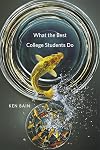
Fifteen years later, I discovered What the Best College Students Do. But this book show more isn’t a sequel in structure or tone. It does something different.
Rather than offering a field guide for students, Bain presents a series of narratives and reflections that describe the mindset of successful learners. It's a rich book, but not one that yields easy implementation.
As an educator, I found the core ideas sound, but their delivery demands patience. It’s less of a manual than the first volume. Still useful, but not immediately actionable.
So, to save you time for this review, you can read my spoilers below. I've provided key points which reflect Bain's core themes, and then tips for students to become good deep learners.
Key Points
The best students:
Lessons for Students
To get the most from a course:
Bottom Line
Bain isn’t a how-to manual. It’s a reflection on what deep, personal, transformative learning looks like. For faculty and advisors, What the Best College Students Do is well worth reading. But for students hoping for direct instruction, or for instructors seeking easily exportable classroom techniques, this book will frustrate you.
In short: worthwhile if you’re invested in pedagogy. Skip it as a student reading assignment. show less
Fifteen years later, I discovered What the Best College Students Do. But this book show more isn’t a sequel in structure or tone. It does something different.
Rather than offering a field guide for students, Bain presents a series of narratives and reflections that describe the mindset of successful learners. It's a rich book, but not one that yields easy implementation.
As an educator, I found the core ideas sound, but their delivery demands patience. It’s less of a manual than the first volume. Still useful, but not immediately actionable.
So, to save you time for this review, you can read my spoilers below. I've provided key points which reflect Bain's core themes, and then tips for students to become good deep learners.
Key Points
The best students:
-
Pursue understanding rather than coverage
They aim to grasp underlying concepts, structures, and relationships. Information matters only insofar as it contributes to understanding something larger. -
Operate from curiosity rather than compliance
Their engagement is driven by interest and meaning, not merely by grades, credentials, or approval. -
Treat intelligence as developmental
Ability is not a fixed trait but something shaped through effort, revision, and sustained engagement. Difficulty is expected, not diagnostic. -
Integrate knowledge across boundaries
They connect ideas across courses and disciplines, seeing learning as cumulative and relational rather than siloed. -
Use failure as information
Mistakes are not indictments but data. They analyze missteps to refine their thinking and strategies. -
Frame learning around questions
They approach coursework as inquiry—seeking problems to explore rather than tasks to complete. -
Monitor and adapt their own learning
They think explicitly about how they learn, adjusting approaches when strategies prove ineffective. -
Engage actively rather than passively
They test ideas, retrieve knowledge, discuss concepts, and apply learning rather than relying on rereading or review alone. -
Anchor learning in personal meaning
They learn most deeply when they can connect material to questions, values, or concerns that matter to them. -
Define success as growth, not performance
Achievement emerges as a byproduct of sustained engagement and understanding, not as the primary objective.
Lessons for Students
To get the most from a course:
-
Identify the animating question of each course
Ask what problem the discipline is trying to solve or what questions still animate it. Let that inquiry guide your attention. -
Read to understand arguments, not just absorb content
Focus on claims, reasoning, and evidence. Ask what the author is trying to persuade you to believe—and why. -
Practice recalling ideas rather than rereading them
Test what you know without notes. Use the struggle to reveal gaps and misconceptions. -
Distribute learning over time
Study in shorter, repeated sessions. Revisit ideas after forgetting has begun. -
Use confusion diagnostically
Treat moments of not understanding as signals pointing to where learning is needed most. -
Externalize your thinking
Talk through ideas, write informally, or teach concepts aloud. Clarity often follows articulation. -
Reflect systematically on feedback and outcomes
After assignments, examine what worked, what didn’t, and how you would revise your approach. -
Separate evaluation from identity
Grades provide information about performance, not measures of intelligence or worth. -
Keep track of questions, not just answers
Maintain a record of unresolved problems, emerging connections, and evolving understanding. -
Aim for intellectual change, not efficiency
Periodically ask whether a course is altering how you think. That, not speed or polish, is the measure of deep learning.
Bottom Line
Bain isn’t a how-to manual. It’s a reflection on what deep, personal, transformative learning looks like. For faculty and advisors, What the Best College Students Do is well worth reading. But for students hoping for direct instruction, or for instructors seeking easily exportable classroom techniques, this book will frustrate you.
In short: worthwhile if you’re invested in pedagogy. Skip it as a student reading assignment. show less
Isn’t it all about getting people to think?
College costs since I graduated in 1981 have risen twice as fast as medical costs, three times as fast as family incomes and four times as fast as inflation. With average private school costs approaching $40,000 a year and public school costs approaching $20,000 a year, the OECD estimates that the United States spent 2.6% of GDP in 2008 on education, about $370 billion. Given the investment, understanding what the best educators do is show more important.
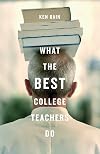
Ken Bain, Director of the Research Academy for University Learning at Montclair State University is attempting to answer that. He has written about it in his 2004 book What the Best College Teachers Do.
The book is based on research done studying (observing, videotaping, interviewing) what the best college teachers do. One could poke holes at the rigor of the study (who defines what “best” is, who identified the “best” teachers, is it anything close to the complete set, and so forth) and claim that the findings are essentially expert opinion. Even so, the book is supremely useful.
The findings are presented along the following lines:
1. Outstanding teachers know their subjects, including the history of their subject, extremely well.
2. Exceptional teachers treat their lectures, discussion sessions and classes as serious intellectual endeavors.
3. The best teachers expect more thinking from their students.
4. The best teachers create environments where learners feel a sense of control over their education, work collaboratively with others, believe their work will be considered fairly.
5. Highly effective teachers tend to reflect a strong trust in students.
6. All the best teachers have a systematic program to assess and continue to improve their own efforts.
In the end I was struck that it all amounts to getting people to think. Of course, this is exactly what businesses with knowledge workers are trying to do, so the question that begs to be asked is this: to what degree are these ideas applicable to business leaders, and to what degree should businesses attempt to replicate the best practices, environment of these college professors? In other words, shouldn’t a business that is trying to get people to think feel like a college classroom where we are trying to get people to think?
Criticism of the book has been along the lines of it being “too idealistic,” “not applicable to the real world,” “only would work with highly motivated students in Ivy League schools.” I’m not worried about all of that. However, one area that I did miss was an emphasis on stories. From my speaking experience, I have learned that stories are a wonderful way to make an emotional connection and convey content that people will remember. Bain cites examples where the best teachers have used stories, like Feynman’s frog in the swimming pool, but he doesn’t specifically call it storytelling, he calls it “good explanations.” show less
College costs since I graduated in 1981 have risen twice as fast as medical costs, three times as fast as family incomes and four times as fast as inflation. With average private school costs approaching $40,000 a year and public school costs approaching $20,000 a year, the OECD estimates that the United States spent 2.6% of GDP in 2008 on education, about $370 billion. Given the investment, understanding what the best educators do is show more important.
Ken Bain, Director of the Research Academy for University Learning at Montclair State University is attempting to answer that. He has written about it in his 2004 book What the Best College Teachers Do.
The book is based on research done studying (observing, videotaping, interviewing) what the best college teachers do. One could poke holes at the rigor of the study (who defines what “best” is, who identified the “best” teachers, is it anything close to the complete set, and so forth) and claim that the findings are essentially expert opinion. Even so, the book is supremely useful.
The findings are presented along the following lines:
1. Outstanding teachers know their subjects, including the history of their subject, extremely well.
2. Exceptional teachers treat their lectures, discussion sessions and classes as serious intellectual endeavors.
3. The best teachers expect more thinking from their students.
4. The best teachers create environments where learners feel a sense of control over their education, work collaboratively with others, believe their work will be considered fairly.
5. Highly effective teachers tend to reflect a strong trust in students.
6. All the best teachers have a systematic program to assess and continue to improve their own efforts.
In the end I was struck that it all amounts to getting people to think. Of course, this is exactly what businesses with knowledge workers are trying to do, so the question that begs to be asked is this: to what degree are these ideas applicable to business leaders, and to what degree should businesses attempt to replicate the best practices, environment of these college professors? In other words, shouldn’t a business that is trying to get people to think feel like a college classroom where we are trying to get people to think?
Criticism of the book has been along the lines of it being “too idealistic,” “not applicable to the real world,” “only would work with highly motivated students in Ivy League schools.” I’m not worried about all of that. However, one area that I did miss was an emphasis on stories. From my speaking experience, I have learned that stories are a wonderful way to make an emotional connection and convey content that people will remember. Bain cites examples where the best teachers have used stories, like Feynman’s frog in the swimming pool, but he doesn’t specifically call it storytelling, he calls it “good explanations.” show less
I suspect that most instructors who will read this book already possess much of the wisdom contained in its pages—and that’s fine. Who doesn’t benefit from positive affirmation of good habits and effective practice? But this volume doesn’t pretend to be a “how-to” manual or the academic equivalent of “Teaching for Dummies.” Instead of providing concrete advice or recipes for good teaching, Bain distills the wisdom and methodology of the most highly effective college show more instructors into a clear and focused analysis of approaches to teaching that yield the best results.
To no one’s surprise, it turns out that an instructor’s beliefs about teaching, learning, and students’ potential have a profound impact on that instructor’s effectiveness. Bain first establishes what he means by outstanding teaching (“helping students learn in ways that made a sustained, substantial, and positive influence on how those students think, act, and feel”). It’s important to note the three dimensions of learning alluded to here—thought, behavior, and affect. All aspects are essential for meaningful teaching and learning.
Bain then discusses, in lucid and enlightening detail, how the best instructors prepare, what they expect of their students, how they teach, how they interact with students, and how they assess their students and themselves. Both beginning teachers and veterans will benefit from his analysis. And those readers who are not teachers will come away with an appreciation for the complexity of the profession, which is part art, part craft, and part science.
Highly recommended. show less
To no one’s surprise, it turns out that an instructor’s beliefs about teaching, learning, and students’ potential have a profound impact on that instructor’s effectiveness. Bain first establishes what he means by outstanding teaching (“helping students learn in ways that made a sustained, substantial, and positive influence on how those students think, act, and feel”). It’s important to note the three dimensions of learning alluded to here—thought, behavior, and affect. All aspects are essential for meaningful teaching and learning.
Bain then discusses, in lucid and enlightening detail, how the best instructors prepare, what they expect of their students, how they teach, how they interact with students, and how they assess their students and themselves. Both beginning teachers and veterans will benefit from his analysis. And those readers who are not teachers will come away with an appreciation for the complexity of the profession, which is part art, part craft, and part science.
Highly recommended. show less
The author of the best-selling book "What the Best College Teachers Do" is back with more humane, doable, and inspiring help, this time for students who want to get the most out of college--and every other educational enterprise, too.
The first thing they should do? Think beyond the transcript. The creative, successful people profiled in this book--college graduates who went on to change the world we live in--aimed higher than straight A's. They used their four years to cultivate habits of show more thought that would enable them to grow and adapt throughout their lives.
Combining academic research on learning and motivation with insights drawn from interviews with people who have won Nobel Prizes, Emmys, fame, or the admiration of people in their field, Ken Bain identifies the key attitudes that distinguished the best college students from their peers. These individuals started out with the belief that intelligence and ability are expandable, not fixed. This led them to make connections across disciplines, to develop a "meta-cognitive" understanding of their own ways of thinking, and to find ways to negotiate ill-structured problems rather than simply looking for right answers. Intrinsically motivated by their own sense of purpose, they were not demoralized by failure nor overly impressed with conventional notions of success. These movers and shakers didn't achieve success by making success their goal. For them, it was a byproduct of following their intellectual curiosity, solving useful problems, and taking risks in order to learn and grow. show less
The first thing they should do? Think beyond the transcript. The creative, successful people profiled in this book--college graduates who went on to change the world we live in--aimed higher than straight A's. They used their four years to cultivate habits of show more thought that would enable them to grow and adapt throughout their lives.
Combining academic research on learning and motivation with insights drawn from interviews with people who have won Nobel Prizes, Emmys, fame, or the admiration of people in their field, Ken Bain identifies the key attitudes that distinguished the best college students from their peers. These individuals started out with the belief that intelligence and ability are expandable, not fixed. This led them to make connections across disciplines, to develop a "meta-cognitive" understanding of their own ways of thinking, and to find ways to negotiate ill-structured problems rather than simply looking for right answers. Intrinsically motivated by their own sense of purpose, they were not demoralized by failure nor overly impressed with conventional notions of success. These movers and shakers didn't achieve success by making success their goal. For them, it was a byproduct of following their intellectual curiosity, solving useful problems, and taking risks in order to learn and grow. show less
Lists
Awards

You May Also Like


Statistics
- Works
- 7
- Members
- 1,421
- Popularity
- #18,108
- Rating
- 3.9
- Reviews
- 20
- ISBNs
- 30
- Languages
- 5