
Sebastian Edwards (1)
Author of American Default: The Untold Story of FDR, the Supreme Court, and the Battle Over Gold
For other authors named Sebastian Edwards, see the disambiguation page.
Works by Sebastian Edwards
American Default: The Untold Story of FDR, the Supreme Court, and the Battle Over Gold (2018) 46 copies, 2 reviews
Crisis and Reform in Latin America: From Despair to Hope (A World Bank Publication) (1995) 19 copies
Financial Markets Volatility and Performance in Emerging Markets (National Bureau of Economic Research Conference Report) (2008) 10 copies
Preventing Currency Crises in Emerging Markets (National Bureau of Economic Research Conference Report) (2002) 7 copies
Real Exchange Rates, Devaluation, and Adjustment: Exchange Rate Policy in Developing Countries (1989) 6 copies
Capital Flows and the Emerging Economies: Theory, Evidence, and Controversies (National Bureau of Economic Research Conference Report) (2000) 5 copies
Economic Adjustment and Exchange Rates in Developing Countries (National Bureau of Economic Research Conference Report) (1986) 5 copies
Tagged
Common Knowledge
- Gender
- male
Members
Reviews
American Default: The Untold Story of FDR, the Supreme Court, and the Battle over Gold by Sebastian Edwards
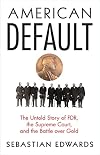
As the subtitle correctly indicates, this is "the untold story of FDR, the Supreme Court and the battle over gold." Prior to WW I, almost all advanced countries were on the gold standard and their currencies traded at a fixed parity to gold. Many countries suspended the gold standard during WW I, and the return to the gold standard after the war was disrupted by changes wrought by the war, debt structures, and ultimately the Great Depression.
The book highlights the world FDR found upon show more election. The book indicates that frankly, he had no choice but to leave the gold standard. Getting off the gold standard was easier said than done. The U.S. Constitution has extensive provisions limiting the ability of the government to modify contractual obligations, including its own. The book discusses the legal struggle as well as the ideological and financial issues. This material is not well known or often discussed.
Some of the other reviewers would have liked more analysis of the Supreme Court decisions of February 18, 1935. I agree with the author that the pair of decisions was result-driven rather than constitutionally driven. The author compares the decision to Marbury v. Madison, another necessity-based Court decision. Both have had profound consequences, with almost non-existent basis or foundation in law.
If someone wants to read a "different" book that is important, this is definitely the book to read. show less
The book highlights the world FDR found upon show more election. The book indicates that frankly, he had no choice but to leave the gold standard. Getting off the gold standard was easier said than done. The U.S. Constitution has extensive provisions limiting the ability of the government to modify contractual obligations, including its own. The book discusses the legal struggle as well as the ideological and financial issues. This material is not well known or often discussed.
Some of the other reviewers would have liked more analysis of the Supreme Court decisions of February 18, 1935. I agree with the author that the pair of decisions was result-driven rather than constitutionally driven. The author compares the decision to Marbury v. Madison, another necessity-based Court decision. Both have had profound consequences, with almost non-existent basis or foundation in law.
If someone wants to read a "different" book that is important, this is definitely the book to read. show less
American Default: The Untold Story of FDR, the Supreme Court, and the Battle over Gold by Sebastian Edwards

In 1935 America defaulted on its debts. Not default in the sense of not paying its obligations, but default in not paying per the terms of the obligation.
When FDR removed the US from the gold standard, and devalued the dollar from about $20 per ounce to $35 per ounce there was another problem, the gold clause. Many contracts, including private financial obligations and government debt, had gold clauses that called for payment in gold or dollars equivalent to the $/gold rate of $20/ounce. show more Abandoning the gold standard required eliminating the gold clause.
Of course, holders of debt sued and four cases wound up at the Supreme Court. Regarding private debts, the court ruled the Congress had the ability to declare what was money so debt holders were out of luck. Regarding the government debt the Court pulled a Marbury v Madison, ruling the government couldn’t pay in depreciated Dollars, but since purchasing power fell as much as prices, there was no damage.
It is a fascinating case in US history, well told by Edwards and the rulings remind me of McDougall’s notion that Americans, when push comes to shove, are more practical than idealistic and will accept violating laws and norms willingly as long as the outcome is beneficial. show less
When FDR removed the US from the gold standard, and devalued the dollar from about $20 per ounce to $35 per ounce there was another problem, the gold clause. Many contracts, including private financial obligations and government debt, had gold clauses that called for payment in gold or dollars equivalent to the $/gold rate of $20/ounce. show more Abandoning the gold standard required eliminating the gold clause.
Of course, holders of debt sued and four cases wound up at the Supreme Court. Regarding private debts, the court ruled the Congress had the ability to declare what was money so debt holders were out of luck. Regarding the government debt the Court pulled a Marbury v Madison, ruling the government couldn’t pay in depreciated Dollars, but since purchasing power fell as much as prices, there was no damage.
It is a fascinating case in US history, well told by Edwards and the rulings remind me of McDougall’s notion that Americans, when push comes to shove, are more practical than idealistic and will accept violating laws and norms willingly as long as the outcome is beneficial. show less

Awards

You May Also Like


Statistics
- Works
- 24
- Members
- 239
- Popularity
- #94,924
- Rating
- 3.8
- Reviews
- 3
- ISBNs
- 63
- Languages
- 2