

Hiroaki Samura
Author of Blade of the Immortal, Book 01: Blood of a Thousand
About the Author
Series
Works by Hiroaki Samura
La espada del inmortal 17 / The Blade of the Immortal (Seinen Manga) (Spanish Edition) (2005) 2 copies
L'Immortale, vol. 5 1 copy
L'Immortale, vol. 7 1 copy
L'Immortale, Vol. 8 1 copy
L'Immortale, vol. 6 1 copy
L'Immortale, vol. 11 1 copy
Blade of the Immortal 14 1 copy
Miecz nieśmiertelnego. 2 1 copy
L'Immortale, vol. 15 1 copy
L'immortale 2 1 copy
Wave, Listen to Me! 11 1 copy
BLADE A LÂMINA DO IMORTAL 1 copy
L'Immortale, Vol. 12 1 copy
L'Immortale, vol. 17 1 copy
L'Immortale, Vol. 20 1 copy
L'Immortale, vol. 22 1 copy
L'Immortale, vol. 23 1 copy
L'Immortale, vol. 24 1 copy
L'Immortale, vol. 28 1 copy
L'Immortale, Vol. 29 1 copy
L'Immortale, vol. 30 1 copy
Miecz nieśmiertelnego. 1 1 copy
Blade of the immortal # 111 1 copy
Blade of the immortal # 123 1 copy
Blade of the immortal # 122 1 copy
Blade of the immortal # 121 1 copy
Blade of the immortal # 120 1 copy
Blade of the immortal # 119 1 copy
Blade of the immortal # 118 1 copy
Blade of the immortal # 117 1 copy
Blade of the immortal # 116 1 copy
Blade of the immortal # 115 1 copy
Blade of the immortal # 114 1 copy
Blade of the immortal # 113 1 copy
Blade of the immortal # 112 1 copy
Blade of the immortal # 109 1 copy
Blade of the immortal # 125 1 copy
Blade of the immortal # 108 1 copy
Blade of the immortal # 107 1 copy
Blade of the immortal # 106 1 copy
Blade of the immortal # 105 1 copy
Blade of the immortal # 104 1 copy
Blade of the immortal # 103 1 copy
Blade of the immortal # 102 1 copy
Blade of the immortal # 101 1 copy
Blade of the immortal # 100 1 copy
Blade of the immortal # 99 1 copy
Blade of the immortal # 110 1 copy
Blade of the Immortal #59 1 copy
Blade of the immortal # 124 1 copy
Blade of the immortal # 126 1 copy
Blade of the immortal # 127 1 copy
Blade of the Immortal 45 1 copy
Blade of the immortal # 131 1 copy
Blade of the immortal # 130 1 copy
Blade of the immortal # 129 1 copy
Blade of the immortal # 128 1 copy
Bloodharley's Coach 1 copy
Tagged
Common Knowledge
- Canonical name
- Samura, Hiroaki
- Other names
- てあし, 竹易
- Birthdate
- 1970-02-17
- Gender
- male
- Relationships
- 星, 岡村 (wife)
- Nationality
- Japan
- Associated Place (for map)
- Japan
Members
Reviews

(this reviewer received an advance copy of the book through NetGalley)
It doesn't take long for an attuned reader to guess where Hiroaki Samura's Soviet historical drama is headed: anyone familiar with the story of Rasputin will immediately know that something's up. This dark but hopeful tale, however, still holds onto some mystery till the very end. Like many other young Russians of their generation, Bielka and Schenok are dealing with the fallout of the Revolution that turned Russian show more society upside down. This unusual pair seems to have more than a desire to survive, though - Bielka, a young disabled woman who uses a wheelchair, and Schenok, her companion, travel across the new Soviet state in search of a lost treasure. The story does not shy away from dark themes, from Bielka's sexual servitude to the gulags of Soviet Russia. Snegurochka of the Spring Breeze is about more than the horrors of authoritarianism, though - it's about the fierce devotion between two young people and their resolve to free themselves of the burdens placed on them by their forebears. While this story is not for the faint of heart, it artfully reimagines a chapter of the Russian Revolution that has been told time and again through yet another new lens. show less
It doesn't take long for an attuned reader to guess where Hiroaki Samura's Soviet historical drama is headed: anyone familiar with the story of Rasputin will immediately know that something's up. This dark but hopeful tale, however, still holds onto some mystery till the very end. Like many other young Russians of their generation, Bielka and Schenok are dealing with the fallout of the Revolution that turned Russian show more society upside down. This unusual pair seems to have more than a desire to survive, though - Bielka, a young disabled woman who uses a wheelchair, and Schenok, her companion, travel across the new Soviet state in search of a lost treasure. The story does not shy away from dark themes, from Bielka's sexual servitude to the gulags of Soviet Russia. Snegurochka of the Spring Breeze is about more than the horrors of authoritarianism, though - it's about the fierce devotion between two young people and their resolve to free themselves of the burdens placed on them by their forebears. While this story is not for the faint of heart, it artfully reimagines a chapter of the Russian Revolution that has been told time and again through yet another new lens. show less
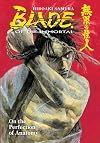
On the Perfection of Anatomy is the seventeenth volume of Hiroaki Samura’s manga series Blade of the Immortal as published in English. Although the Japanese and English volumes collect slightly differently chapters, On the Perfection of Anatomy is most closely equivalent to the sixteenth volume of the Japanese release of the series, published in 2004. (The Japanese volume includes one additional chapter.) On the Perfection of Anatomy was released by Dark Horse in 2007. Blade of the show more Immortal has won several awards and honors, including a Japan Media Arts Award in 1998 and an Eisner Award in 2000. The series is also one my personal favorites. There were some fairly dramatic developments in the previous volume, Shortcut, so I was particularly interested in seeing where Samura would take things in On the Perfection of Anatomy.
Manji’s life has gotten more complicated ever since he became a near immortal. Even more so now that he has been captured and imprisoned in a hidden underground cell where he is the primary subject of an investigation into immortality. Manji and other felons are being experimented upon in an effort to transfer Manji’s bizarre regenerative powers to another person. Initially, the shogunate’s doctor Mozen was in charge of the investigation, but he was removed from the case after he was unable to produce results. Now the responsibility of finding the secrets behind Manji’s immortality has fallen to Ayame Burando, a young doctor who, due to his pursuit of Western medicine, is also considered a criminal. Burando sees the investigation not only as a way to redeem himself, but as an opportunity to advance the state of Japanese medicine.
Most of On the Perfection of Anatomy is devoted to Burando and the experiments he is conducting in the prison. Burando was first introduced in the previous volume, Shortcut. He goes through some very significant changes as a person by the end of On the Perfection of Anatomy. Burando was originally so devoted to advancing his own knowledge of medicine that he was willing to risk his own life. He tried to leave Japan in order to study Western medicine, inviting execution should he be caught or try to return. Ultimately he was found out which is how he became involved with the immortality experiments. At first things go astonishing well, but then Burando is confronted by failure after failure. Faced with this, his struggle as he tries to justify himself as both a scientist and doctor changes him.
Some of the experiments carried out in Shortcut and On the Perfection of Anatomy and their results are truly horrifying. Samura's artwork captures the grotesqueness, terror, and despair as bodies fall apart and waste away. The experiments are not only physically damaging, they also take a huge mental toll on most of the people who are even remotely involved with them. Of course, there are also those who don’t appear to be affected much at all, which is a little terrifying in its own right. On the Perfection of Anatomy doesn’t actually advance the plot of Blade of the Immortal much, but it is a critical volume in the characters’ development, particularly Burando’s evolution. And, as usual, I’m very interested in reading the next volume in the series, The Sparrow Net.
Experiments in Manga show less
Manji’s life has gotten more complicated ever since he became a near immortal. Even more so now that he has been captured and imprisoned in a hidden underground cell where he is the primary subject of an investigation into immortality. Manji and other felons are being experimented upon in an effort to transfer Manji’s bizarre regenerative powers to another person. Initially, the shogunate’s doctor Mozen was in charge of the investigation, but he was removed from the case after he was unable to produce results. Now the responsibility of finding the secrets behind Manji’s immortality has fallen to Ayame Burando, a young doctor who, due to his pursuit of Western medicine, is also considered a criminal. Burando sees the investigation not only as a way to redeem himself, but as an opportunity to advance the state of Japanese medicine.
Most of On the Perfection of Anatomy is devoted to Burando and the experiments he is conducting in the prison. Burando was first introduced in the previous volume, Shortcut. He goes through some very significant changes as a person by the end of On the Perfection of Anatomy. Burando was originally so devoted to advancing his own knowledge of medicine that he was willing to risk his own life. He tried to leave Japan in order to study Western medicine, inviting execution should he be caught or try to return. Ultimately he was found out which is how he became involved with the immortality experiments. At first things go astonishing well, but then Burando is confronted by failure after failure. Faced with this, his struggle as he tries to justify himself as both a scientist and doctor changes him.
Some of the experiments carried out in Shortcut and On the Perfection of Anatomy and their results are truly horrifying. Samura's artwork captures the grotesqueness, terror, and despair as bodies fall apart and waste away. The experiments are not only physically damaging, they also take a huge mental toll on most of the people who are even remotely involved with them. Of course, there are also those who don’t appear to be affected much at all, which is a little terrifying in its own right. On the Perfection of Anatomy doesn’t actually advance the plot of Blade of the Immortal much, but it is a critical volume in the characters’ development, particularly Burando’s evolution. And, as usual, I’m very interested in reading the next volume in the series, The Sparrow Net.
Experiments in Manga show less

Shortcut is the sixteenth volume in Dark Horse's release of Hiroaki Samura's manga series Blade of the Immortal. Due to the differences between the Japanese and English releases of the series, Shortcut is actually equivalent to the fifteenth volume published in Japan in 2004. Shortcut itself was released in 2006. Blade of the Immortal has won several awards, including a Japan Media Arts Award and and Eisner Award for Best U.S. Edition of International Material. I myself have been quite fond show more of Blade of the Immortal since its beginning. I enjoy the series' morally ambiguous characters, anachronistic style, and dynamic artwork. Shortcut picks up the story immediately where the previous volume, Trickster, leaves off. Things weren't looking particularly good for Manji in Trickster, so I definitely wanted to see how the events in Shortcut would unfold.
Rin hasn't seen her bodyguard Manji since he was invited into the residence of Habaki Kagimura, the leader of the shogunate's banshū samurai as well as the head of the Mugai-ryū assassins. Fearing the worst, Rin does her best to try to find him but she is unable to make much progress. She is right to worry. Manji's disappearance has nothing to do with being forced to join the Mugai-ryū. Instead, Kagimura is very interested in Manji and his apparent immortality, something that Kagimura has personally been witness to. On top of Manji being missing, Rin suddenly has a couple of uninvited house guests to deal with, too. Isaku Yasonokami and Dōa Yoshino make a strange pair--he's a hulk of a man while she's a petite young woman who orders him around. Little does Rin know that she is helping to hide two members of the Ittō-ryū, the group responsible for the death of her parents.
I find Isaku and Dōa to be very intriguing characters. Not much is really known yet about either of them. Except for their apparent devotion to each other and their association with the Ittō-ryū, they largely remain a mystery. From the far northern reaches of Japan, they are out of place in Edo society. I'm curious to find out how they became involved with the Ittō-ryū, but it does go to show how accepting the sword school is of outsiders. This is in direct contrast to the majority of Japanese society during this time period. The shogunate's isolationist policies made it extremely dangerous for anyone to even leave the country and hierarchical social classes were rigidly enforced. In part, this is what the Ittō-ryū is fighting against, so it shouldn't be too surprising that social outcasts and criminals are to be counted among their number.
On the opposite end of the spectrum of power is Kagimura. He is very in control of himself and those around him, using his position as the bangashira to his advantage. Blade of the Immortal has shown Kagimura to be cunning and manipulative and not above using unsavory methods to reach his goals. This is very unfortunate for Manji in Shortcut. Simply put, being immortal can really suck. This certainly isn't new to Manji who has repeatedly, and literally, been hacked to pieces in the past. But Shortcut is the first time in Blade of the Immortal that the extent of his immortality has deliberately, thoroughly, and methodically been put to the test. If things weren't looking good for Manji in Trickster, they're looking even worse for him in Shortcut. What else is in store for Manji will be revealed in the next volume, On the Perfection of Anatomy.
Experiments in Manga show less
Rin hasn't seen her bodyguard Manji since he was invited into the residence of Habaki Kagimura, the leader of the shogunate's banshū samurai as well as the head of the Mugai-ryū assassins. Fearing the worst, Rin does her best to try to find him but she is unable to make much progress. She is right to worry. Manji's disappearance has nothing to do with being forced to join the Mugai-ryū. Instead, Kagimura is very interested in Manji and his apparent immortality, something that Kagimura has personally been witness to. On top of Manji being missing, Rin suddenly has a couple of uninvited house guests to deal with, too. Isaku Yasonokami and Dōa Yoshino make a strange pair--he's a hulk of a man while she's a petite young woman who orders him around. Little does Rin know that she is helping to hide two members of the Ittō-ryū, the group responsible for the death of her parents.
I find Isaku and Dōa to be very intriguing characters. Not much is really known yet about either of them. Except for their apparent devotion to each other and their association with the Ittō-ryū, they largely remain a mystery. From the far northern reaches of Japan, they are out of place in Edo society. I'm curious to find out how they became involved with the Ittō-ryū, but it does go to show how accepting the sword school is of outsiders. This is in direct contrast to the majority of Japanese society during this time period. The shogunate's isolationist policies made it extremely dangerous for anyone to even leave the country and hierarchical social classes were rigidly enforced. In part, this is what the Ittō-ryū is fighting against, so it shouldn't be too surprising that social outcasts and criminals are to be counted among their number.
On the opposite end of the spectrum of power is Kagimura. He is very in control of himself and those around him, using his position as the bangashira to his advantage. Blade of the Immortal has shown Kagimura to be cunning and manipulative and not above using unsavory methods to reach his goals. This is very unfortunate for Manji in Shortcut. Simply put, being immortal can really suck. This certainly isn't new to Manji who has repeatedly, and literally, been hacked to pieces in the past. But Shortcut is the first time in Blade of the Immortal that the extent of his immortality has deliberately, thoroughly, and methodically been put to the test. If things weren't looking good for Manji in Trickster, they're looking even worse for him in Shortcut. What else is in store for Manji will be revealed in the next volume, On the Perfection of Anatomy.
Experiments in Manga show less
Whole lot of fridging, but the series is no less potent.
Lists
Awards


You May Also Like


Associated Authors
Statistics
- Works
- 196
- Members
- 6,786
- Popularity
- #3,601
- Rating
- 4.0
- Reviews
- 76
- ISBNs
- 348
- Languages
- 9
- Favorited
- 11