
Frederick S. Perls (1893–1970)
Author of Gestalt Therapy Verbatim
About the Author
Image credit: Friedrich Salomon (Fritz) Perls (1893 – 1970) circa 1923 (Uncredited photograph from Wikipedia. Source: http://gestaltnsk1.narod.ru/photos.htm)
Works by Frederick S. Perls
Gestalt: Terapia Explicada 1 copy
Gestalt therapy verbatim 1 copy
Associated Works
Tagged
Common Knowledge
- Legal name
- Perls, Friedrich Salomon
- Other names
- Perls, Fritz
- Birthdate
- 1893-07-08
- Date of death
- 1970-03-14
- Gender
- male
- Occupations
- psychiatrist
- Organizations
- German Army
South African Army
Esalen Institute - Relationships
- Reich, Wilhelm (supervising analyst)
- Nationality
- Germany
- Birthplace
- Berlin, Germany
- Places of residence
- Berlin, Germany
Chicago, Illinois, USA
New York, New York, USA
Big Sur, California, USA
Lake Cowichan, Vancouver Island, Canada - Place of death
- Chicago, Illinois, USA
- Associated Place (for map)
- USA
Members
Reviews

I ma amazed that there has not been a review of Perls' major work on his own life - although its not one to be too proud of - and its place in Gestalt Therapy literature is assured. It's a must read for those who know nothing aout Perls. But be warned, he was one of the great b*** artists of the 20th century and a lot of what is in this book is vitriolic and amazingly self centered, which is probably why its so much fun to read.

Gestalt Therapy In A Nutshell -- As Seen By Its Founder and Most Flamboyant Practitioner
From Fritz Perls himself comes this deceptively "simple," breezy, and brashly personal account in later life on how his work and thinking developed over time.
He sketches a broad-stroke portrait from his childhood in Berlin, Bar Mitzvah and puberty crisis ("I am a very bad boy and cause my parents plenty of trouble"), on through his military service in World War I, into the period that followed in show more Frankfurt during the time when the Institute for Social Research was being founded (sharing the same intellectual ethos of the neurological clinic in which Gestalt psychology was begun in earnest), up to his actual break in both theory and practice with Freud's traditional psychoanalytic method and circle, followed by his own subsequent individual development of Gestalt Therapy, starting in South Africa and then later carrying it to the United States, eventually landing him at Esalen Institute in Big Sur, California -- which became the closest thing to a spiritual home he ever found.
Part autobiography, part theoretical elaboration and summing up, part off-the-cuff philosophizing and qualifying commentary, part painful personal admission, true confession, and a clearing of the air, part playful peacock parading and pleasurable pontificating of an iconic figure and public paragon, this work is woefully misunderstood and seriously distorted if it is either taken too lightly or made too much of. It must be seen in the context of all his other writings and serious work with clients, workshops led and lectures given, and ever-animated and sometimes slightly animalistic encounters (and he would be the first to admit when this was true -- as, indeed, he does in these pages) -- with the actual acquaintances, close friends, and yes, the enemies too, that made up the unusually rambunctious life that was his.
A member of my doctoral committee, Dr. Vincent F. O'Connell, then also teaching on the Psychiatric Faculty of the Medical School at the University of Florida, had heard Perls deliver the very first lecture on Gestalt Therapy ever given in the United States (attended by three people!). The two became close friends and collaborating colleagues from that point on until Perls's eventual death, March 14, 1970. "Vinnie" is referred to by Perls at a few places in this book. Among the many elaborations he shared with me about Perls's specific views on select topics -- which were always original, provocative, and enlightening -- was an intriguing one about Perls's having once written a paper entitled, "Interpretation is a hostile act." He was given to making such remarks. When working with the Human Development Institute in Atlanta, we filmed both Perls and Eric Berne in action before the American Psychological Association's convention in San Francisco, near the end of their lives. Lamentably, these rich and revealing films on the two colorful figures were both withdrawn from circulation as part of a legal dispute and are no longer available for public or even private viewing. -G.R.
(Cover painting: One of Perls's own entitled "Eyeglass in Gaza." If you look closely in the top right corner of this painting, you can plainly make out the famous face of Sigmund Freud. -G.R.) show less
From Fritz Perls himself comes this deceptively "simple," breezy, and brashly personal account in later life on how his work and thinking developed over time.
He sketches a broad-stroke portrait from his childhood in Berlin, Bar Mitzvah and puberty crisis ("I am a very bad boy and cause my parents plenty of trouble"), on through his military service in World War I, into the period that followed in show more Frankfurt during the time when the Institute for Social Research was being founded (sharing the same intellectual ethos of the neurological clinic in which Gestalt psychology was begun in earnest), up to his actual break in both theory and practice with Freud's traditional psychoanalytic method and circle, followed by his own subsequent individual development of Gestalt Therapy, starting in South Africa and then later carrying it to the United States, eventually landing him at Esalen Institute in Big Sur, California -- which became the closest thing to a spiritual home he ever found.
Part autobiography, part theoretical elaboration and summing up, part off-the-cuff philosophizing and qualifying commentary, part painful personal admission, true confession, and a clearing of the air, part playful peacock parading and pleasurable pontificating of an iconic figure and public paragon, this work is woefully misunderstood and seriously distorted if it is either taken too lightly or made too much of. It must be seen in the context of all his other writings and serious work with clients, workshops led and lectures given, and ever-animated and sometimes slightly animalistic encounters (and he would be the first to admit when this was true -- as, indeed, he does in these pages) -- with the actual acquaintances, close friends, and yes, the enemies too, that made up the unusually rambunctious life that was his.
A member of my doctoral committee, Dr. Vincent F. O'Connell, then also teaching on the Psychiatric Faculty of the Medical School at the University of Florida, had heard Perls deliver the very first lecture on Gestalt Therapy ever given in the United States (attended by three people!). The two became close friends and collaborating colleagues from that point on until Perls's eventual death, March 14, 1970. "Vinnie" is referred to by Perls at a few places in this book. Among the many elaborations he shared with me about Perls's specific views on select topics -- which were always original, provocative, and enlightening -- was an intriguing one about Perls's having once written a paper entitled, "Interpretation is a hostile act." He was given to making such remarks. When working with the Human Development Institute in Atlanta, we filmed both Perls and Eric Berne in action before the American Psychological Association's convention in San Francisco, near the end of their lives. Lamentably, these rich and revealing films on the two colorful figures were both withdrawn from circulation as part of a legal dispute and are no longer available for public or even private viewing. -G.R.
(Cover painting: One of Perls's own entitled "Eyeglass in Gaza." If you look closely in the top right corner of this painting, you can plainly make out the famous face of Sigmund Freud. -G.R.) show less
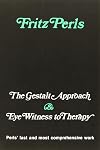
'The Gestalt Approach' and 'Eye Witness to Therapy' can be read together as one entity and also as two separate works. This book is an exploration of a somewhat new approach to the entire subject of human behavior- both in its actuality and its potentiality. It is written from the belief that man can live a fuller, richer life than most of us now do. It is written from the conviction that man has not yet even begun to discover the potential of energy and enthusiasm that lies in him. The book show more endeavors to bring together a theory and a practical application of that theory of the problems of daily life and to the techniques of psychotherapy. The theory itself is grounded in experience and observation; it has grown and changed with years of practice and application. -- from Introduction. Source: Publisher
LOC Notes: Two books on which the author was working at the time of his death, published as one. show less
LOC Notes: Two books on which the author was working at the time of his death, published as one. show less
Ego, Hunger and Aggression: The Gestalt Therapy of Sensory Awakening Through Spontaneous Personal Encounter, Fantasy and Contemplation by Frederick S. Perls

A good primer to Gestalt Therapy and a must read for anyone who want to read people .
Lists
You May Also Like


Associated Authors
Statistics
- Works
- 44
- Also by
- 1
- Members
- 1,263
- Popularity
- #20,319
- Rating
- 3.7
- Reviews
- 12
- ISBNs
- 101
- Languages
- 11
- Favorited
- 1