
About the Author
Jonathan Taplin is the director emeritus of the USC Annenberg Innovation Lab and a former tour manager for Bob Dylan and The Band, as well as a film producer for Martin Scorsese and an expert in digital media entertainment. Taplin is a member of the Academy of Motion Picture Arts and Sciences and show more sits on the California Broadband Task Force and Los Angeles mayor Eric Garcetti's Council on Technology and Innovation. show less
Works by Jonathan Taplin
Move Fast and Break Things: How Facebook, Google, and Amazon Cornered Culture and Undermined Democracy (2017) 251 copies, 7 reviews
The End of Reality: How Four Billionaires are Selling a Fantasy Future of the Metaverse, Mars, and Crypto (2023) 64 copies, 4 reviews
Until The End Of The World: Music From The Motion Picture Soundtrack (1991) — Producer — 25 copies, 1 review
Associated Works
Tagged
Common Knowledge
- Gender
- male
Members
Reviews
The End of Reality: How Four Billionaires are Selling a Fantasy Future of the Metaverse, Mars, and Crypto by Jonathan Taplin
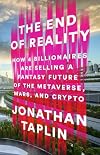
I like to think I help people comprehend complex issues by making them easier to understand, to put things in perspective by distancing myself from the mess, and getting to the bottom of claims that most readers miss. But here is Jonathan Taplin, assembling the big four billionaire Technocrats and putting everything they are and want to do into crystal clear language, backed with their own words and deeds, pulling together facts that get by the average reader, and leaving me in his dust. His show more book The End of Reality is a masterpiece of connecting the fantasy, the fraud, the lies, the ulterior motives and the exceptional greed of the internet’s billionaire class. It will change how readers view the world.
On one level, The End of Reality is a profile of the present day Four Horsemen of the Apocalypse: Elon Musk, Mark Zuckerberg, Marc Andreessen and Peter Thiel. Each is a young billionaire and a major player in cyberspace. This makes for an incredibly rich, character-driven tale that pieces their stories, which everyone knows parts of, into a scandalous whole that is as ugly and offensive as anything in science fiction.
They are all extreme right wing, bordering on fascist, if not way over the line, and all have clear intentions to be even more unbelievably rich by reshaping the world to their own distorted vision. Taplin cites one of Thiel’s heroes, the extremist Murray Rothbard, who in the 1950s, when America was great, said that the task of the New Right was “to break the clock of the New Deal…to repeal the 20th century.” Seventy years later, these four are hard at work on that.
On another level, they all have gigantic lifework projects. Taplin says and proves. “These four projects—the metaverse, crypto currency, human travel to and colonization of distant planets, and transhumanism—are an existential risk to the world in moral, political, and economic terms.” They are sci-fi, fantasy, unworkable and in complete denial of reality. That is what unifies them. Connecting these scattered dots is new territory.
The book is nicely divided into past, present and future, and how each of these Technocrats came to where he is today. Their cookie crumb trail points quite clearly to where they want to go, and it’s never pretty, except for them.
The hypocrisy begins as all four are rabid libertarians, insisting they have bootstrapped themselves and their companies without government aid, and wishing only to have no relationships with government whatsoever. And of course, nothing could be further from the truth. Social media firms for example, got an early and extremely valuable get out of jail free card from government, absolving them from lawsuits over words they published from others. Elon Musk, for all his go-it-alone bravura, has obtained loans, subsidies and grants totaling nearly $16 billion to build his empire, and now he wants trillions from taxpayers for a colony on Mars. Thiel and Andreessen have plowed their money into crypto, which is not doing so well, and they want zero regulation over it so they can continue to manipulate the crypto markets. Thiel in particular is funding high-profile libertarian political candidates who will toe this line in office.
Zuckerberg is betting his company on the metaverse, which the public has almost no interest in. He fully expects and intends for everyone to spend seven hours a day wearing a virtual reality helmet and interacting with others they will never meet, rather than doing the same thing in the real world. The metaverse will function on crypto, of course (which is why Facebook tried to start its own coin), and everything will be available, for a price. Every little thing players see will be an ad from some brand, selling that object or experience. From the tiles on the floor to the shirts in the closet to the app on the phone, everything will have an ad attached, and a price in crypto for immediate delivery in the metaverse. Zuckerberg would like to force players to watch ads all day long, just like in Black Mirror. What such a life would do to a human is of no concern to him; it’s all about the ad revenues. Of the four, Zuckerberg is seen as the “intellectual lightweight” according to Kara Swisher. She says he adopted their libertarian ideals in order to fit in.
Between them they have a couple of trillion dollars of wealth, but won’t use it to solve any problems for humanity. It’s all about insane projects like defeating death – for themselves. All four of them, Taplin says, believe in transhumanism, from biological enhancements, to the singularity, to completely defeating death. They support growing new organs with their own DNA for implanting when they need them in their hundreds, uploading their minds to a computer, freezing their brains until the technology to restore their dead bodies is ready, and endlessly on. In other words, only the superrich need apply. The thought of these four living forever should send shivers up spines worldwide.
Elon Musk has probably pillaged government the most. His NASA and defense contracts typically provide him 30% margin, while the standard defense contractors in the military-industrial complex have managed to get massively rich on half that. He not only depends on government largesse, he rips them off in outrageous bids continually. Despite his rockets exploding and the Biosphere II project proving humans cannot live in an enclosed world, he is pressing ahead with a plan to colonize Mars and abandon the mess here.
Scientists say it is a total waste of time and money. That transporting humans and supplying their life-sustaining needs is unacceptably costly and pointless. We have robots and machines that will do it faster, cheaper, longer, more efficiently and with far less downside and drama.
Rather than spend billions helping the ecosphere here, Musk wants the USA to spend ten trillion dollars for him to send a team of people to start over on Mars, a barren wreck where no civilization can flourish. His proposal to restart civilization there with his crew is flat out wrong, according to economists. They say it would take a hundred million people to do that. Anything less will fail.
In addition to the planet’s surface being uninhabitable because of the constant bombardment of almost totally unfiltered deadly solar winds, Musk is actually proposing to explode nuclear bombs above the surface “every few moments”, to compress the atmosphere and warm the planet. This is precisely why geo-engineering to “save” the Earth must never be allowed. And why Elon Musk must be feared, Or in Jonathan Taplin’s more direct words: ”Musk’s idea of Martian space colonies is insane.”
Musk’s colony will not be a democracy; it will be run by Musk-picked engineers. This is the legacy of his grandfather, Joshua Haldeman, who loathed democracy as inefficient, cumbersome and ineffective. Far better to have a sensible, well-grounded engineer making all the decisions for everybody. It was Haldeman who began Technocracy Inc. in the 1940s. Musk has tweeted his desire to follow through with it, fulfilling his grandfather’s scheme and dream. At least on Mars where he will assume total control.
Thiel seems to be the most dangerous today. Aside from spending tens of millions on each of several extreme Republican candidates, he personally funded a lawsuit to bankrupt Gawker, which outed him as gay before he was ready. He doesn’t deny it, so there was no libel, but Thiel decided on the death penalty anyway. He is on record saying Apartheid South Africa was an economically sound system and that the moral issues of denying native blacks their civil rights were irrelevant. He wants to go back to the era of city-states defended by private militias, and do away with state and national government. And of course, his main vehicle, Palantir, thrives on government contracts, basically spying on citizens.
He and Musk were in Paypal together, and seem to fight a lot. But then, these four are so single-minded, it is hard not to see them fighting, among themselves and with everyone who dares have another vision. But still, money comes first, so Thiel and Andreessen will still finance Musk if need be, for example buying out twitter on a whim, to promote right wing politicians and speech and restore Trump’s controversial account to him.
Marc Andreessen comes off as a know-it-all who cannot suffer fools, and pretty much everyone else falls into that category. He appears to be distant, arrogant and insistent. He knows how to make money, and those with their own ideas are just in the way.
Taplin explains how these four Technocrats fit into American society, where fantasy has become a way of life: “Fifty million Republicans,” he says “are living the fantasy of a stolen election. And early adopters are spending six hours wearing a virtual reality headset trying to navigate the metaverse. In this context, a colony on Mars and living to 200 seems a bit more plausible.”
Taplin explains precisely why crypto won’t ever be mainstream. It is far too slow to complete transactions, taking hours rather than milliseconds. It is expensive, consuming vast resources to accomplish what fiat money does for little or nothing. It is not at all private, as everyone can see transactions on the blockchain. It has proven not to be a stable store of wealth. And it is totally manipulated by the likes of Thiel and Andreessen and their minions, who will talk up a crypto coin and sell into the boomlet in volume (aka pump and dump). Musk is rightly infamous for talking up dogecoin on the internet and national television, too. Taplin cites a group of computer scientists who told Congress: “It is a technology that is not built for purpose and will remain forever unsuitable as a foundation for large-scale economic activity.” But the richest people in the world are hyping it daily. It actively destroys wealth, Taplin says, particularly among Blacks who fell for celebrity shills like LeBron James, and lost their life savings trying to get rich quick. But it is the cornerstone of Thiel and Andreessen’s formula for trillionairedom, and they and their lawyers will continue to actively push it.
I love the way Taplin has connected these seemingly disparate projects from these seemingly individual men. The web of connections he makes is not intuitive, but it is as busy as the neurons in a brain. It makes for a book that is very hard to put down, with revelation after revelation, connection after connection, and aha! moments galore.
The bottom line is that these are all very dangerous men, Taplin says, because not only are they richest people in the world, but they control the major global means of communication, in the form of Facebook, Instagram, WhatsApp, Twitter, and for hardware, Starlink. If their projects were not mad enough, there’s the aspect that they solve absolutely no human problem. These are purely selfish endeavors meant solely to enrich them individually. The stunning hubris of outrageous inequality is fully on display here. If a revolution is coming, these four will share a good portion of the blame.
David Wineberg show less
On one level, The End of Reality is a profile of the present day Four Horsemen of the Apocalypse: Elon Musk, Mark Zuckerberg, Marc Andreessen and Peter Thiel. Each is a young billionaire and a major player in cyberspace. This makes for an incredibly rich, character-driven tale that pieces their stories, which everyone knows parts of, into a scandalous whole that is as ugly and offensive as anything in science fiction.
They are all extreme right wing, bordering on fascist, if not way over the line, and all have clear intentions to be even more unbelievably rich by reshaping the world to their own distorted vision. Taplin cites one of Thiel’s heroes, the extremist Murray Rothbard, who in the 1950s, when America was great, said that the task of the New Right was “to break the clock of the New Deal…to repeal the 20th century.” Seventy years later, these four are hard at work on that.
On another level, they all have gigantic lifework projects. Taplin says and proves. “These four projects—the metaverse, crypto currency, human travel to and colonization of distant planets, and transhumanism—are an existential risk to the world in moral, political, and economic terms.” They are sci-fi, fantasy, unworkable and in complete denial of reality. That is what unifies them. Connecting these scattered dots is new territory.
The book is nicely divided into past, present and future, and how each of these Technocrats came to where he is today. Their cookie crumb trail points quite clearly to where they want to go, and it’s never pretty, except for them.
The hypocrisy begins as all four are rabid libertarians, insisting they have bootstrapped themselves and their companies without government aid, and wishing only to have no relationships with government whatsoever. And of course, nothing could be further from the truth. Social media firms for example, got an early and extremely valuable get out of jail free card from government, absolving them from lawsuits over words they published from others. Elon Musk, for all his go-it-alone bravura, has obtained loans, subsidies and grants totaling nearly $16 billion to build his empire, and now he wants trillions from taxpayers for a colony on Mars. Thiel and Andreessen have plowed their money into crypto, which is not doing so well, and they want zero regulation over it so they can continue to manipulate the crypto markets. Thiel in particular is funding high-profile libertarian political candidates who will toe this line in office.
Zuckerberg is betting his company on the metaverse, which the public has almost no interest in. He fully expects and intends for everyone to spend seven hours a day wearing a virtual reality helmet and interacting with others they will never meet, rather than doing the same thing in the real world. The metaverse will function on crypto, of course (which is why Facebook tried to start its own coin), and everything will be available, for a price. Every little thing players see will be an ad from some brand, selling that object or experience. From the tiles on the floor to the shirts in the closet to the app on the phone, everything will have an ad attached, and a price in crypto for immediate delivery in the metaverse. Zuckerberg would like to force players to watch ads all day long, just like in Black Mirror. What such a life would do to a human is of no concern to him; it’s all about the ad revenues. Of the four, Zuckerberg is seen as the “intellectual lightweight” according to Kara Swisher. She says he adopted their libertarian ideals in order to fit in.
Between them they have a couple of trillion dollars of wealth, but won’t use it to solve any problems for humanity. It’s all about insane projects like defeating death – for themselves. All four of them, Taplin says, believe in transhumanism, from biological enhancements, to the singularity, to completely defeating death. They support growing new organs with their own DNA for implanting when they need them in their hundreds, uploading their minds to a computer, freezing their brains until the technology to restore their dead bodies is ready, and endlessly on. In other words, only the superrich need apply. The thought of these four living forever should send shivers up spines worldwide.
Elon Musk has probably pillaged government the most. His NASA and defense contracts typically provide him 30% margin, while the standard defense contractors in the military-industrial complex have managed to get massively rich on half that. He not only depends on government largesse, he rips them off in outrageous bids continually. Despite his rockets exploding and the Biosphere II project proving humans cannot live in an enclosed world, he is pressing ahead with a plan to colonize Mars and abandon the mess here.
Scientists say it is a total waste of time and money. That transporting humans and supplying their life-sustaining needs is unacceptably costly and pointless. We have robots and machines that will do it faster, cheaper, longer, more efficiently and with far less downside and drama.
Rather than spend billions helping the ecosphere here, Musk wants the USA to spend ten trillion dollars for him to send a team of people to start over on Mars, a barren wreck where no civilization can flourish. His proposal to restart civilization there with his crew is flat out wrong, according to economists. They say it would take a hundred million people to do that. Anything less will fail.
In addition to the planet’s surface being uninhabitable because of the constant bombardment of almost totally unfiltered deadly solar winds, Musk is actually proposing to explode nuclear bombs above the surface “every few moments”, to compress the atmosphere and warm the planet. This is precisely why geo-engineering to “save” the Earth must never be allowed. And why Elon Musk must be feared, Or in Jonathan Taplin’s more direct words: ”Musk’s idea of Martian space colonies is insane.”
Musk’s colony will not be a democracy; it will be run by Musk-picked engineers. This is the legacy of his grandfather, Joshua Haldeman, who loathed democracy as inefficient, cumbersome and ineffective. Far better to have a sensible, well-grounded engineer making all the decisions for everybody. It was Haldeman who began Technocracy Inc. in the 1940s. Musk has tweeted his desire to follow through with it, fulfilling his grandfather’s scheme and dream. At least on Mars where he will assume total control.
Thiel seems to be the most dangerous today. Aside from spending tens of millions on each of several extreme Republican candidates, he personally funded a lawsuit to bankrupt Gawker, which outed him as gay before he was ready. He doesn’t deny it, so there was no libel, but Thiel decided on the death penalty anyway. He is on record saying Apartheid South Africa was an economically sound system and that the moral issues of denying native blacks their civil rights were irrelevant. He wants to go back to the era of city-states defended by private militias, and do away with state and national government. And of course, his main vehicle, Palantir, thrives on government contracts, basically spying on citizens.
He and Musk were in Paypal together, and seem to fight a lot. But then, these four are so single-minded, it is hard not to see them fighting, among themselves and with everyone who dares have another vision. But still, money comes first, so Thiel and Andreessen will still finance Musk if need be, for example buying out twitter on a whim, to promote right wing politicians and speech and restore Trump’s controversial account to him.
Marc Andreessen comes off as a know-it-all who cannot suffer fools, and pretty much everyone else falls into that category. He appears to be distant, arrogant and insistent. He knows how to make money, and those with their own ideas are just in the way.
Taplin explains how these four Technocrats fit into American society, where fantasy has become a way of life: “Fifty million Republicans,” he says “are living the fantasy of a stolen election. And early adopters are spending six hours wearing a virtual reality headset trying to navigate the metaverse. In this context, a colony on Mars and living to 200 seems a bit more plausible.”
Taplin explains precisely why crypto won’t ever be mainstream. It is far too slow to complete transactions, taking hours rather than milliseconds. It is expensive, consuming vast resources to accomplish what fiat money does for little or nothing. It is not at all private, as everyone can see transactions on the blockchain. It has proven not to be a stable store of wealth. And it is totally manipulated by the likes of Thiel and Andreessen and their minions, who will talk up a crypto coin and sell into the boomlet in volume (aka pump and dump). Musk is rightly infamous for talking up dogecoin on the internet and national television, too. Taplin cites a group of computer scientists who told Congress: “It is a technology that is not built for purpose and will remain forever unsuitable as a foundation for large-scale economic activity.” But the richest people in the world are hyping it daily. It actively destroys wealth, Taplin says, particularly among Blacks who fell for celebrity shills like LeBron James, and lost their life savings trying to get rich quick. But it is the cornerstone of Thiel and Andreessen’s formula for trillionairedom, and they and their lawyers will continue to actively push it.
I love the way Taplin has connected these seemingly disparate projects from these seemingly individual men. The web of connections he makes is not intuitive, but it is as busy as the neurons in a brain. It makes for a book that is very hard to put down, with revelation after revelation, connection after connection, and aha! moments galore.
The bottom line is that these are all very dangerous men, Taplin says, because not only are they richest people in the world, but they control the major global means of communication, in the form of Facebook, Instagram, WhatsApp, Twitter, and for hardware, Starlink. If their projects were not mad enough, there’s the aspect that they solve absolutely no human problem. These are purely selfish endeavors meant solely to enrich them individually. The stunning hubris of outrageous inequality is fully on display here. If a revolution is coming, these four will share a good portion of the blame.
David Wineberg show less
The End of Reality: How Four Billionaires Are Selling a Fantasy Future of the Metaverse, Mars, and Crypto by Jonathan Taplin
**.5
Repeat after me: "Correlation does not imply causation".
Starts with a brutal and well deserved excoriation of four narcissistic and dangerous asshole billionaires. Then uses them as stand-ins for railing against four technologies that he claims they represent: virtual and augmented reality (VR/AR), blockchain based economies, transhumanism (specifically life extension therapies), and space exploration (focusing on manned missions to Mars).
While he makes some good points about some of the show more challenges facing the beneficial implementation of these four areas, he completely rejects any and all potential benefits, and jumps back and forth between blanket dismissals and personal attacks on the men that he has chosen as representatives of entire industries, many of which don't even exist yet. His argument stoops to the shallowest of logical fallacies: [asshole billionaire A] is bad. He supports [advanced technology A]. Therefore [advanced technology A] is bad. Repeat for B, C, D.
The problems are much more fundamental than that, however. By equating entire domains to a single bad man, he creates a strawman that's easy to criticize. For instance, he reduces all of AR/VR to consist solely of Mark Zuckerberg's implementation of Facebook's [aka Meta] Metaverse. While acknowledging that the term was blatantly appropriated, he ignores every other competitive application or vision (e.g. Microsoft, Google, Apple, Samsung, Sony, etc.), because those don't fit into his narrow view of why it's bad.
He then slippery slopes his way from the potential pitfalls to a wider rant against what he considers the moral decay of society. Unsurprisingly, he repeats the usual tired tropes that video games, rap music, fantasy books, and sci-fi movies cause depression and violence, and explain the rise of everything from QAnon/MAGA, gang violence, school shootings, teenage eating disorders, low voter turnout, Covid conspiracies, etc. Of course there is zero evidence provided that these causal links exist, and even the correlation is sketchy at best.
It's too bad, because he does make some good points, but they are largely about the larger issues of surveillance capitalism, neoliberalism, neo-fascism, the influence of big money on politics, inequality, etc., all of which are covered better and in more detail in other books. Which you should read instead of this one. show less
Repeat after me: "Correlation does not imply causation".
Starts with a brutal and well deserved excoriation of four narcissistic and dangerous asshole billionaires. Then uses them as stand-ins for railing against four technologies that he claims they represent: virtual and augmented reality (VR/AR), blockchain based economies, transhumanism (specifically life extension therapies), and space exploration (focusing on manned missions to Mars).
While he makes some good points about some of the show more challenges facing the beneficial implementation of these four areas, he completely rejects any and all potential benefits, and jumps back and forth between blanket dismissals and personal attacks on the men that he has chosen as representatives of entire industries, many of which don't even exist yet. His argument stoops to the shallowest of logical fallacies: [asshole billionaire A] is bad. He supports [advanced technology A]. Therefore [advanced technology A] is bad. Repeat for B, C, D.
The problems are much more fundamental than that, however. By equating entire domains to a single bad man, he creates a strawman that's easy to criticize. For instance, he reduces all of AR/VR to consist solely of Mark Zuckerberg's implementation of Facebook's [aka Meta] Metaverse. While acknowledging that the term was blatantly appropriated, he ignores every other competitive application or vision (e.g. Microsoft, Google, Apple, Samsung, Sony, etc.), because those don't fit into his narrow view of why it's bad.
He then slippery slopes his way from the potential pitfalls to a wider rant against what he considers the moral decay of society. Unsurprisingly, he repeats the usual tired tropes that video games, rap music, fantasy books, and sci-fi movies cause depression and violence, and explain the rise of everything from QAnon/MAGA, gang violence, school shootings, teenage eating disorders, low voter turnout, Covid conspiracies, etc. Of course there is zero evidence provided that these causal links exist, and even the correlation is sketchy at best.
It's too bad, because he does make some good points, but they are largely about the larger issues of surveillance capitalism, neoliberalism, neo-fascism, the influence of big money on politics, inequality, etc., all of which are covered better and in more detail in other books. Which you should read instead of this one. show less
Move Fast and Break Things: How Facebook, Google, and Amazon Cornered Culture and Undermined Democracy by Jonathan Taplin
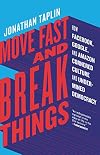
It's hard to imagine and really understand how fast modern technology has been moving in the past several years. The iPhone, for example, a device millions of people panic about misplacing or being without for 5 minutes, was introduced by Steve Jobs in 2007, the iPad only in 2010 -- merely 7 YEARS AGO. Google, Facebook, and all the other internet mainstays we use on a daily basis, are very, very new technologies.
And yet, the speed at which they have been implemented is rivaled only by the show more speed at which we willingly give these entities our personal information, which they then use to data mine, sell to other companies (and the government), use for targeted ads, etc. The amount of personal and private information we willingly give to these anonymous mega-giant corporations happens every day, and without much awareness on our part, but they have tremendous influence in our lives. For example, the algorithms Facebook uses fiddle around with what items we see in our newsfeeds, and are curated based on our clicking habits. Though we are free to, we no longer go directly to sources of newspapers and magazines that we used to buy and read by choice; we are directed towards sources that Facebook thinks we will like based on previous internet choices we've made.
This kind of creeping invasiveness into our lives is one of the ideas behind this very informative book by Jonathan Taplin. Although Taplin comes off sounding like a bit of a Luddite, he is actually ringing a warning bell. Coming from the world of entertainment, he laments the closing off of the internet world supposedly to artistic types because of entities like YouTube and pirating, and the taking over of this technology by mega-corporations, specifically Apple, Google, Facebook and Amazon. In so doing, he says, they have become monopolies, much like the early energy barons of the early 20th century, gobbling up smaller internet start-ups like Instagram and Snapchat. He is also ringing an alarm bell about how we as consumers and citizens have willingly ceded control of our information and our very lives as the conglomerates have demanded more and more information from us. If nothing else, his book should wake us all up to be more vigilant and aware of what is happening to us, and what we are allowing. Like the proverbial frog in the pot of water, we don't realize our freedoms and very lives are being boiled away, degree by degree.
Thank you to the author and publisher for a review copy. show less
And yet, the speed at which they have been implemented is rivaled only by the show more speed at which we willingly give these entities our personal information, which they then use to data mine, sell to other companies (and the government), use for targeted ads, etc. The amount of personal and private information we willingly give to these anonymous mega-giant corporations happens every day, and without much awareness on our part, but they have tremendous influence in our lives. For example, the algorithms Facebook uses fiddle around with what items we see in our newsfeeds, and are curated based on our clicking habits. Though we are free to, we no longer go directly to sources of newspapers and magazines that we used to buy and read by choice; we are directed towards sources that Facebook thinks we will like based on previous internet choices we've made.
This kind of creeping invasiveness into our lives is one of the ideas behind this very informative book by Jonathan Taplin. Although Taplin comes off sounding like a bit of a Luddite, he is actually ringing a warning bell. Coming from the world of entertainment, he laments the closing off of the internet world supposedly to artistic types because of entities like YouTube and pirating, and the taking over of this technology by mega-corporations, specifically Apple, Google, Facebook and Amazon. In so doing, he says, they have become monopolies, much like the early energy barons of the early 20th century, gobbling up smaller internet start-ups like Instagram and Snapchat. He is also ringing an alarm bell about how we as consumers and citizens have willingly ceded control of our information and our very lives as the conglomerates have demanded more and more information from us. If nothing else, his book should wake us all up to be more vigilant and aware of what is happening to us, and what we are allowing. Like the proverbial frog in the pot of water, we don't realize our freedoms and very lives are being boiled away, degree by degree.
Thank you to the author and publisher for a review copy. show less

I'd never heard of Jonathan Taplin before reading his captivating book The Magic Years. He's a fascinating person with a fascinating, thought-provoking, moving, thoughtful, informative story to tell. His adventures in the movie and music industries were most interesting to me, but the entire volume was engaging. Philosophical in parts, insightful in many others, The Magic Years is much more that I expected it to be. Throughout the text Taplin mentions a number of movies and books that I want show more to acquire and watch or read, and many that I already had. It's uncanny how much Taplin has had a hand in media that is of direct personal interest to me. He also includes a playlist of songs in the back of the book, which I've turned into a Spotify playlist for drivetime listening. The Magic Years is a treasure I never expected to unearth. A reminder that it's good to occasionally read a book outside of your normal sphere of interest: it just may turn out to be one of the most interesting things you've ever read. show less
Awards


You May Also Like


Associated Authors
Statistics
- Works
- 5
- Also by
- 1
- Members
- 372
- Popularity
- #64,809
- Rating
- 3.6
- Reviews
- 14
- ISBNs
- 24
- Languages
- 2