
The Arbinger Institute
Author of Leadership and Self-Deception: Getting Out of the Box
About the Author
The Arbinger Institute is a worldwide training, consulting, and coaching organization whose programs and methodologies are based on forty-five years of research in the psychology of human behavior and motivation and more than thirty-five years of experience working with organizations worldwide. show more Headquartered in the United States, Arbinger has operations around the world, including throughout the Americas, Europe, Africa, the Middle East, Oceania, and Asia. show less
Works by The Arbinger Institute
The Anatomy of Peace, Expanded Second Edition: Resolving the Heart of Conflict (2015) 27 copies, 1 review
The Parenting Pyramid 3 copies
The Choice 3 copies
Leder i dit eget liv 1 copy
Outward Mind Set 1 copy
What We Are 1 copy
Tagged
Common Knowledge
Members
Reviews
Leadership and Self-Deception, Fourth Edition: The Secret to Transforming Relationships and Unleashing Results by The Arbinger Institute
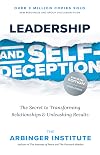
Many blindly go into leadership roles to achieve a level of social prestige and power over others. However, that attitude does not last long as the spoils of ego satisfaction fade away quickly. To contrast, the Arbinger Institute offers a better way: service to one’s fellow human beings, centered around getting results for the company. When an organizational catches on to this purpose, its effectiveness can skyrocket. This fictional story illustrates how such a mindset can transform a show more company and a life towards becoming more effective.
In this fable, a skilled manager is engaged in struggles at a new workplace and with his wife and son at home. A situation of limited burnout transpires. The business’s leader calls him into his office one day and teaches him the company’s management techniques, centered around this abstract concept of “the box.” The technique takes root to transform the manager’s life as he realizes his ultimate value is in who he is, not his products. He learns that investing in himself helps him invest in others.
The general approach is not to focus on one’s personal needs, insecurities, and ambitions, but instead to involve oneself in the larger life of an organization. The book admits that this is not a cure-all for every sort of management malfunction. People’s employments may need to be terminated sometimes; we’re all selfish at moments, often multiple times a day; and changing oneself does not always induce others to change themselves. However, the focus on personal self-improvement first is an adage carried throughout centuries of spiritual wisdom.
This book doesn’t dive deeply into what to do when organizational structures go bad. It’s addressed to organizational leaders to implement change from the top down. However, many of today’s organizations are flatter than ever before, and “leadership from behind” is an increasingly common mandate to today’s workers. Sometimes, senior leaders pose more of a hindrance than a solution, and aside from offering senior leaders more inspiration, this book does not offer detailed advice when that quagmire occurs.
This book is generally addressed to those interested in organizational leadership. Its applications are extremely broad to many aspects of modern work life. Its impacts may not extend quite as far as its marketing material suggests, and its framework might not be as novel as it purports. Nonetheless, its message needs to continue to be heard by all of us in the trenches. How we help people – i.e., results – is much more important and lasting than mere self-interest. show less
In this fable, a skilled manager is engaged in struggles at a new workplace and with his wife and son at home. A situation of limited burnout transpires. The business’s leader calls him into his office one day and teaches him the company’s management techniques, centered around this abstract concept of “the box.” The technique takes root to transform the manager’s life as he realizes his ultimate value is in who he is, not his products. He learns that investing in himself helps him invest in others.
The general approach is not to focus on one’s personal needs, insecurities, and ambitions, but instead to involve oneself in the larger life of an organization. The book admits that this is not a cure-all for every sort of management malfunction. People’s employments may need to be terminated sometimes; we’re all selfish at moments, often multiple times a day; and changing oneself does not always induce others to change themselves. However, the focus on personal self-improvement first is an adage carried throughout centuries of spiritual wisdom.
This book doesn’t dive deeply into what to do when organizational structures go bad. It’s addressed to organizational leaders to implement change from the top down. However, many of today’s organizations are flatter than ever before, and “leadership from behind” is an increasingly common mandate to today’s workers. Sometimes, senior leaders pose more of a hindrance than a solution, and aside from offering senior leaders more inspiration, this book does not offer detailed advice when that quagmire occurs.
This book is generally addressed to those interested in organizational leadership. Its applications are extremely broad to many aspects of modern work life. Its impacts may not extend quite as far as its marketing material suggests, and its framework might not be as novel as it purports. Nonetheless, its message needs to continue to be heard by all of us in the trenches. How we help people – i.e., results – is much more important and lasting than mere self-interest. show less

I read this for a book study, as a part of my coursework for a Masters in Teaching. It's a book that I think that everyone should read, especially if you wish to reduce drama, conflict, and stress in your life. However, I do have a few criticisms. First of all, it's strange because it's a fictional narrative. I think that, for many, this would be a characteristic that would make it more engaging, and it does make the book much more accessible. For me, however, I thought that it was kind of show more hard to apply the universal theme to my own life because it was so attached to the characters in the story (as opposed to a nonfiction book with a similar purpose, like A New Earth). Which leads me to my second point, the fact that the main character, whom the book examines the deepest, is a man. A business man. This book was originally written for the business world and similar leaders, so it makes sense. But as a female, I'm always waiting for the book to explore the main character's wife more, for example, because I identified a lot more with her struggles (Want-to-Be-Seen-As boxes and passive aggressiveness). Of course I still gleaned a lot of great information from this book (After all, I do still have Better-Than and I-Deserve boxes as well, just not as many.), but I question the books applicability in the teaching world, a profession predominately composed of women. Despite my criticisms, I enjoyed this book very much and would recommend it to pretty much anyone. Too bad I purchased it on the Kindle and can't pass it around. show less
I can’t decide how to start the review of Leadership and Self Deception: Getting Out of the Box. I could say this was an easy read which makes it accessible to every reader. I could say that this is one of the most useful books I’ve read in years (including my college years). I could say that this is a powerful book that will change its readers. However, I find it best to say that a friend lent me “Leadership and Self Deception” and it was so good that I bought a copy after reading show more the book. I even helped sell a few copies as I insisted a few of my friends buy it and read it.
I generally dislike leadership books; I don’t have the wall space to write down 12 reminders for leaders or 15 steps to effective leadership. “Leadership and Self Deception” at the end of the story there were a few key ideas to keep in mind but they all boiled down to the simple ideas “getting out of the box” (view people as people) and “self deception.” Even though the key ideas are entombed in the title the book is still a must read. The book chips away at leadership excuses by effectively challenging and building leadership. It pulls leadership out of the personality, quality, skill and talent realm and places it squarely into the accessible realm reaction and choices.
“Leadership and Self Deception” is written as humorous story which softens the body blows it often inflects to the reader’s ego. It follows the story of Tom Callum, a new executive at Zagrum who meets with Zagrum’s executive vice president Bud Jefferson. The book follows the course of the meeting as Bud shares with Tom about Leadership and Self Deception and being in the box and how to be out of the box.
There aren’t ground breaking principles in this book but the simplicity and accessibility force the reader to acknowledge and desire to act upon the principles. show less
I generally dislike leadership books; I don’t have the wall space to write down 12 reminders for leaders or 15 steps to effective leadership. “Leadership and Self Deception” at the end of the story there were a few key ideas to keep in mind but they all boiled down to the simple ideas “getting out of the box” (view people as people) and “self deception.” Even though the key ideas are entombed in the title the book is still a must read. The book chips away at leadership excuses by effectively challenging and building leadership. It pulls leadership out of the personality, quality, skill and talent realm and places it squarely into the accessible realm reaction and choices.
“Leadership and Self Deception” is written as humorous story which softens the body blows it often inflects to the reader’s ego. It follows the story of Tom Callum, a new executive at Zagrum who meets with Zagrum’s executive vice president Bud Jefferson. The book follows the course of the meeting as Bud shares with Tom about Leadership and Self Deception and being in the box and how to be out of the box.
There aren’t ground breaking principles in this book but the simplicity and accessibility force the reader to acknowledge and desire to act upon the principles. show less
Horrible. Tolerable advice but wrapped in an utterly inane and condescending story frame. For a book where the core message is not treating people like shit, the book is almost a self referential example toward a normal IQ adult reader.
Lists
Awards

You May Also Like


Associated Authors
Statistics
- Works
- 20
- Members
- 3,466
- Popularity
- #7,335
- Rating
- 4.0
- Reviews
- 57
- ISBNs
- 111
- Languages
- 9
