

Stephen M. R. Covey
Author of The SPEED of Trust: The One Thing That Changes Everything
About the Author
Disambiguation Notice:
Do not combine Stephen R. Covey and Stephen M. R. Covey. They are different authors.
Works by Stephen M. R. Covey
Tagged
Common Knowledge
- Birthdate
- 1950
- Gender
- male
- Organizations
- The Church of Jesus Christ of Latter-day Saints
- Relationships
- Covey, Stephen R. (father)
- Nationality
- USA
- Disambiguation notice
- Do not combine Stephen R. Covey and Stephen M. R. Covey. They are different authors.
- Associated Place (for map)
- USA
Members
Reviews
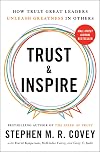
Today’s leadership, as practiced, often includes an approach borrowed from the Industrial Age and popularized by Frederick Winslow Taylor’s “scientific management.” It seeks to have a leader in complete “command and control” of all aspects of production. However, in the postmodern age, interdisciplinary knowledge workers often conduct every step along the way, and any leader does not and cannot know every step of the journey. Coupled with human nature, command and control tactics show more inhibit productivity often and limit creativity to one mind. Instead, leadership expert Stephen Covey suggests a paradigm of “trust and inspire” take its place. It promises to unleash creative contributions in all a team, not just one authoritarian leader. He illustrates and extrapolates what that spiritual approach looks like in every domain of professional and family life.
I first experienced “trust and inspire” leadership techniques at a church while in college 25 years ago. It changed how I approach work and life. I intuitively grasped the approach, but the church never explicitly taught the principles. In independent reading since, I’ve learned how to apply this mindset, popular in contemporary leadership guides, to many elements of my life. Books like this one give me more concrete images to embody this approach to those around me.
Covey places “command and control” tactics as a relic of a prior age. I somewhat agree. While Taylor’s “scientific management” broke new ground in his time during the early 20th century, it is not the only source of “command and control.” In many ways, the journey consists of overcoming human nature, not just an older set of habits. Overcoming that type of tactics takes a lifetime of practice. Despite my best intentions, I find myself getting lazy at moments in life by treating people as things to manage. Books like this prod me towards a better way.
To Covey, everyone has the opportunity to be a leader, not just those in positions of authority. Even those in highly regulated jobs can influence the attitudes of those around them. For him, “trust and inspire” leadership is a spiritual approach for every individual. Therefore, this book is for the broad audience of the general public. He’s not super-fuzzy as in religious spirituality, but he certainly maintains that this relational approach can benefit each one of us. I certainly have found its benefit in my life and would encourage anyone to explore giving it a go. show less
I first experienced “trust and inspire” leadership techniques at a church while in college 25 years ago. It changed how I approach work and life. I intuitively grasped the approach, but the church never explicitly taught the principles. In independent reading since, I’ve learned how to apply this mindset, popular in contemporary leadership guides, to many elements of my life. Books like this one give me more concrete images to embody this approach to those around me.
Covey places “command and control” tactics as a relic of a prior age. I somewhat agree. While Taylor’s “scientific management” broke new ground in his time during the early 20th century, it is not the only source of “command and control.” In many ways, the journey consists of overcoming human nature, not just an older set of habits. Overcoming that type of tactics takes a lifetime of practice. Despite my best intentions, I find myself getting lazy at moments in life by treating people as things to manage. Books like this prod me towards a better way.
To Covey, everyone has the opportunity to be a leader, not just those in positions of authority. Even those in highly regulated jobs can influence the attitudes of those around them. For him, “trust and inspire” leadership is a spiritual approach for every individual. Therefore, this book is for the broad audience of the general public. He’s not super-fuzzy as in religious spirituality, but he certainly maintains that this relational approach can benefit each one of us. I certainly have found its benefit in my life and would encourage anyone to explore giving it a go. show less
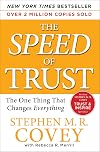
I was a little hesitant to buy this because it was "Covey's son." Was he writing a book and hoping to ride his father's coattails? He hooked me quick, though, as he told the story of the low trust he experienced during the Franklin and Covey merger. He was writing what he learned from that experience; it's not just a theory. I enjoyed the book, and would recommend it.
A framework, reference guide, and useful starting point. Good enough for a business book. The framework and forced symmetries drive the discussion rather than whether or where Covey has supporting data, unique insights, or depth of understanding. This leads to long passages of filler.
Use the framework to establish a shared language about trust in business settings. Refer to sections of the book for ideas about how to improve specific skills or habits associated with trusting relationships in show more a "fake it till you make it" sense. The experience will teach you what the book cannot. Mine the book for it's insights, capture them, and let the rest fall away. show less
Use the framework to establish a shared language about trust in business settings. Refer to sections of the book for ideas about how to improve specific skills or habits associated with trusting relationships in show more a "fake it till you make it" sense. The experience will teach you what the book cannot. Mine the book for it's insights, capture them, and let the rest fall away. show less
From a purely writing-style perspective, I found the book to read much more like a textbook than "business lit". I really struggled to get through it--probably why it took 4 months to finish, and that only because my department's book-club deadline finally came close enough to push me into it! #procrastination
I felt the book could have been a lot shorter and still gotten its point across. I found a few decent takeaways, but it really didn't revolutionize my game or provide new insights.
I felt the book could have been a lot shorter and still gotten its point across. I found a few decent takeaways, but it really didn't revolutionize my game or provide new insights.
You May Also Like


Associated Authors
Statistics
- Works
- 17
- Members
- 2,412
- Popularity
- #10,632
- Rating
- 3.8
- Reviews
- 23
- ISBNs
- 75
- Languages
- 11
- Favorited
- 1