
John P. Kotter
Author of Leading Change: Why Transformation Efforts Fail
About the Author
John P. Kotter is a graduate of the Massachusetts Institute of Technology and Harvard University. He is the Konosuke Matashusita Professor of Leadership at the Harvard Business School and was one of the youngest people in Harvard history to receive full professorship. Kotter's works include Power show more and Influence: Beyond Formal Authority, The Leadership Factor and Corporate Culture and Performance. (Bowker Author Biography) show less
Image credit: Dr. John Kotter of Harvard Business School by Keiradog
Works by John P. Kotter
Our Iceberg Is Melting: Changing and Succeeding Under Any Conditions (2006) 1,533 copies, 26 reviews
The Heart of Change: Real-Life Stories of How People Change Their Organizations (2002) 651 copies, 6 reviews
HBR's 10 Must Reads on Change Management (including featured article "Leading Change," by John P. Kotter) (2011) — Author — 301 copies
That's Not How We Do It Here!: A Story about How Organizations Rise and Fall--and Can Rise Again (2016) 106 copies, 4 reviews
Matsushita Leadership: Lessons From the 20th Century's Most Remarkable Entrepreneur (1997) 51 copies
Change: How Organizations Achieve Hard-to-Imagine Results in Uncertain and Volatile Times (2021) 41 copies
Alerte sur la banquise ! 2e Ed: Réussir le changement dans n'importe quelles conditions (2018) 4 copies
Liderar a Mudança 2 copies
Nu asa procedam noi aici! 1 copy
Olvad a jéghegyünk! 1 copy
Accelerate XLR8 1 copy
Inima schimbării: povestiri adevărate despre felul în care oamenii îşi transformă organizaţiile (2008) 1 copy
Combating Complacency 1 copy
Transforming Organizations 1 copy
Forța schimbării 1 copy
Associated Works
HBR's 10 Must Reads on Managing People (with featured article "Leadership That Gets Results," by Daniel Goleman) (2011) — Contributor — 327 copies, 1 review
Rethinking the Future: Rethinking Business, Principles, Competition, Control and Complexity, Leadership, Markets, and the World (1993) — Contributor — 122 copies
The Heart of Change Field Guide: Tools And Tactics for Leading Change in Your Organization (2005) — Foreword — 106 copies
Tagged
Common Knowledge
- Canonical name
- Kotter, John P.
- Legal name
- Kotter, John Paul
- Other names
- KOTTER, John Paul
KOTTER, John P. - Birthdate
- 1947
- Gender
- male
- Education
- Massachusetts Institute of Technology
Harvard University - Occupations
- professor
- Organizations
- Harvard University
- Nationality
- USA
- Birthplace
- San Diego, California, USA
- Places of residence
- Cambridge, Massachusetts, USA
Ashland, New Hampshire, USA - Associated Place (for map)
- USA
Members
Reviews
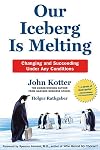
Our Iceberg Is Melting: Changing and Succeeding Under Any Conditions (Kotter, Our Iceberg is Melting) by John Kotter
I know that I should like this book and give it a good review but I didn't and I can't.
I think I would have preferred Kotter's original book about change management without all the animal nonsense that is in this.
This is the kind of book a manager goes out and buys for all their staff and says "Read this! It won't take you long. You'll have it finished by this afternoon/tonight!" And they'd be correct. It doesn't take long to read at all. So for goodness sake read it and have a discussion show more with me if you will.
I just object to the use of "dumbing-down" or sugar-coating management speak. The analogy for me is lame (OMG I'm using teenager type words - it must have really touched a sensitive nerve in me!)
What we're talking about here is change-management. In this "picture book for grown ups" we're presented with a fable about a group of penguins who are sitting on a melting iceberg. Where can they go? Will they listen to the wise lone penguin voice in the wilderness who says they have to go, when it would be so much more comfortable to stay (and all drown and witness their kids dying?????)
Let's forget about the fact that penguins can swim. Let's forget about the fact that penguins can't talk. Just humour me for a second. If you are willing to suspend disbelief and go along with penguins being as silly as humans, then you would understand why I have a fundamental problem with this tale. It just doesn't ring true. Maybe I am too cynical. Maybe I am reading this too literally. I don't think so. I don't think I am like the very subtly (deep cynicism here folks) named "NoNo" character in the book.
I just hate being spoken to as if I am a 3rd-grader. In this book we are to believe that all the penguins, if they cooperate and pull-together will re-locate to a better iceberg - every five years.
Oh puhleeeeeezzzzz. Anyone who has been through change knows that not all the penguins get to go......and it's never another better iceberg. Animal Farm would be a better read at this point I think....a better iceberg for some.
I'm not saying I object to change. I just wish someone would call it like it is for once. Be honest. Tell it like it is. Acknowledge that there will be collateral damage for the sake of the survival of the fittest and all that.
What do you think? Am I a "NoNo". Should I read Kotter's other book? show less
I think I would have preferred Kotter's original book about change management without all the animal nonsense that is in this.
This is the kind of book a manager goes out and buys for all their staff and says "Read this! It won't take you long. You'll have it finished by this afternoon/tonight!" And they'd be correct. It doesn't take long to read at all. So for goodness sake read it and have a discussion show more with me if you will.
I just object to the use of "dumbing-down" or sugar-coating management speak. The analogy for me is lame (OMG I'm using teenager type words - it must have really touched a sensitive nerve in me!)
What we're talking about here is change-management. In this "picture book for grown ups" we're presented with a fable about a group of penguins who are sitting on a melting iceberg. Where can they go? Will they listen to the wise lone penguin voice in the wilderness who says they have to go, when it would be so much more comfortable to stay (and all drown and witness their kids dying?????)
Let's forget about the fact that penguins can swim. Let's forget about the fact that penguins can't talk. Just humour me for a second. If you are willing to suspend disbelief and go along with penguins being as silly as humans, then you would understand why I have a fundamental problem with this tale. It just doesn't ring true. Maybe I am too cynical. Maybe I am reading this too literally. I don't think so. I don't think I am like the very subtly (deep cynicism here folks) named "NoNo" character in the book.
I just hate being spoken to as if I am a 3rd-grader. In this book we are to believe that all the penguins, if they cooperate and pull-together will re-locate to a better iceberg - every five years.
Oh puhleeeeeezzzzz. Anyone who has been through change knows that not all the penguins get to go......and it's never another better iceberg. Animal Farm would be a better read at this point I think....a better iceberg for some.
I'm not saying I object to change. I just wish someone would call it like it is for once. Be honest. Tell it like it is. Acknowledge that there will be collateral damage for the sake of the survival of the fittest and all that.
What do you think? Am I a "NoNo". Should I read Kotter's other book? show less

“Managing up” has become a part of work culture over the past 20-or-so years, but that scenario hasn’t always been the case. This article, originally published in Harvard Business Review (HBR) in 1993 and 2005, represents some of the first voices to discuss this topic at length. Thus, the HBR Press has compiled this article into a brief book for sale. Had I known of its prior distribution, I would not have purchased the book since I have access to HBR’s archives, but I also would not show more have known about the article were it not for this publication.
In it, the authors make the concise case that this relationship is crucial both to individual and corporate success. They also persuade that relations with one’s superior often take a different shape than those with direct reports. Then they coach readers how to understand their boss’s professional personality. For example, they suggest categorizing your boss as a “reader,” who gathers information primarily by text, or as a “listener,” who gathers information primarily orally. Ultimately, individuals must know themselves and how they relate to authority to become more effective.
Managing authority figures is an inescapable, universal challenge for anyone involved in society. Frankly, there’s no one right way to do it, but it must be done. I’m concerned that the art of healthy relationships is, in recent years, losing out (in the individualist United States, at least), and this book can address those skill deficits by encouraging reflection about core issues. show less
In it, the authors make the concise case that this relationship is crucial both to individual and corporate success. They also persuade that relations with one’s superior often take a different shape than those with direct reports. Then they coach readers how to understand their boss’s professional personality. For example, they suggest categorizing your boss as a “reader,” who gathers information primarily by text, or as a “listener,” who gathers information primarily orally. Ultimately, individuals must know themselves and how they relate to authority to become more effective.
Managing authority figures is an inescapable, universal challenge for anyone involved in society. Frankly, there’s no one right way to do it, but it must be done. I’m concerned that the art of healthy relationships is, in recent years, losing out (in the individualist United States, at least), and this book can address those skill deficits by encouraging reflection about core issues. show less
I’m doing research for something and I was encouraged to look deeper into “change management.” It’s a management trend that’s been trending for a long time. I remember back in the 1990s hearing at almost every turn “change is the new norm.” Now, that encouragement I was given was more toward looking to the internet but I like books first. Mr. Kotter seems to be thechange management guru, and the title of this is about leading and not managing, so it seems a good starting point. show more
This book is both dated (1996 original pub, and this, the second edition, 2012), and still relevant: “The simple insight that management is not leadership (chapter 2) is better understood today, but not nearly as well as is needed.”
Kotter starts out with identifying eight common mistakes of organizational change. I noted of the first four:
“Error #1: Allowing Too Much Complacency”
{Organizations that rest on their laurels get left behind}
“Error #2: Failing to Create a Sufficiently Powerful Guiding Coalition”
{This is wordy, and loses its impact}
“Error #3: Underestimating the Power of Vision”
{Of the first three, I don't think this is as common. If anything, "vision" is overestimated, and overused.}
“Error #4: Undercommunicating the Vision by a Factor of 10 (or 100 or Even 1,000)”
{Okay, this aspect of vision is quite true. Overall, for any changes - even ones where the concepts are socialized well - there will be some. missing communication.}
He says “Normally, people skip steps because they are feeling pressures to produce.” I wonder if people might skip sections of this because it is can be a bit academic. Still, there is a lot of value in this.
Curated notes and highlights:
“With a strong emphasis on management but not leadership, bureaucracy and an inward focus take over.”
{Ouch. And spot on.}
“After a while, one might easily conclude that the kind of leadership that is so critical to any change can come only from a single larger-than-life person.
This is a very dangerous belief.”
[...]
No one individual, even a monarch-like CEO, is ever able to develop the right vision, communicate it to large numbers of people, eliminate all the key obstacles, generate short-term wins, lead and manage dozens of change projects, and anchor new approaches deep in the organization’s culture.”
{Single point of direction, single point of failure.}
“Characteristics of an effective vision
• Imaginable: Conveys a picture of what the future will look like
• Desirable: Appeals to the long-term interests of employees, customers, stockholders, and others who have a stake in the enterprise
• Feasible: Comprises realistic, attainable goals
• Focused: Is clear enough to provide guidance in decision making
• Flexible: Is general enough to allow individual initiative and alternative responses in light of changing conditions
• Communicable: Is easy to communicate; can be successfully explained within five minutes”
{Good summary}
“I am sometimes amazed at how many people try to transform organizations using methods that look like the first two scenarios: authoritarian decree and micromanagement. Both approaches have been applied widely in enterprises over the last century, but mostly for maintaining existing systems, not transforming those systems into something better. ”
{And yet, authoritarian and micromanaging are ubiquitous.}
“While the [vision] statement does not give anything close to a detailed directive, it does provide focus ”
{Vision is an abstract goal of a future impact. Mission should be a definition of what is now. And an action plan gives the direction. }
“Vision creation can be difficult for at least five reasons [...] First, we have raised a number of generations of very talented people to be managers, not leaders or leader/managers, and vision is not a component of effective management. ”
{Focus is on management, not leadership. In the military, it is the opposite. In both, a mix of the two is necessary (with emphasis on leadership, of course.)}
“Key elements in the effective communication of vision
• Simplicity: All jargon and technobabble must be eliminated.
• Metaphor, analogy, and example: A verbal picture is worth a thousand words.
• Multiple forums: Big meetings and small, memos and newspapers, formal and informal interaction—all are effective for spreading the word.
• Repetition: Ideas sink in deeply only after they have been heard many times.
• Leadership by example: Behavior from important people that is inconsistent with the vision overwhelms other forms of communication.
• Explanation of seeming inconsistencies: Unaddressed inconsistencies undermine the credibility of all communication.
• Give-and-take: Two-way communication is always more powerful than one-way
communication.”
“If I hear the word empowerment one more time,” someone recently told me, “I think I’ll gag.”
A few years ago, I might have agreed with his reservations. Today, I don’t. I’m still not enthusiastic about using faddish words, but in this ever faster-moving world, I think the idea of helping more people to become more powerful is important.”
{good point}
“Short-Term Wins Aren’t Short-Term Gimmicks”
{Another good point}
“Cultural Change Comes Last, Not First”
{This is too seldom realized, recognized, and called out.}
“I can imagine a day not long from now when succession at the top of firms may no longer be an exercise in picking one person to replace another. Succession could be a process of picking at least the core of a team.
[…]
I can also imagine a day when big egos and snakes are eliminated from promotion lists, no matter how smart, clever, hard working, or well educated they”
{He has a good imagination. That is a change that will be long in coming.} show less
This book is both dated (1996 original pub, and this, the second edition, 2012), and still relevant: “The simple insight that management is not leadership (chapter 2) is better understood today, but not nearly as well as is needed.”
Kotter starts out with identifying eight common mistakes of organizational change. I noted of the first four:
“Error #1: Allowing Too Much Complacency”
{Organizations that rest on their laurels get left behind}
“Error #2: Failing to Create a Sufficiently Powerful Guiding Coalition”
{This is wordy, and loses its impact}
“Error #3: Underestimating the Power of Vision”
{Of the first three, I don't think this is as common. If anything, "vision" is overestimated, and overused.}
“Error #4: Undercommunicating the Vision by a Factor of 10 (or 100 or Even 1,000)”
{Okay, this aspect of vision is quite true. Overall, for any changes - even ones where the concepts are socialized well - there will be some. missing communication.}
He says “Normally, people skip steps because they are feeling pressures to produce.” I wonder if people might skip sections of this because it is can be a bit academic. Still, there is a lot of value in this.
Curated notes and highlights:
“With a strong emphasis on management but not leadership, bureaucracy and an inward focus take over.”
{Ouch. And spot on.}
“After a while, one might easily conclude that the kind of leadership that is so critical to any change can come only from a single larger-than-life person.
This is a very dangerous belief.”
[...]
No one individual, even a monarch-like CEO, is ever able to develop the right vision, communicate it to large numbers of people, eliminate all the key obstacles, generate short-term wins, lead and manage dozens of change projects, and anchor new approaches deep in the organization’s culture.”
{Single point of direction, single point of failure.}
“Characteristics of an effective vision
• Imaginable: Conveys a picture of what the future will look like
• Desirable: Appeals to the long-term interests of employees, customers, stockholders, and others who have a stake in the enterprise
• Feasible: Comprises realistic, attainable goals
• Focused: Is clear enough to provide guidance in decision making
• Flexible: Is general enough to allow individual initiative and alternative responses in light of changing conditions
• Communicable: Is easy to communicate; can be successfully explained within five minutes”
{Good summary}
“I am sometimes amazed at how many people try to transform organizations using methods that look like the first two scenarios: authoritarian decree and micromanagement. Both approaches have been applied widely in enterprises over the last century, but mostly for maintaining existing systems, not transforming those systems into something better. ”
{And yet, authoritarian and micromanaging are ubiquitous.}
“While the [vision] statement does not give anything close to a detailed directive, it does provide focus ”
{Vision is an abstract goal of a future impact. Mission should be a definition of what is now. And an action plan gives the direction. }
“Vision creation can be difficult for at least five reasons [...] First, we have raised a number of generations of very talented people to be managers, not leaders or leader/managers, and vision is not a component of effective management. ”
{Focus is on management, not leadership. In the military, it is the opposite. In both, a mix of the two is necessary (with emphasis on leadership, of course.)}
“Key elements in the effective communication of vision
• Simplicity: All jargon and technobabble must be eliminated.
• Metaphor, analogy, and example: A verbal picture is worth a thousand words.
• Multiple forums: Big meetings and small, memos and newspapers, formal and informal interaction—all are effective for spreading the word.
• Repetition: Ideas sink in deeply only after they have been heard many times.
• Leadership by example: Behavior from important people that is inconsistent with the vision overwhelms other forms of communication.
• Explanation of seeming inconsistencies: Unaddressed inconsistencies undermine the credibility of all communication.
• Give-and-take: Two-way communication is always more powerful than one-way
communication.”
“If I hear the word empowerment one more time,” someone recently told me, “I think I’ll gag.”
A few years ago, I might have agreed with his reservations. Today, I don’t. I’m still not enthusiastic about using faddish words, but in this ever faster-moving world, I think the idea of helping more people to become more powerful is important.”
{good point}
“Short-Term Wins Aren’t Short-Term Gimmicks”
{Another good point}
“Cultural Change Comes Last, Not First”
{This is too seldom realized, recognized, and called out.}
“I can imagine a day not long from now when succession at the top of firms may no longer be an exercise in picking one person to replace another. Succession could be a process of picking at least the core of a team.
[…]
I can also imagine a day when big egos and snakes are eliminated from promotion lists, no matter how smart, clever, hard working, or well educated they”
{He has a good imagination. That is a change that will be long in coming.} show less
One of those books that makes much of the business world make a lot more sense when you're done. A lightbulb about successful and failed change efforts at workplaces throughout my career went off probably every two or three pages throughout the book. It has some good insights too, I think, for anyone wondering why we are doing such a crap job of transforming on a larger, societal scale to deal wtih environmental threats like climate change.
Lists
Awards


You May Also Like


Associated Authors
Statistics
- Works
- 60
- Also by
- 4
- Members
- 6,652
- Popularity
- #3,680
- Rating
- 3.7
- Reviews
- 67
- ISBNs
- 228
- Languages
- 15
- Favorited
- 3