
Alix Berenzy
Author of A Frog Prince
About the Author
Works by Alix Berenzy
Associated Works
The Last Slice of Rainbow and Other Stories (1985) — Illustrator, some editions — 184 copies, 2 reviews
Tagged
Common Knowledge
- Canonical name
- Berenzy, Alix
- Birthdate
- 1957-08-03
- Gender
- female
- Education
- Columbus College of Art and Design
Philadelphia College of Art - Occupations
- book Illustrator
children's author - Short biography
- Alix Berenzy is an American children's book author and illustrator. Born in New York in 1957, she was raised in suburban New Jersey, and was educated at Columbus College of Art and Design (1974–76) and Philadelphia College of Art (1979–81). She worked as an art director in the advertising field in the 1970s, before launching a career as a freelance illustrator in 1982. She has written and illustrated three books of her own, and has illustrated a number of books by other authors.
- Nationality
- USA
- Birthplace
- New York, New York, USA
- Places of residence
- New York, New York, USA
Benton, Pennsylvania, USA - Map Location
- USA
Members
Reviews

Taking the original Brothers Grimm fairy-tale as her inspiration, Alix Berenzy reimagines The Frog Prince as a heroic quest, in which the frog - spurned by the beautiful but spoiled princess whom he has loved from afar - sets out to find a lady more worthy of his devotion. Rescuing doves and turtles in the course of his journey, and being aided in return, the frog eventually finds himself in a far kingdom, where he encounters the princess of his dreams...
I enjoyed this tale of a kind-hearted show more and resourceful hero determined to find someone who values his finer qualities, and appreciated the fact that the frog, though hurt by the first princess' scornful rejection, never sees himself as ugly or worthless. Berenzy's artwork, with its rich color, and mysterious play of dark and light, is quite beautiful. All in all, a lovely little picture-book, perfect for fans of fractured fairy-tales! show less
I enjoyed this tale of a kind-hearted show more and resourceful hero determined to find someone who values his finer qualities, and appreciated the fact that the frog, though hurt by the first princess' scornful rejection, never sees himself as ugly or worthless. Berenzy's artwork, with its rich color, and mysterious play of dark and light, is quite beautiful. All in all, a lovely little picture-book, perfect for fans of fractured fairy-tales! show less

When an expectant mother spies the rapunzel growing in her neighbor's garden, her longing for the herb is so strong, that she becomes ill. Finally, in desperation, her husband steals into the garden to fetch her some of the plant, only to be caught by the powerful fairy owner, who demands their unborn child as payment. And so Mother Gothel comes to possess a beautiful girl-child, whom she names Rapunzel, and whom, from the age of twelve, she imprisons in a high tower in the show more forest...
According to the comments on the front dust-jacket flap, this version of the classic fairy-tale is taken from a German source predating the Brothers Grimm, although that source is never named. Could this be a reference to the Rapunzel of J.C.F. Schulz, a 1790 translation of the French Persinette, itself a translation of Giambattista Basile's Petrosinella? It's difficult to say, but however that may be, this version is so close to the Grimms - with the fairy/witch being named Mother Gothel, and the inclusion of the final episode, in which Rapunzel and her prince wander in the wilderness - that it will make little difference to the non-scholar.
Although the Neapolitan Petrosinella has always been my favorite of this tale-type, I have a soft spot in my heart for the German variant, and this retelling - with its engaging narrative and gorgeous artwork - ranks with the Paul Zelinsky edition, as one of my favorite Rapunzels. The illustrations, done in colored pencil and gouache on black paper, are intensely expressive. The reader can almost taste the rapunzel, in the painting of the mother savoring her herb salad, or feel the warmth of the fire and the coolness of the night air, in the two-page spread showing Rapunzel in her tower. Truly, a lovely edition of a beloved story - fairy-tale fans will not want to miss this one! show less
According to the comments on the front dust-jacket flap, this version of the classic fairy-tale is taken from a German source predating the Brothers Grimm, although that source is never named. Could this be a reference to the Rapunzel of J.C.F. Schulz, a 1790 translation of the French Persinette, itself a translation of Giambattista Basile's Petrosinella? It's difficult to say, but however that may be, this version is so close to the Grimms - with the fairy/witch being named Mother Gothel, and the inclusion of the final episode, in which Rapunzel and her prince wander in the wilderness - that it will make little difference to the non-scholar.
Although the Neapolitan Petrosinella has always been my favorite of this tale-type, I have a soft spot in my heart for the German variant, and this retelling - with its engaging narrative and gorgeous artwork - ranks with the Paul Zelinsky edition, as one of my favorite Rapunzels. The illustrations, done in colored pencil and gouache on black paper, are intensely expressive. The reader can almost taste the rapunzel, in the painting of the mother savoring her herb salad, or feel the warmth of the fire and the coolness of the night air, in the two-page spread showing Rapunzel in her tower. Truly, a lovely edition of a beloved story - fairy-tale fans will not want to miss this one! show less
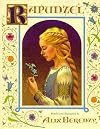
I have two picture books of the classic fairy tale “Rapunzel” in my library: Paul Zelinsky’s 1998 Caldecott winner, and this lesser-known effort from Alix Berenzy. Of the two, Zelinsky wins out for both his sumptuous illustrations and his interesting textual research, but Berenzy’s version is worth reading as well, especially if you love “Rapunzel” as much as I do. The most interesting thing about this book is the artistic medium she uses: colored pencil and watercolor on a black show more canvas. The black canvas makes the shadows on each page (and, by extension, the falls of light) all the more striking; I only wish she had used this technique for all it was worth by reveling in the bleakness of the story. This could have been a very moody Rapunzel indeed, a dark tale touched with occasional spots of glorious sunshine.
One illustration in the book sticks out to me as coming very close to this ambition: a two-page spread of Rapunzel abandoned in the rocky desert, with Mother Gothel hurrying away as a storm begins to break overhead. The text reads simply, “Rapunzel cried in fear as the flowers fell from her hair.” This combination—textual understatement paired with emotionally turbulent visuals—is an evocative picture of what Berenzy might have given us. show less
One illustration in the book sticks out to me as coming very close to this ambition: a two-page spread of Rapunzel abandoned in the rocky desert, with Mother Gothel hurrying away as a storm begins to break overhead. The text reads simply, “Rapunzel cried in fear as the flowers fell from her hair.” This combination—textual understatement paired with emotionally turbulent visuals—is an evocative picture of what Berenzy might have given us. show less

This retelling of the traditional German story is very well done. It is based on the original story, predating the Brothers Grimm version. The language is pretty, yet simple. Together with beautiful, vivid illustrations, it makes a great read-aloud of the classic story for children.
As with most fairy tales, the character roles are easily defined: the flawed, weak parents, the evil fairy (witch), the handsome and faithful prince, and the beautiful, virtuous heroine. The parents give up show more Rapunzel in order to pay the evil fairy for the rapunzel plant the mother craved. The evil fairy, covetous of Rapunzel's beauty, locked her up in a tower to keep her hidden. Rapunzel attracts the handsome prince with her beautiful sining voice. The prince climbs up her hair to the tower and the two plan Rapunzel's escape. When the evil fairy learns of the plan, she banishes Rapunzel to a barren desert. The prince, fearing the power of the fairy, jumps out of the tower and into a rosebush, blinding himself. The love between Rapunzel and the prince perseveres when they are united years later. Love, virtue, and bravery triumph. show less
As with most fairy tales, the character roles are easily defined: the flawed, weak parents, the evil fairy (witch), the handsome and faithful prince, and the beautiful, virtuous heroine. The parents give up show more Rapunzel in order to pay the evil fairy for the rapunzel plant the mother craved. The evil fairy, covetous of Rapunzel's beauty, locked her up in a tower to keep her hidden. Rapunzel attracts the handsome prince with her beautiful sining voice. The prince climbs up her hair to the tower and the two plan Rapunzel's escape. When the evil fairy learns of the plan, she banishes Rapunzel to a barren desert. The prince, fearing the power of the fairy, jumps out of the tower and into a rosebush, blinding himself. The love between Rapunzel and the prince perseveres when they are united years later. Love, virtue, and bravery triumph. show less
Lists
Princess Tales (1)
Awards

You May Also Like


Associated Authors
Statistics
- Works
- 3
- Also by
- 10
- Members
- 479
- Popularity
- #51,491
- Rating
- 3.9
- Reviews
- 17
- ISBNs
- 17
- Languages
- 2
- Favorited
- 2