
Robert J. Serling (1918–2010)
Author of Something's Alive on the Titanic
About the Author
Disambiguation Notice:
Born Jerome Robert Serling and legally changed his name to Robert Jerome Serling.
Image credit: Robert J. Serling
Works by Robert J. Serling
The Electra Story: The Dramatic History of Aviation's Most Controversial Airliner (1991) 33 copies, 2 reviews
Loud and clear; the full answer to aviation's vital question: Are the jets really safe? (1969) 28 copies, 1 review
Birth of an Industry, a Nostalgic Collection of Airline Schedules 1929 - 1939 (In Facsimile) (1969) 7 copies
Whisky, naranja o crimen 2 copies
EL PIONERO 1 copy
Τό ἀεροπλάνο τοῦ προέδρου… 1 copy
A century of wings 1903-2003 1 copy
O piloto usava saias 1 copy
Associated Works
Twilight Zone: 19 Original Stories on the 50th Anniversary (2009) — Contributor — 146 copies, 3 reviews
Tagged
Common Knowledge
- Legal name
- Serling, Robert Jerome
- Other names
- Serling, Jerome Robert (birth name)
- Birthdate
- 1918-03-28
- Date of death
- 2010-05-06
- Gender
- male
- Education
- Antioch College (BA, 1942)
- Occupations
- aviation writer
novelist - Organizations
- Society of Air Safety Investigators
Aviation/Space Writers Association
United States Air Force (Aircraft Identification Instructor, WWII) - Awards and honors
- Trans-World Airlines, seven awards, 1958-65, for aviation news reporting, Strebig-Dobben Memorial Award, 1960; special citations from Sherman Fairchild Foundation, 1963, Flight Safety Foundation, 1970, and Airline Pilots Association, 1970; Aviation/Space Writers Association, James Trebig Memorial Award, 1964, special citation, 1967, award in fiction, 1966, for The Left Seat, and in nonfiction, 1969, for Loud and Clear.
- Relationships
- Serling, Rod (brother)
- Nationality
- USA
- Birthplace
- Cortland, New York, USA
- Places of residence
- Potomac, Maryland, USA
- Place of death
- Tucson, Arizona, USA
- Burial location
- Tucson, Arizona, USA
- Disambiguation notice
- Born Jerome Robert Serling and legally changed his name to Robert Jerome Serling.
- Associated Place (for map)
- USA
Members
Reviews

How possibly could the "Ghost Story Junkie" resist a title like this? It had a supernatural element along a really great story based on some truths and some things entirely from the imagination of the author. Sometimes it was difficult to tell them apart. I have always been fascinated with the history of this great vessel and how she met her fate...this story uses those facts but adds a delicious element of pure terror. The story starts with the 1975 expedition, one which ended in tragedy in show more very unusual circumstances. This is based on documented facts. It continues 18 years later with the sole surviving member of that original crew and adds some new characters all with the same purpose...find the treasure...and they get the same response...something says, "Go Away". The message is delivered in the strongest and most deadly terms possible. The story is fun while also being a little fanciful...but as I said there is an element of truth woven throughout. It’s really not hard to imagine that the Titanic is a haunted ship...but exactly what forms the haunting takes? That is what makes this story so haunting, and terror filled as well as making it interesting for lack of a better word. Ask yourself just what would it be like to search a wreck where more than 1,500 people died? Being on the bottom of the sea just adds to the atmosphere. What spirits would haunt those old staterooms? What wants the living gone? Well...here’s your chance to find out. show less

An interesting book that looks at a series of puzzling accidents with the Lockheed Electra in the 1950s and 1960s. The book was brief, and used a good mix of foreshadowing and intrigue to keep the narrative interesting and moving along.
The modern reader may note some interesting parallels with more recent aviation accidents (I'm referring to the 737 MAX 8) in that even in the 1960s people were looking critically at the CAA/FAA's "outsourcing" of quality control and certification to the show more airline manufacturers, instead of investing in actual outside governmental accountability. We may be living in a much safer world as far as airline travel is concerned, but in a way, many things have not changed at all. show less
The modern reader may note some interesting parallels with more recent aviation accidents (I'm referring to the 737 MAX 8) in that even in the 1960s people were looking critically at the CAA/FAA's "outsourcing" of quality control and certification to the show more airline manufacturers, instead of investing in actual outside governmental accountability. We may be living in a much safer world as far as airline travel is concerned, but in a way, many things have not changed at all. show less
There are many interesting parallels in this story to the current issues with the 737 Maxx: The CAA ( predecessor to the FAA) was heavily involved in certifying new aircraft, but because of reduced staffing many of the tasks were left to the company. For years the CAA had utilized a “designee” system to assure compliance with its regulations. Under this system, key employees of the applicant manufacturer were delegated to approve test methods and data, blueprints, design work, etc. The show more perennially money-starved CAA simply did not have the manpower to monitor aircraft design. Sound familiar? The DC-6, Martin 202, and Constellation all developed bugs that made it through the certification process.
Engineering progress is often measured by learning from mistakes. Unfortunately disasters are essential to help us learn as Henry Petroski has so eloquently written about in To Engineer is Human: The Roles of Failure in Succesful Design.
The Lockheed Electra, one of the most tested and lauded aircraft in the early sixties, was a marvel -- until the wings began to fall off. It was a ship that fulfilled the pilot’s prerequisites for a transport better than any other plane in history. It had enormous reserve power. It handled smoothly, docilely, responsively. It was fast, versatile, uncomplaining and even — for such a huge aircraft — forgiving of mistakes. In brief, it was a pilot’s airplane.
Investigation following two crashes showed that the outboard engine mounts were not strong enough to damp a phenomenon called "whirl mode flutter" (analogous to the wobbling of a child's top as it slows down). "When the oscillation was transmitted to the wings and the flutter frequency decreased to a point where it was resonant with the outer wing panels (at the same frequency, or harmonically related ones), violent up-and-down oscillation increased until the wings would tear off."
After two violent crashes where the wings had been torn off, a crash (pathetic pun) effort was made to determine the cause. Resources of competing companies like Boeing and Douglas were offered and used. Wind tunnel tests and thousands of hours of test flights finally revealed the problem." Basically the trouble had nothing to do with the Electra’s strength. It involved stiffness — stiffness of the nacelle structure. Stiffness is not the same as strength. If one confuses the two, it is like thinking glass and air are the same because both are transparent. And in an airplane, stiffness is the chief resistant force against flutter. What had happened to the Electra was devastating in its deadly simplicity.
At enormous cost to Lockheed, the planes were all retro-fitted and it went on to have a reasonably successful commercial life. The hull plan is still being used in P-3 Orions. It took a while for the aircraft to get beyond its "jinxed" reputation, especially following a crash where on takeoff three of the planes engines shut down after ingesting hundreds of starlings. Yes, birds are still a problem. (The book was written in 1963.)
I remember flying in an Electra in 1968, several years after the problem was fixed. It was a nice airplane. But I won't get on a DC-10. show less
Engineering progress is often measured by learning from mistakes. Unfortunately disasters are essential to help us learn as Henry Petroski has so eloquently written about in To Engineer is Human: The Roles of Failure in Succesful Design.
The Lockheed Electra, one of the most tested and lauded aircraft in the early sixties, was a marvel -- until the wings began to fall off. It was a ship that fulfilled the pilot’s prerequisites for a transport better than any other plane in history. It had enormous reserve power. It handled smoothly, docilely, responsively. It was fast, versatile, uncomplaining and even — for such a huge aircraft — forgiving of mistakes. In brief, it was a pilot’s airplane.
Investigation following two crashes showed that the outboard engine mounts were not strong enough to damp a phenomenon called "whirl mode flutter" (analogous to the wobbling of a child's top as it slows down). "When the oscillation was transmitted to the wings and the flutter frequency decreased to a point where it was resonant with the outer wing panels (at the same frequency, or harmonically related ones), violent up-and-down oscillation increased until the wings would tear off."
After two violent crashes where the wings had been torn off, a crash (pathetic pun) effort was made to determine the cause. Resources of competing companies like Boeing and Douglas were offered and used. Wind tunnel tests and thousands of hours of test flights finally revealed the problem." Basically the trouble had nothing to do with the Electra’s strength. It involved stiffness — stiffness of the nacelle structure. Stiffness is not the same as strength. If one confuses the two, it is like thinking glass and air are the same because both are transparent. And in an airplane, stiffness is the chief resistant force against flutter. What had happened to the Electra was devastating in its deadly simplicity.
At enormous cost to Lockheed, the planes were all retro-fitted and it went on to have a reasonably successful commercial life. The hull plan is still being used in P-3 Orions. It took a while for the aircraft to get beyond its "jinxed" reputation, especially following a crash where on takeoff three of the planes engines shut down after ingesting hundreds of starlings. Yes, birds are still a problem. (The book was written in 1963.)
I remember flying in an Electra in 1968, several years after the problem was fixed. It was a nice airplane. But I won't get on a DC-10. show less
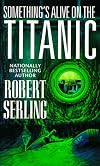
Something's Alive on the Titanic has a bit of a split story line, with one part of the book taking place in 1975, and the other part taking place in 1995. Written by the late Robert Serling, who is, in fact, Rod Serling's older brother, Something's Alive on the Titanic plays off of the idea that Dr. Robert Ballard was not the first one to discover the final resting place of the Titanic. Instead, a team led by John Hawke, at the behest of code-breaker Derek Montague, departs on an expedition show more to retrieve treasure from the Titanic's watery grave after Montague discovers that a shipment from a smuggling ring under the guise of a salvage company by the name of Sovereign Metals.
A true product of its time, and remaining faithful to the time-period in which the story is set, one of the few things of note to make in regards to its characters is the absolute lack of a strong female presence. The two women that are present, especially Chaney in the 1975 portion of the book, are Mary Sue-esque and, without a doubt, sexualized. Another note to be made comes in the form of the male characters: they are portrayed as stereotypical, stubborn men that, despite being superstitious, are also skeptics. This manner of male character is more prominent in the second part of the book than the first.
The plot, on the other hand, was pretty stellar. In 1975, the expedition lacks the proper equipment to dive down into the depths of the Atlantic and explore the ship for extended periods of time. They make the most of what they do have, however. Intent on claiming the lost treasure, most of John Hawke's crew show little regard for the fact that they are desecrating a grave: greed is, after all, the heart of all evil. While the Atlantic Ocean treats the crew well, the Titanic is anything but forgiving: the decrepit ship plays host to more than the relics of the souls that once stood upon its deck. Whatever that thing is, it doesn't play nicely. In 1995, the US Navy gathers a crew to find out what exactly happened in 1975, and to complete the earlier expedition's salvage mission.
Given the presence of a female in a heavily male dominated field, it goes without saying that there's a bit of teasing and a bit of romance. That subplot is fairly minor and serves mostly to remind readers of a certain character's penchant for being a total asshole and little more. There is also sex, briefly, but I'll leave that to someone else.
Serling's knowledge of the Titanic is actually pretty accurate, down to the fact that the fourth funnel on the ship was a fake, there was a shortage of lifeboats, and most of the lifeboats were dropped before they were filled.
It isn't very often that a book really draws me in, but that could be attributed to the fact that I no longer read as I used to. Serling's prose kept me on the edge of my seat and at times, it even raised my heart rate a little. Rather than paint us an entire picture of the supernatural phenomena that takes place, he begins with little bits and pieces, crumbs if you will, until finally, you begin to question the sanity of the characters involved, whilst simultaneously hoping for the best. show less
A true product of its time, and remaining faithful to the time-period in which the story is set, one of the few things of note to make in regards to its characters is the absolute lack of a strong female presence. The two women that are present, especially Chaney in the 1975 portion of the book, are Mary Sue-esque and, without a doubt, sexualized. Another note to be made comes in the form of the male characters: they are portrayed as stereotypical, stubborn men that, despite being superstitious, are also skeptics. This manner of male character is more prominent in the second part of the book than the first.
The plot, on the other hand, was pretty stellar. In 1975, the expedition lacks the proper equipment to dive down into the depths of the Atlantic and explore the ship for extended periods of time. They make the most of what they do have, however. Intent on claiming the lost treasure, most of John Hawke's crew show little regard for the fact that they are desecrating a grave: greed is, after all, the heart of all evil. While the Atlantic Ocean treats the crew well, the Titanic is anything but forgiving: the decrepit ship plays host to more than the relics of the souls that once stood upon its deck. Whatever that thing is, it doesn't play nicely. In 1995, the US Navy gathers a crew to find out what exactly happened in 1975, and to complete the earlier expedition's salvage mission.
Given the presence of a female in a heavily male dominated field, it goes without saying that there's a bit of teasing and a bit of romance. That subplot is fairly minor and serves mostly to remind readers of a certain character's penchant for being a total asshole and little more. There is also sex, briefly, but I'll leave that to someone else.
Serling's knowledge of the Titanic is actually pretty accurate, down to the fact that the fourth funnel on the ship was a fake, there was a shortage of lifeboats, and most of the lifeboats were dropped before they were filled.
It isn't very often that a book really draws me in, but that could be attributed to the fact that I no longer read as I used to. Serling's prose kept me on the edge of my seat and at times, it even raised my heart rate a little. Rather than paint us an entire picture of the supernatural phenomena that takes place, he begins with little bits and pieces, crumbs if you will, until finally, you begin to question the sanity of the characters involved, whilst simultaneously hoping for the best. show less
Lists
Awards

You May Also Like


Associated Authors
Statistics
- Works
- 37
- Also by
- 2
- Members
- 1,083
- Popularity
- #23,732
- Rating
- 3.6
- Reviews
- 30
- ISBNs
- 46
- Languages
- 2
- Favorited
- 1