
Stephanie Sabol
Author of What Was the Titanic?
Works by Stephanie Sabol
NEW-What Was the Titanic? 1 copy
Tagged
Common Knowledge
There is no Common Knowledge data for this author yet. You can help.
Members
Reviews

Just like their enchantment with dinosaurs, pirates, and animals, children across the globe love to learn about the solar system. Heck, I’m in my 40s, yet I can remember doing an oral presentation (possibly my very first), where I stood up at the front of the class and nervously sputtered out the names of the colourful orbs I had cut out from construction paper and displayed on a navy blue, pencil-crayoned poster board. Dollar stores weren't around every corner, with a devoted section to show more Bristol board, displaying every colour of the rainbow.
With technology being what it is, kids have it too easy these days! And how often do they even do a physical presentation, given the habits being adapted through COVID virtual learning? With the choice available to him, my son has opted multiple times now for online slide projects as opposed to the cutting, pasting, and printing required for a tangible design.
Never mind research trips to the library for facts and content - which I loved - this lad only needs to do a simple web search and he's met with endless pages of info to draw from; easy, peasy!
Where is Our Solar System? is not only a fun and interesting read, it would have been the perfect resource for doing a project back in the olden days. This one book would give you all the interesting data you needed for any middle grade project.
Historically speaking, the book informs us of how watching the sky helped ancient people with navigating their ships based on the stars, how they told time with the position of the sun, and how they would organise planting schedules based on the moon’s phases, for better yields at harvest. We learn how planets were first discovered with the naked eye of early stargazers, and how the curiosity of early Greek scientists led to the study of astronomy.
There are sections devoted to describing a few of the planets, their size in comparison to Earth, I found to be very enlightening. Although my little space lover was quick to inform me, “You’re just late to the party, Mummy!’ I learned a fascinating fact about Jupiter: its famous red spot is a storm that has been raging for 350 years! To the thrill of my son, special attention was also paid to the planet Mars, and the Curiosity Rover that landed there in 2012.
Learning is made easy as the informative diagrams and pictures throughout are not only attractive but help to explain some of the concepts visually for little ones. For example, a basketball court is used to describe the Earth’s distance from the sun, the Earth’s axis, and the resulting season changes around the globe.
Minor mention of UFOs, and aliens, are part of the recount, as well as major innovations in space exploration like the Hubble Telescope, and the ISS. To find out where it all began, we were informed of the space race that spurred JFK to extensively fund space research, with the goal to beat the Russian Cosmonauts in putting the first man on the moon.
We really enjoyed reading this one from Who HQ, and this novice learned a tonne of new things since my early years when I was fascinated by our solar system. I’ve rounded up to 4.5 stars for my rating, so make sure to share this educational book with your budding astronomer, they won’t be disappointed!
To see the bookmark I was inspired to make after reading Where Is Our Solar System? please visit my blog post at: https://peachybooks.ca/2021/06/03/review-where-is-our-solar-system-by-stephanie-... show less
With technology being what it is, kids have it too easy these days! And how often do they even do a physical presentation, given the habits being adapted through COVID virtual learning? With the choice available to him, my son has opted multiple times now for online slide projects as opposed to the cutting, pasting, and printing required for a tangible design.
Never mind research trips to the library for facts and content - which I loved - this lad only needs to do a simple web search and he's met with endless pages of info to draw from; easy, peasy!
Where is Our Solar System? is not only a fun and interesting read, it would have been the perfect resource for doing a project back in the olden days. This one book would give you all the interesting data you needed for any middle grade project.
Historically speaking, the book informs us of how watching the sky helped ancient people with navigating their ships based on the stars, how they told time with the position of the sun, and how they would organise planting schedules based on the moon’s phases, for better yields at harvest. We learn how planets were first discovered with the naked eye of early stargazers, and how the curiosity of early Greek scientists led to the study of astronomy.
There are sections devoted to describing a few of the planets, their size in comparison to Earth, I found to be very enlightening. Although my little space lover was quick to inform me, “You’re just late to the party, Mummy!’ I learned a fascinating fact about Jupiter: its famous red spot is a storm that has been raging for 350 years! To the thrill of my son, special attention was also paid to the planet Mars, and the Curiosity Rover that landed there in 2012.
Learning is made easy as the informative diagrams and pictures throughout are not only attractive but help to explain some of the concepts visually for little ones. For example, a basketball court is used to describe the Earth’s distance from the sun, the Earth’s axis, and the resulting season changes around the globe.
Minor mention of UFOs, and aliens, are part of the recount, as well as major innovations in space exploration like the Hubble Telescope, and the ISS. To find out where it all began, we were informed of the space race that spurred JFK to extensively fund space research, with the goal to beat the Russian Cosmonauts in putting the first man on the moon.
We really enjoyed reading this one from Who HQ, and this novice learned a tonne of new things since my early years when I was fascinated by our solar system. I’ve rounded up to 4.5 stars for my rating, so make sure to share this educational book with your budding astronomer, they won’t be disappointed!
To see the bookmark I was inspired to make after reading Where Is Our Solar System? please visit my blog post at: https://peachybooks.ca/2021/06/03/review-where-is-our-solar-system-by-stephanie-... show less
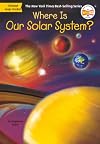
I found this book to be very interesting and informative. Young children who are fascinated by space and planets will love reading this book! It has many illustrations that will help children understand the concepts of the solar system in a fun and easy way. The book even includes a large colorful map that children can look at for reference! Not only does Stephanie Sabol teach about where the different planets are in the solar system, she also teaches about the histories of the solar system show more and planets which make the learning much more enjoyable and relatable. show less
A page in the book states: "Because of astronomy - the scientific study of objects in space - we know there are no gods or dragons ruling over the heavens."
Recommended Reading Ages: 8 – 12
Length:112 Pages
Part of a series: What Was?
Length:112 Pages
Part of a series: What Was?
You May Also Like


Associated Authors
Statistics
- Works
- 6
- Members
- 1,672
- Popularity
- #15,366
- Rating
- 3.9
- Reviews
- 6
- ISBNs
- 47
- Languages
- 1
- Favorited
- 1