
Jeremy R. Strong
Author of Lectures on Weird Fiction: Volume 1
Series
Works by Jeremy R. Strong
Tagged
Common Knowledge
- Gender
- male
Members
Reviews

I appreciated getting the ARC of this title from the author and the Early Reviewers program.
The subject is near and dear to my wizened little heart: I am a longtime reader (and wannabe writer) of "weird" fiction, and there are too few studies devoted to it.
Another reviewer was put off by the 'involvement' of AI. I probably won't address this much, here -- the stated involvement appears to be limited to "editing, transcribing, and formatting" content that already existed (the author also show more apparently used AI to create the images, about which more below). I'm going to take the author at his word and *assume* AI was not used to write this, or to make judgments, etc.
So what do we have here? The book is a series of essays on nine "weird" short stories (and one movie), chronologically ranging from 1910 to 2002 ... basically, the 20th century. The authors' names are mostly familiar: H. P. Lovecraft, Ray Bradbury, for example, but there are some surprising and pleasing inclusions like Leonora Carrington, who deserves as much attention as she can get, and Stefan Grabinski. A couple of the authors are unknown to me.
The 'gimmick' here -- if I can call it that -- is that these are edited copies of actual lectures by the author. That means the text contains questions from students, occasional digressions by the lecturer and rhetorical questions.
And so on.
I confess I find this format, which might more accurately be called a tone or a zoo of tones, to be somewhat off-putting. I think I can see what the author was after, but I'm not convinced the goal was achieved. The author says in the Introduction (which is a bit overlong) that he worked hard in the editing process to remove his "most pernicious phatic utterances." OK. That's actually funny. But there are still a lot of references in the text to "later this semester" and even to things that happened before the class began. Hmm. We're NOT actually in this class ... you know?
Stuff like this: "Did I hint earlier that Mrs. DeRopp might hope to inherit Conradin's estate? Yes, I think I did" scream "dammit, get an editor!" to me. It's distracting & has no function. And then there is the fact that instances of "um" and so forth are lovingly preserved. Why?
In the book's and the author's defense, I found his analyses of the included stories to be ... well, just fine. This *is* the sort of analysis I'm familiar with from having done it back in college. There's nothing wrong with the intellectual content -- the problem is with how it is wrapped. I think it would do the author good to pull back from the "present it as it happened" model (if that's what it is) and either edit, edit, edit or get someone to do it for him. It would be much better to find a ground that is informal (if that's what he wants) but isn't so shambolic that it seems lazy. And the form of this book comes across as ... lazy.
You've got all the content present and accounted for, Mr. Strong ... now shape it!
The AI-inspired-or-assisted images are ... well, they're OK. It would probably not be a surprise if I told you they lack individuality and anything recognizable as artistic 'character.' They're agreeably spooky, I suppose, but there are probably too many of them.
[And if you are going to commit factual errors to print, I recommend they don't happen right at the beginning. H. H. Munro/Saki did not write "The Monkey's Paw." W. W. Jacobs did. This is one of the most well-known "weird" stories of all time -- how did the author manage this one? I think I could fairly call this a "howler."] show less
The subject is near and dear to my wizened little heart: I am a longtime reader (and wannabe writer) of "weird" fiction, and there are too few studies devoted to it.
Another reviewer was put off by the 'involvement' of AI. I probably won't address this much, here -- the stated involvement appears to be limited to "editing, transcribing, and formatting" content that already existed (the author also show more apparently used AI to create the images, about which more below). I'm going to take the author at his word and *assume* AI was not used to write this, or to make judgments, etc.
So what do we have here? The book is a series of essays on nine "weird" short stories (and one movie), chronologically ranging from 1910 to 2002 ... basically, the 20th century. The authors' names are mostly familiar: H. P. Lovecraft, Ray Bradbury, for example, but there are some surprising and pleasing inclusions like Leonora Carrington, who deserves as much attention as she can get, and Stefan Grabinski. A couple of the authors are unknown to me.
The 'gimmick' here -- if I can call it that -- is that these are edited copies of actual lectures by the author. That means the text contains questions from students, occasional digressions by the lecturer and rhetorical questions.
And so on.
I confess I find this format, which might more accurately be called a tone or a zoo of tones, to be somewhat off-putting. I think I can see what the author was after, but I'm not convinced the goal was achieved. The author says in the Introduction (which is a bit overlong) that he worked hard in the editing process to remove his "most pernicious phatic utterances." OK. That's actually funny. But there are still a lot of references in the text to "later this semester" and even to things that happened before the class began. Hmm. We're NOT actually in this class ... you know?
Stuff like this: "Did I hint earlier that Mrs. DeRopp might hope to inherit Conradin's estate? Yes, I think I did" scream "dammit, get an editor!" to me. It's distracting & has no function. And then there is the fact that instances of "um" and so forth are lovingly preserved. Why?
In the book's and the author's defense, I found his analyses of the included stories to be ... well, just fine. This *is* the sort of analysis I'm familiar with from having done it back in college. There's nothing wrong with the intellectual content -- the problem is with how it is wrapped. I think it would do the author good to pull back from the "present it as it happened" model (if that's what it is) and either edit, edit, edit or get someone to do it for him. It would be much better to find a ground that is informal (if that's what he wants) but isn't so shambolic that it seems lazy. And the form of this book comes across as ... lazy.
You've got all the content present and accounted for, Mr. Strong ... now shape it!
The AI-inspired-or-assisted images are ... well, they're OK. It would probably not be a surprise if I told you they lack individuality and anything recognizable as artistic 'character.' They're agreeably spooky, I suppose, but there are probably too many of them.
[And if you are going to commit factual errors to print, I recommend they don't happen right at the beginning. H. H. Munro/Saki did not write "The Monkey's Paw." W. W. Jacobs did. This is one of the most well-known "weird" stories of all time -- how did the author manage this one? I think I could fairly call this a "howler."] show less
 This review was written for LibraryThing Early Reviewers.
The topic of this book is fascinating. Although I’m a lifelong reader of the stories defined here as weird fiction, in reading this book I still learned a lot about some familiar authors as well as being introduced to new ones. I succeeded in reading all of the featured stories as I read through the book, as well as storing up for the future some other pieces by the authors who were discussed. The book identifies some useful themes that appear throughout weird fiction, including the use of show more liminal spaces, ways of being monstrous, and sources of uncanniness.
That said, this is a mixed review. One reservation I had is that the prose style of the book was quite casual, consisting of transcriptions of spoken material. I would have been a happier reader if this had been refined more solidly into prose for the printed modality. Not necessarily highly academic prose, but smoother, more edited writing. In my field there are a number of famous sets of “lectures” that are in fact edited versions of public talks in a form that is meant to be read. My complaint here is that the author seems undecided whether he's documenting the classroom experience or creating a distinct reader experience.
Organizationally, the chapters are arranged in the chronological order of the publication of the stories being discussed. However, the content of the lectures frequently talks about material that the class has already read that has not appeared in the previous chapters. So, it’s a bit unclear what the intended organizing principle is.
Regarding the use of AI—mentioned in other reviews--the AI illustrations were a point of frustration. My partner is a visual artist, and I have learned to be quite wary of prompt-driven art that steals images from an underlying base of other people’s work. But more crucially, the illustrations would have been stronger if they’d been based on real drawings from original publications, instead of exaggerated amalgams. For example, the final story by Neil Gaiman was originally a comic, a panel of which would have made a striking illustration. But on an issue separate from that of graphics, frankly, as it was a lecture, and meant to inform, the larger work would have benefited by some signposting of PowerPoint overviews and quotes that are mentioned in the talks. And crucially, readers would benefit from seeing the images that the author talked about, such as the monument to Lovecraft. Other mentioned visual examples include: “You can see from this highlight here” (p. 79). “As you can see here, I have a few paintings on the screen (p. 103). And “this slide gives us a little bit of interesting information” (p. 165). I can only assume that Strong did not have the copyright to share all these with a larger reading public, but if not, I would have not referenced them in the written version of the lectures.
Lastly, there are some inaccuracies about the stories. For Bradbury’s “The Crowd,” for example, Strong is mistaken about a secondary character dying.
All in all, the subject matter was intriguing, but the volume seems a bit thrown together. show less
That said, this is a mixed review. One reservation I had is that the prose style of the book was quite casual, consisting of transcriptions of spoken material. I would have been a happier reader if this had been refined more solidly into prose for the printed modality. Not necessarily highly academic prose, but smoother, more edited writing. In my field there are a number of famous sets of “lectures” that are in fact edited versions of public talks in a form that is meant to be read. My complaint here is that the author seems undecided whether he's documenting the classroom experience or creating a distinct reader experience.
Organizationally, the chapters are arranged in the chronological order of the publication of the stories being discussed. However, the content of the lectures frequently talks about material that the class has already read that has not appeared in the previous chapters. So, it’s a bit unclear what the intended organizing principle is.
Regarding the use of AI—mentioned in other reviews--the AI illustrations were a point of frustration. My partner is a visual artist, and I have learned to be quite wary of prompt-driven art that steals images from an underlying base of other people’s work. But more crucially, the illustrations would have been stronger if they’d been based on real drawings from original publications, instead of exaggerated amalgams. For example, the final story by Neil Gaiman was originally a comic, a panel of which would have made a striking illustration. But on an issue separate from that of graphics, frankly, as it was a lecture, and meant to inform, the larger work would have benefited by some signposting of PowerPoint overviews and quotes that are mentioned in the talks. And crucially, readers would benefit from seeing the images that the author talked about, such as the monument to Lovecraft. Other mentioned visual examples include: “You can see from this highlight here” (p. 79). “As you can see here, I have a few paintings on the screen (p. 103). And “this slide gives us a little bit of interesting information” (p. 165). I can only assume that Strong did not have the copyright to share all these with a larger reading public, but if not, I would have not referenced them in the written version of the lectures.
Lastly, there are some inaccuracies about the stories. For Bradbury’s “The Crowd,” for example, Strong is mistaken about a secondary character dying.
All in all, the subject matter was intriguing, but the volume seems a bit thrown together. show less
This review was written for LibraryThing Early Reviewers.Received this as an early reviewer.
This book is exactly what it says it is. The chapters are full transcriptions of lectures the author gave, including questions put to the class, answers, student questions and commentary. I find this to be a distracting choice. While I appreciate the conversational manner of the lectures, it just doesn't make for an enjoyable read to me. I'm sure his lectures are very engaging in person. A series of webinars would be a better medium for this content. The show more follow-up for teachers and students section isn't bad, but it is fairly standard and routine.
The author begins by letting everyone know he resorted to the use of AI for editing, formatting, and transcribing content. This is an interesting note as I feel each of those components could be improved.
Due to the exact transcription of the classroom setting, this was a hard slog for me. If you are willing to spend time wading through the classroom chatter to distill the actual learning objectives, it could prove informational. show less
This book is exactly what it says it is. The chapters are full transcriptions of lectures the author gave, including questions put to the class, answers, student questions and commentary. I find this to be a distracting choice. While I appreciate the conversational manner of the lectures, it just doesn't make for an enjoyable read to me. I'm sure his lectures are very engaging in person. A series of webinars would be a better medium for this content. The show more follow-up for teachers and students section isn't bad, but it is fairly standard and routine.
The author begins by letting everyone know he resorted to the use of AI for editing, formatting, and transcribing content. This is an interesting note as I feel each of those components could be improved.
Due to the exact transcription of the classroom setting, this was a hard slog for me. If you are willing to spend time wading through the classroom chatter to distill the actual learning objectives, it could prove informational. show less
This review was written for LibraryThing Early Reviewers.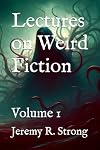
Great series of articles or pieces on weird literature. Now, I am biased, as this is one of my favorite genres. R.E. Howard. H.P. Lovecraft. Etc. Love them! And after reading everything these great authors wrote, you start wanting to read scholarly articles on them. This book scratches that itch, and in a fine way.
This review was written for LibraryThing Early Reviewers.Statistics
- Works
- 4
- Members
- 23
- Popularity
- #537,597
- Rating
- 3.1
- Reviews
- 8
- ISBNs
- 4
