
Nick Herbert (1) (1936–)
Author of Quantum Reality: Beyond the New Physics
For other authors named Nick Herbert, see the disambiguation page.
About the Author
Image credit: Photo courtesy of Nick Herbert
Works by Nick Herbert
Associated Works
Future Science: Life Energies and the Physics of Paranormal Phenomena (1977) — Contributor — 26 copies
Tagged
Common Knowledge
- Birthdate
- 1936-09-07
- Gender
- male
- Education
- Ohio State University
Stanford University - Occupations
- physicist
- Organizations
- Lawrence Berkeley National Laboratory
- Nationality
- USA
- Birthplace
- Pittsburgh, Pennsylvania, USA
- Associated Place (for map)
- Pennsylvania, USA
Members
Reviews
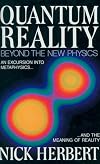
This book is really comprehensive towards the most commonly accepted ontologies, and goes over several of the major quantum oddities (the measurement problem, nonlocality, etc.) and gives the standard response from each ontology.
The term "quantumstuff" is really a solid way to talk to non-physicists about wave-particle duality, and I found the detail given to the neorealist perspective refreshing.
The term "quantumstuff" is really a solid way to talk to non-physicists about wave-particle duality, and I found the detail given to the neorealist perspective refreshing.
This is a great book by Nick Herbert. This is a book that deals with the interpretation of Quantum Physics. But its importance is that it deals not with a 'spiritual' or 'mystical' understanding of quantum physics but with how scientists and physicists themselves interpret quantum physics. It is a book of pure science and there is no quantum mysticism involved here.
Nick Lembert discusses basically eight different interpretations of quantum physics. These include the Copenhagen show more interpretation, Feynman's interpretation, the 'multiple worlds' interpretation, etc. All these interpretations are the work of the greatest physicists in quantum physics. These are the ways in which the scientists understand how physics work. They are not important in getting the results of quantum dynamics, the maths of quantum physics works independently of which interpretation we may choose to believe.
And this is where Herbert shows the craziness of quantum physics: although all these interpretations are radically different from each other, they can all explain quantum physics equally well. Neither we, the non-physicists, nor the greatest physicists in the world, really know what actually is going on in this strange little world, whether the particles are behaving according to the Copehnhagen interpretation, the multiple world explanation, etc. Herbert handles this very well, we get a sense of why Feynman said, 'just shut up and calculate'. Scientists dont understand the basic reality of quantum physics either!
Another very useful thing I took away from the book was the explanation of the wave equations of Quantum Physics. Herbert does a fine job of showing what exactly waves are and how physics describes the particles as waves and what this means. This again shows up the mysteriousness of Quantum Physics in another way.
All in all, I would call this a very important book to understand the general principles of quantum physics, one that is vital because it sets out the different interpretations in a very clear and comprehensible manner. show less
Nick Lembert discusses basically eight different interpretations of quantum physics. These include the Copenhagen show more interpretation, Feynman's interpretation, the 'multiple worlds' interpretation, etc. All these interpretations are the work of the greatest physicists in quantum physics. These are the ways in which the scientists understand how physics work. They are not important in getting the results of quantum dynamics, the maths of quantum physics works independently of which interpretation we may choose to believe.
And this is where Herbert shows the craziness of quantum physics: although all these interpretations are radically different from each other, they can all explain quantum physics equally well. Neither we, the non-physicists, nor the greatest physicists in the world, really know what actually is going on in this strange little world, whether the particles are behaving according to the Copehnhagen interpretation, the multiple world explanation, etc. Herbert handles this very well, we get a sense of why Feynman said, 'just shut up and calculate'. Scientists dont understand the basic reality of quantum physics either!
Another very useful thing I took away from the book was the explanation of the wave equations of Quantum Physics. Herbert does a fine job of showing what exactly waves are and how physics describes the particles as waves and what this means. This again shows up the mysteriousness of Quantum Physics in another way.
All in all, I would call this a very important book to understand the general principles of quantum physics, one that is vital because it sets out the different interpretations in a very clear and comprehensible manner. show less

Great exposition of quantum mechanics. The most memorable for me was his telling of all the different types of waveshapes that can be considered as representations. He used the analogy of a synthesizer to great effect.
A clear yet rather extensive introduction to the relationship between Quantum theory and a definition of reality. Though Herbert's book can be used as an introduction to the core of Quantum theory, the book is intended to explore the relationship between the theory and what can be asserted about the very nature of reality. This is even better if you have already started with one of the numerous book meant to describe the theory only.
Four stars only because the book is getting a bit old :)
Four stars only because the book is getting a bit old :)
Lists
You May Also Like


Associated Authors
Statistics
- Works
- 4
- Also by
- 2
- Members
- 755
- Popularity
- #33,681
- Rating
- 3.8
- Reviews
- 6
- ISBNs
- 15
- Languages
- 2