
Sophie Mackintosh
Author of The Water Cure
About the Author
Image credit: David Higham Associates
Series
Works by Sophie Mackintosh
The Weak Spot {short story} 1 copy
Associated Works
Tagged
Common Knowledge
- Birthdate
- 1988
- Gender
- female
- Nationality
- UK
- Birthplace
- South Wales, UK
- Places of residence
- Pembrokeshire, Wales, UK
London, England, UK - Associated Place (for map)
- UK
Members
Reviews
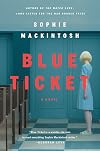
We Know Your Best Life
Throughout history societies have deemed it important to control women, as if left on their own they would wreak havoc on themselves and everybody around them. (Blame Aristotle, Robert Filmer, et al., not your reviewer.)
In Sophie Mackintosh’s dystopian novel Blue Ticket, set in some vague time and country, society solves the problem of female free choice by dictating what sort of life a woman will live. A select few receive a white ticket upon reaching puberty, show more entitling them to have children, homes, and husbands. Most draw a blue ticket (why most isn’t explained), which denies them childbearing but allows them to hold jobs and generally live somewhat independent lives.
Somewhat, because in this world, society keeps an eye on its women, especially the blue ticket variety, providing them with doctors that appear to be psychologists who quell whatever angst these women might be suffering. You might view all this as a metaphor for how real society once treated women who thought they might enjoy a life other than married with children, odd, needing watching, and prone to hysteria.
You might regard Blue Ticket as a cautionary, that if we aren’t careful we might find ourselves smacked back a couple of decades. And you know there are whole groups who not only would like this but who are actively working toward that.
In Mackintosh’s dystopia conjuring, Calla draws a blue ticket and proceeds to lead her life as an apparently unfettered woman. She studies. She gets a good, meaningful job. She drinks. She smokes. She hangs in bars. She picks up men. She has sex. She does this for years, but as the years pass, she grows dissatisfied. Within her grows a desire to know what it would be like to have a child, to give and receive unconditional love. Her doctor labors to keep her on the straight and narrow, but without success. One day, Calla removes her IUD and shortly afterwards she discovers herself pregnant by a man she thinks she might love and she hopes might love her. Wrong. She’s on her own, and then, after her doctor discovers her pregnancy, she’s on the run.
On the road, she meets several women in the same situation as she is. Their objective, as is hers, is to reach the border and in another country live the lives of their choice. They form a nomadic community and Calla even finds love with one of the women, Marisol. At this point, the novel takes some turns that demonstrate the authoritarian society in which these women exist does not easily relinquish control of its women.
Whether you enjoy this novel probably will depend on a number of things. Do you have to love your characters? Do you need your dystopia fully fleshed out? Are you okay with antiseptic writing that can seem rather cool? Yes to any of these questions could mean you’re in for a slog. Otherwise, you will find the whole exercise intriguing, even if it does leave you a bit emotionally unfulfilled, like life in Mackintosh’s world. However, many readers will find better choices featuring dystopian worlds designed to repress women. show less
Throughout history societies have deemed it important to control women, as if left on their own they would wreak havoc on themselves and everybody around them. (Blame Aristotle, Robert Filmer, et al., not your reviewer.)
In Sophie Mackintosh’s dystopian novel Blue Ticket, set in some vague time and country, society solves the problem of female free choice by dictating what sort of life a woman will live. A select few receive a white ticket upon reaching puberty, show more entitling them to have children, homes, and husbands. Most draw a blue ticket (why most isn’t explained), which denies them childbearing but allows them to hold jobs and generally live somewhat independent lives.
Somewhat, because in this world, society keeps an eye on its women, especially the blue ticket variety, providing them with doctors that appear to be psychologists who quell whatever angst these women might be suffering. You might view all this as a metaphor for how real society once treated women who thought they might enjoy a life other than married with children, odd, needing watching, and prone to hysteria.
You might regard Blue Ticket as a cautionary, that if we aren’t careful we might find ourselves smacked back a couple of decades. And you know there are whole groups who not only would like this but who are actively working toward that.
In Mackintosh’s dystopia conjuring, Calla draws a blue ticket and proceeds to lead her life as an apparently unfettered woman. She studies. She gets a good, meaningful job. She drinks. She smokes. She hangs in bars. She picks up men. She has sex. She does this for years, but as the years pass, she grows dissatisfied. Within her grows a desire to know what it would be like to have a child, to give and receive unconditional love. Her doctor labors to keep her on the straight and narrow, but without success. One day, Calla removes her IUD and shortly afterwards she discovers herself pregnant by a man she thinks she might love and she hopes might love her. Wrong. She’s on her own, and then, after her doctor discovers her pregnancy, she’s on the run.
On the road, she meets several women in the same situation as she is. Their objective, as is hers, is to reach the border and in another country live the lives of their choice. They form a nomadic community and Calla even finds love with one of the women, Marisol. At this point, the novel takes some turns that demonstrate the authoritarian society in which these women exist does not easily relinquish control of its women.
Whether you enjoy this novel probably will depend on a number of things. Do you have to love your characters? Do you need your dystopia fully fleshed out? Are you okay with antiseptic writing that can seem rather cool? Yes to any of these questions could mean you’re in for a slog. Otherwise, you will find the whole exercise intriguing, even if it does leave you a bit emotionally unfulfilled, like life in Mackintosh’s world. However, many readers will find better choices featuring dystopian worlds designed to repress women. show less
This book sure sparked lots of discussion at our book club meeting. It is the story of Elodie, who lives a monotonous life in a small town, largely ignored by her husband. And the story of Violet, the wife of an ambassador who arrives in town. Violet is a master of manipulation -- approaching and withdrawing from Elodie; being somehow both helpless and powerful. No wonder Elodie becomes obsessed with her.
As Elodie tells us what happened in their small town where many people went mad or died show more one summer, her reality begins to blur and her imagination comes increasingly into her account. So what actually happened? I certainly don't know. But it was a good read. It felt like neither the characters nor the reader could get away from impending disaster. There is a sinister tone to the writing. The book explores desire and obsession from a female perspective, and that was very interesting and left lots to think about.
The ending is ambiguous, as is the "ending" of the true story the book is somewhat based on. show less
As Elodie tells us what happened in their small town where many people went mad or died show more one summer, her reality begins to blur and her imagination comes increasingly into her account. So what actually happened? I certainly don't know. But it was a good read. It felt like neither the characters nor the reader could get away from impending disaster. There is a sinister tone to the writing. The book explores desire and obsession from a female perspective, and that was very interesting and left lots to think about.
The ending is ambiguous, as is the "ending" of the true story the book is somewhat based on. show less
This is a beautifuly written thought experiment on the nature of love, illicit love, and the impermanence of relationships. It explores how life can come between two people, change them and their circumstances, and how longing can sometimes be superior to fulfillment. The novel reminded me of Keats' "Ode on a Grecian Urn." The battle between perfect but static beauty (here, love) on the one hand, and imperfect, decaying but fulfilling real life on the other.
Please, publishers, I beg of you, show more cease the abhorrent practice of not using quotation marks for dialogue. WE ARE BEGGING YOU show less
Please, publishers, I beg of you, show more cease the abhorrent practice of not using quotation marks for dialogue. WE ARE BEGGING YOU show less

This novel tells the story of three young women living on a Scottish island with their parents. They have spent their lives there and know that off the island is a world where men hurt women, the air is toxic and they would surely die. Living in an isolated, decaying hotel, protected by the rites and tests designed to keep them wary and safe, they find various ways to survive. The oldest, Grace, has been rewarded for her diligence with a swelling stomach while Lia, the middle daughter, cuts show more herself for the good of all of them. Their father leaves one day, and then the two men and a boy show up on their island.
This is an odd and dreamy dystopian novel where the reader is left in the same information-deprived limbo as the three women. They're trying to survive, but what they've been taught might not actually be true and their father was perhaps not the protector they believed him to be. I read this book desperately wanting more information about the world this novel exists in, but by the end of the story, I had just enough to satisfy me, without spelling out everything. Sophie MacKintosh writes evocatively about the inner lives of these isolated women, but if you're looking for clear resolutions, they remain tantalizingly just out of sight. show less
This is an odd and dreamy dystopian novel where the reader is left in the same information-deprived limbo as the three women. They're trying to survive, but what they've been taught might not actually be true and their father was perhaps not the protector they believed him to be. I read this book desperately wanting more information about the world this novel exists in, but by the end of the story, I had just enough to satisfy me, without spelling out everything. Sophie MacKintosh writes evocatively about the inner lives of these isolated women, but if you're looking for clear resolutions, they remain tantalizingly just out of sight. show less
Lists
Awards


You May Also Like


Associated Authors
Statistics
- Works
- 7
- Also by
- 4
- Members
- 1,588
- Popularity
- #16,242
- Rating
- 3.9
- Reviews
- 69
- ISBNs
- 62
- Languages
- 3
- Favorited
- 1