
Christina Dalcher
Author of Vox
About the Author
Christina Dalcher is a Linguist, Teacher, and writer, based in Northfolk, Virginia. She earned her doctorate in theoretical linguistics from Georgetown University. Her short stories and flash fiction have been published in numerous journals. Her debut novel is entitled Vox and was published in show more August 2018. (Bowker Author Biography) show less
Image credit: Christina Dalcher
Works by Christina Dalcher
Tagged
Common Knowledge
- Birthdate
- 20th century
- Gender
- female
- Education
- Georgetown University (PhD ) (theoretical linguistics) (2006)
George Mason University (MA) (linguistics) (2000)
University of Virginia (BA) (drama) (1989) - Occupations
- assistant professor of linguistics
Teacher of English as a Second Language - Organizations
- Khalifa University of Science, Technology and Research
University of Westminster
Queen Mary College, London University
The City Literary Institute, London
George Mason University
Northern Virginia Community College - Agent
- Laura Bradford
- Nationality
- USA
- Places of residence
- Northfolk, Virginia, USA
London, England, UK
United Arab Emirates
Members
Reviews
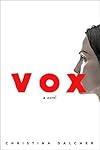
You’ve read The Handmaids Tale and you're caught up on the last episode of the series. Now what? Here’s one that might fill the bill - Vox by Christina Dalcher.
It’s not hard to imagine a future (present or past) where women’s lives are controlled by men. And how is that control achieved in Vox? By language - the lack of, to be precise. In Vox women are only allowed 100 words a day. They wear a silver band on their wrist that shocks them if they go over that limit, increasing in show more voltage with every word above the limit. It's all part of a return to 'traditional values'. "Pure"
Jeanne McClellan was a neurolinguist before her voice was taken away. It is only when the new president needs a cure for his brother that her bracelet is taken off and she’s brought in to resume work on her research - restoring language to brain-damaged individuals. But with every suppression...there's resistance. Vox details a time in the near future that isn't too hard to imagine.
I enjoyed Dalcher's world building. And yes, it's not much of a stretch to see the traditional value, male dominated society. Dalcher herself has worked in the linguistics field and that knowledge gave the plot depth and detail. There's lots of action as the tension ramps up to the final 'showdown'. The author has created a good cast of characters in both Jeanne and supporting players. I did find myself more drawn to those supporters though, instead of Jeanne. I didn't agree with some of her decisions or treatment of other resistance members.
Some developments and plot directions seemed a bit quick, if you will. There were points where I felt there should be more plausibility built in. But, on reading the publisher's notes, I learned that Vox was written in two months - which is pretty darn amazing.
There's lots of food for thought in Vox, mirroring many of today's news headlines. I was thoroughly entertained by Vox and would be curious to see what Dalcher writes next. (And that cover is great isn't it?!) show less
It’s not hard to imagine a future (present or past) where women’s lives are controlled by men. And how is that control achieved in Vox? By language - the lack of, to be precise. In Vox women are only allowed 100 words a day. They wear a silver band on their wrist that shocks them if they go over that limit, increasing in show more voltage with every word above the limit. It's all part of a return to 'traditional values'. "Pure"
Jeanne McClellan was a neurolinguist before her voice was taken away. It is only when the new president needs a cure for his brother that her bracelet is taken off and she’s brought in to resume work on her research - restoring language to brain-damaged individuals. But with every suppression...there's resistance. Vox details a time in the near future that isn't too hard to imagine.
I enjoyed Dalcher's world building. And yes, it's not much of a stretch to see the traditional value, male dominated society. Dalcher herself has worked in the linguistics field and that knowledge gave the plot depth and detail. There's lots of action as the tension ramps up to the final 'showdown'. The author has created a good cast of characters in both Jeanne and supporting players. I did find myself more drawn to those supporters though, instead of Jeanne. I didn't agree with some of her decisions or treatment of other resistance members.
Some developments and plot directions seemed a bit quick, if you will. There were points where I felt there should be more plausibility built in. But, on reading the publisher's notes, I learned that Vox was written in two months - which is pretty darn amazing.
There's lots of food for thought in Vox, mirroring many of today's news headlines. I was thoroughly entertained by Vox and would be curious to see what Dalcher writes next. (And that cover is great isn't it?!) show less
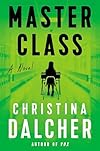
Master Class grabbed me from the start and at a third of the way through the book I was already thinking five stars and starting to write my review. However, the deceptively Dystopian atmosphere was soon replaced by a horrific realism as the author began to fill in the blanks to draw the parallels with Nazism and Nazi eugenics (better she should have left the term and history out of the novel to allow readers to draw their own conclusions). I felt like the author thought I needed to be hit show more over the head with this when, in fact, Malcom Scumbag’s seemingly innocuous remark about cheery films on Yellow Schools was all I needed to make the association with Kurt Gerron’s Nazi propaganda film painting the “model” Theresienstadt camp as a paradise for its Jewish inmates.
You see, I needed to make the association myself and draw my own conclusions instead of reducing the Holocaust to a literary gimmick – removing us from the realm of Dystopia.
So, this is basically where the author lost me. Just as Elena’s grandmother’s attempts to warn her of the evils of the Q testing for tier school grading did not absolve Granny of her own actions in the Hitler Youth, neither did Elena’s heroic actions to expose the system of dangerous selection process and (yes!) medical experiments on the undesirables (Yellow School pupils) mitigate her own responsibility in helping to create the monster. I don’t feel sorry for Elena. If the Q testing results had not sent her own daughter to a Yellow School it is most likely that Elena would have remained deaf, dumb, and blind as she watched and contributed to the selection process affecting the lives of others, lest perfect than her and hers.
Thank goodness there was no epilogue reducing the holocaust to some inconsequential period in history. show less
You see, I needed to make the association myself and draw my own conclusions instead of reducing the Holocaust to a literary gimmick – removing us from the realm of Dystopia.
So, this is basically where the author lost me. Just as Elena’s grandmother’s attempts to warn her of the evils of the Q testing for tier school grading did not absolve Granny of her own actions in the Hitler Youth, neither did Elena’s heroic actions to expose the system of dangerous selection process and (yes!) medical experiments on the undesirables (Yellow School pupils) mitigate her own responsibility in helping to create the monster. I don’t feel sorry for Elena. If the Q testing results had not sent her own daughter to a Yellow School it is most likely that Elena would have remained deaf, dumb, and blind as she watched and contributed to the selection process affecting the lives of others, lest perfect than her and hers.
Thank goodness there was no epilogue reducing the holocaust to some inconsequential period in history. show less
Much like traditional white feminism itself, this book comes up short. It's certainly believable in the catastrophe it sets up - after all, we're actually living it. But the resolution is pat and convenient and thus, false. See, when you convince tens and tens of millions of people - men and women both -that female subjugation is right and proper, and that there shouldn't be a separation of church and state -
I want to give the author credit for making the heroine deeply, deeply unlikable and flawed; but then I want to take away the credit because in the end she kind of just gets off scott free - don't like your old husband because he's an "intellectual pussy" (sic, and internalized misogyny noted) - hey cool, he gets it in the end along with a redemptive scheme showing you didn't pick wrong in the first place, what a hero he was, well and now she gets to have the sexy italian doctor / renaissance man she had an affair with. oh and she gets to live in sexy! amazing! italy! where everything's grand and expressive.
In the end for me this book just doesn't work. Want to say that people didn't really go along with the BS message? cool - then site the rebellion earlier on, before the tendrils of religiously inspired inferiority are in everything. Want to say that people really did buy into it all (as I think this author did) then don't offer up a pat bullshit ending involving the death or removal from power of a few people.
Imagine that a new President has been elected with the help of the extreme Christian right. So extreme, and so powerful, that they reverse over a hundred years of women's rights, and worse. Women are limited to 100 words a day, enforced by a "bracelet" they wear that administers worsening electric shocks for every word over the limit. Dalcher doesn't waste much time on the details of how this came about, which is fine, as they're largely beside the point for the purposes of her story. But, show more every time I caught myself saying "this is just too unbelievable - that would never happen here," I reminded myself that that's been said by other people at other times and places in history, and it could, and it did.
As for this book, though, comparisons to The Handmaid's Tale are inevitbale, but Vox has a different ambition. Dalcher doesn't pull her punches when it comes to the details of women's subjugation in the new regime, but the story focuses on a small group of people who suddenly realize that they can change everything.
Even that isn't the real point, though. Dalcher also pulls no punches in getting her message across. Everyone: use your voice. While you still can. show less
As for this book, though, comparisons to The Handmaid's Tale are inevitbale, but Vox has a different ambition. Dalcher doesn't pull her punches when it comes to the details of women's subjugation in the new regime, but the story focuses on a small group of people who suddenly realize that they can change everything.
Even that isn't the real point, though. Dalcher also pulls no punches in getting her message across. Everyone: use your voice. While you still can. show less
Lists
To Read (1)
Awards


You May Also Like


Associated Authors
Statistics
- Works
- 8
- Members
- 2,421
- Popularity
- #10,587
- Rating
- 3.5
- Reviews
- 157
- ISBNs
- 95
- Languages
- 10
- Favorited
- 2