
Raymond J. Healy (1907–1997)
Author of Adventures in Time and Space
About the Author
Works by Raymond J. Healy
Tagged
Common Knowledge
- Legal name
- Healy, Raymond John
- Birthdate
- 1907-09-21
- Date of death
- 1997-07-17
- Gender
- male
- Nationality
- USA
- Birthplace
- Brooklyn, New York, USA
- Place of death
- North Sandwich, New Hampshire, USA
- Associated Place (for map)
- USA
Members
Reviews

33 of the greatest stories novelettes and short novels by the best SF writers of all time: so it says on the cover of my Del Rey edition first published in 1975. You can never trust the blurb on the cover (especially when you discover there are actually 35 stories in the book), which had all appeared previously in American pulp fiction magazines: mostly in Astounding Science Fiction when it was under the editorship of John W Campbell from 1937-1945. This period up to and just beyond the show more second world war has justly been labelled The Golden Age of Science Fiction and most of these stories fit right into that Golden Age.
Some famous names from the period are represented here; Robert A Heinlein has three stories as does A E Van Vogt, John W Campbell writing under the pseudonym of Don A Stuart has two stories and there are stories by Isaac Asimov, Alfred Bester, Lewis Padgett and L Sprague Du Camp and all of these have some excellent pieces in the collection. There are 24 authors represented and a high percentage of the 35 stories are well worth reading, there are very few duds. I quite happily read the stories from end to end through nearly one thousand pages over a one week period without getting bored or feeling the need to turn to something else.
There are a few classic stories here that still hold the imagination today. “Who Goes there” by Don A Stuart has been filmed a number of times as “The Thing”: an Antartica expedition come across an alien spaceship deep in an ice field; they thaw out the alien pilot and unleash a creature that can imitate any life form with which it comes into contact and can do this with every cell of its body, the original story is well written and packs a massive punch. “The Dark Destroyer” is one of the best things I have read by A E Van Vogt, which moves through the gears from a hunter/stalker scenario to a modern space opera. “Adam and No Eve” is an atmospheric dystopian novella by Alfred Bester and “Nightfall” is a brilliant short story by Isaac Asimov who imagines a planet with six suns whose inhabitants go crazy every 2500 years when there is a total eclipse and there is nightfall. “He who Shrank” by Harry Hasse imagines that there are universes that exist as a succession of tiny particles and when a scientist invents a shrinking formula that reduces a person in size he will shrink down through a succession of universes ad infinitum. There are a few stories that imagine strange things happening in the present time (the 1930’s) and Lewis Padgett’s “The Twonky” and Raymond F Jones’ ‘The Correspondence Course” are two of the best of these. There are a clutch of time travel tales ranging from adventure stories following a step backwards or forwards in time to tales that explore the paradox of time travel.
The best stories from the Golden Age of science fiction contained ideas the stirred the imagination, it was not a time for much hard science fiction although in this collection there is a factual account of the German V2 rocket system. The ideas behind many of these tales were recycled through the comics of the 1960’s: publications like “Journey into Mystery” or “Strange Tales” by Atlas comics; stuff that I avidly collected as a kid and I was amazed that most of these stories originated from a period 20-30 years earlier.
I suppose that you have got to like science fiction to want to read this collection and you have got to remind yourself for whom they were written: mainly male young adults and so in many of the stories it is old fashioned American muscle that solves many of the tricky situations, but this is not always the case: females of course hardly get a look in. There is no great literature here, but many of the stories are well written and thoroughly entertaining if you have a mind to give them a fair hearing. I enjoyed myself and so 4.5 stars. show less
Some famous names from the period are represented here; Robert A Heinlein has three stories as does A E Van Vogt, John W Campbell writing under the pseudonym of Don A Stuart has two stories and there are stories by Isaac Asimov, Alfred Bester, Lewis Padgett and L Sprague Du Camp and all of these have some excellent pieces in the collection. There are 24 authors represented and a high percentage of the 35 stories are well worth reading, there are very few duds. I quite happily read the stories from end to end through nearly one thousand pages over a one week period without getting bored or feeling the need to turn to something else.
There are a few classic stories here that still hold the imagination today. “Who Goes there” by Don A Stuart has been filmed a number of times as “The Thing”: an Antartica expedition come across an alien spaceship deep in an ice field; they thaw out the alien pilot and unleash a creature that can imitate any life form with which it comes into contact and can do this with every cell of its body, the original story is well written and packs a massive punch. “The Dark Destroyer” is one of the best things I have read by A E Van Vogt, which moves through the gears from a hunter/stalker scenario to a modern space opera. “Adam and No Eve” is an atmospheric dystopian novella by Alfred Bester and “Nightfall” is a brilliant short story by Isaac Asimov who imagines a planet with six suns whose inhabitants go crazy every 2500 years when there is a total eclipse and there is nightfall. “He who Shrank” by Harry Hasse imagines that there are universes that exist as a succession of tiny particles and when a scientist invents a shrinking formula that reduces a person in size he will shrink down through a succession of universes ad infinitum. There are a few stories that imagine strange things happening in the present time (the 1930’s) and Lewis Padgett’s “The Twonky” and Raymond F Jones’ ‘The Correspondence Course” are two of the best of these. There are a clutch of time travel tales ranging from adventure stories following a step backwards or forwards in time to tales that explore the paradox of time travel.
The best stories from the Golden Age of science fiction contained ideas the stirred the imagination, it was not a time for much hard science fiction although in this collection there is a factual account of the German V2 rocket system. The ideas behind many of these tales were recycled through the comics of the 1960’s: publications like “Journey into Mystery” or “Strange Tales” by Atlas comics; stuff that I avidly collected as a kid and I was amazed that most of these stories originated from a period 20-30 years earlier.
I suppose that you have got to like science fiction to want to read this collection and you have got to remind yourself for whom they were written: mainly male young adults and so in many of the stories it is old fashioned American muscle that solves many of the tricky situations, but this is not always the case: females of course hardly get a look in. There is no great literature here, but many of the stories are well written and thoroughly entertaining if you have a mind to give them a fair hearing. I enjoyed myself and so 4.5 stars. show less

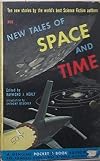
First published in 1951, this was something of a groundbreaking collection of stories. As Anthony Boucher points out in his introduction, until this book all the anthologies being published were collections of stories from magazines. The collections were being increasingly duplicative and he also thought that many of the stories being reprinted never should have been. Bottom scraping. This was the first of a new type with all original stories. It begins with stories by Bradbury and Asimov show more and ends with a true classic of the genre, one that stretched the boundaries a bit, the dystopian religious tale of "The Quest for Saint Aquin." These stories are clearly from an earlier era, but most are still quite enjoyable. This was a worthwhile collection to read, more for curiosity's sake, despite a couple stinkers.
The included stories are:
xi • Introduction (New Tales of Space and Time) • (1951) • essay by Anthony Boucher
1 • Here There Be Tygers • (1951) • shortstory by Ray Bradbury
16 • "In a Good Cause—" • (1951) • novelette by Isaac Asimov
44 • Tolliver's Travels • (1951) • novelette by Frank Fenton and Joseph Petracca
67 • Bettyann • (1951) • novelette by Kris Neville
113 • Little Anton • (1951) • novelette by Reginald Bretnor
143 • Status Quondam • (1951) • novelette by P. Schuyler Miller
170 • B + M - Planet 4 • (1951) • novelette by Gerald Heard
197 • You Can't Say That • (1951) • novelette by Cleve Cartmill
222 • Fulfillment • (1951) • novelette by A. E. van Vogt
253 • The Quest for Saint Aquin • (1951) • novelette by Anthony Boucher
Bradbury's opening story is kind of neat. It is an allegorical piece, an ecological tale, of a sentient planet like Eden. Remind yourself this was written in 1951. If you're like me a Star Trek episode from the 60's will probably come to mind. I've read this story before in one of Bradbury's collections, but it had been a pretty long time ago.
I'm lukewarm at best on Asimov's story. To me, this isn't one of his excellent ones, although it is interesting. There are many factions of humanity, not united. We view this as one faction idealistic, one faction practical, embodied by two men, friends in youth, that can't seem to unite against what is an alien common enemy. I never felt any tension in this story. At the end we are supposed to see that neither side was entirely right or wrong - both views were needed. Isn't politics almost always that way?
I was unfamiliar with the authors of "Tolliver's Travels." A wiki check reveals that Frank Fenton was a pretty successful screenwriter but only wrote a very few stories. Joseph Petracca was also a successful screenwriter with a number of stories. Science fiction pieces were not their usual territory. This is actually pretty good. A modestly successful but not wealthy man (a screenwriter of course) wants the world to be a better place. He is frustrated with society. He goes out for his weekly round of golf but his golf buddies have dumped him and started early. He pairs up with this little older man who has been a member of the club for a while but not anyone's friend. He doesn't play "serious" golf so is a bit of an outcast. Sounds like a totally blah premise but the story is not blah. What happens may be a drunken dream after hitting the bar a little too hard or it may be something else entirely.
I've probably read a little Kris Neville in the past. "Bettyann" was a nice surprise. It was apparently later updated and expanded into a longer work, but this is the original novelette, almost novella length. An interesting story of an alien child left behind and raised as a human. A very good story that was one of my favorites in the collection.
"Little Anton" was an atrocious bit of punning and far worse. NOT funny. The less said the better.
I know P. Schuyler Miller from many years of book reviews for Analog magazine that I was grateful for as a teenager. An enormous help for figuring out what was the good stuff to be on the lookout for. Before and during those years (he died in 1974) however he was a popular science fiction writer of the Golden Age and I have read very little of his short story output. "Status Quondam" was an entertaining time travel piece about a man who daydreams about how great it would be to live in the Age of Pericles rather than the modern world of "Big Business, Big Government, Big War, and little men" as the intro to the story describes it. He gets his wish through the invention of an acquaintance and finds himself under the Aegean sun 2400 years earlier. This story from 1951 was one of the last he wrote before focusing on being a book reviewer. An enjoyable piece of historical fiction, although it stumbles badly towards the end.
"B + M - Planet 4" by Gerald Heard may have appeared nowhere else but in this anthology. I certainly hope so. The explanation for all those flying saucers is giant bees from another planet. Seriously. Heard may or may not have been a popular author in his time, although he wrote little science fiction. That's probably a good thing. He seems to be one of those out there on the edge authors. Wikipedia notes him as a co-founder of Alcoholics Anonymous so he must have not been all wacky. This story just seemed too silly for me to enjoy. The writing also hit me as awful and I could not slog through this to finish it. Yuck.
Cleve Cartmill's story "You Can't Say That" was an OK enough read. Post war dystopia with a twist. Felt incomplete and had no resolution. Better was finding out that this author was the guy behind "The Cartmill Affair" in WWII with his description of the atomic bomb. Rather fascinating. http://boingboing.net/2008/01/20/science-fiction-writ-3.html
I thought Van Vogt's "Fulfillment" was a very cool story about machine intelligence. I had no idea where it was going and wished this story was longer than it was. The story begins with a lone machine inhabiting the earth in the far future. It appears to be stranded there but suddenly an opportunity to escape presents itself. There's a cool twist to the story which I should have seen but did not. Van Vogt's stories are hit or miss with me and this was a hit. show less
The included stories are:
xi • Introduction (New Tales of Space and Time) • (1951) • essay by Anthony Boucher
1 • Here There Be Tygers • (1951) • shortstory by Ray Bradbury
16 • "In a Good Cause—" • (1951) • novelette by Isaac Asimov
44 • Tolliver's Travels • (1951) • novelette by Frank Fenton and Joseph Petracca
67 • Bettyann • (1951) • novelette by Kris Neville
113 • Little Anton • (1951) • novelette by Reginald Bretnor
143 • Status Quondam • (1951) • novelette by P. Schuyler Miller
170 • B + M - Planet 4 • (1951) • novelette by Gerald Heard
197 • You Can't Say That • (1951) • novelette by Cleve Cartmill
222 • Fulfillment • (1951) • novelette by A. E. van Vogt
253 • The Quest for Saint Aquin • (1951) • novelette by Anthony Boucher
Bradbury's opening story is kind of neat. It is an allegorical piece, an ecological tale, of a sentient planet like Eden. Remind yourself this was written in 1951. If you're like me a Star Trek episode from the 60's will probably come to mind. I've read this story before in one of Bradbury's collections, but it had been a pretty long time ago.
I'm lukewarm at best on Asimov's story. To me, this isn't one of his excellent ones, although it is interesting. There are many factions of humanity, not united. We view this as one faction idealistic, one faction practical, embodied by two men, friends in youth, that can't seem to unite against what is an alien common enemy. I never felt any tension in this story. At the end we are supposed to see that neither side was entirely right or wrong - both views were needed. Isn't politics almost always that way?
I was unfamiliar with the authors of "Tolliver's Travels." A wiki check reveals that Frank Fenton was a pretty successful screenwriter but only wrote a very few stories. Joseph Petracca was also a successful screenwriter with a number of stories. Science fiction pieces were not their usual territory. This is actually pretty good. A modestly successful but not wealthy man (a screenwriter of course) wants the world to be a better place. He is frustrated with society. He goes out for his weekly round of golf but his golf buddies have dumped him and started early. He pairs up with this little older man who has been a member of the club for a while but not anyone's friend. He doesn't play "serious" golf so is a bit of an outcast. Sounds like a totally blah premise but the story is not blah. What happens may be a drunken dream after hitting the bar a little too hard or it may be something else entirely.
I've probably read a little Kris Neville in the past. "Bettyann" was a nice surprise. It was apparently later updated and expanded into a longer work, but this is the original novelette, almost novella length. An interesting story of an alien child left behind and raised as a human. A very good story that was one of my favorites in the collection.
"Little Anton" was an atrocious bit of punning and far worse. NOT funny. The less said the better.
I know P. Schuyler Miller from many years of book reviews for Analog magazine that I was grateful for as a teenager. An enormous help for figuring out what was the good stuff to be on the lookout for. Before and during those years (he died in 1974) however he was a popular science fiction writer of the Golden Age and I have read very little of his short story output. "Status Quondam" was an entertaining time travel piece about a man who daydreams about how great it would be to live in the Age of Pericles rather than the modern world of "Big Business, Big Government, Big War, and little men" as the intro to the story describes it. He gets his wish through the invention of an acquaintance and finds himself under the Aegean sun 2400 years earlier. This story from 1951 was one of the last he wrote before focusing on being a book reviewer. An enjoyable piece of historical fiction, although it stumbles badly towards the end.
"B + M - Planet 4" by Gerald Heard may have appeared nowhere else but in this anthology. I certainly hope so. The explanation for all those flying saucers is giant bees from another planet. Seriously. Heard may or may not have been a popular author in his time, although he wrote little science fiction. That's probably a good thing. He seems to be one of those out there on the edge authors. Wikipedia notes him as a co-founder of Alcoholics Anonymous so he must have not been all wacky. This story just seemed too silly for me to enjoy. The writing also hit me as awful and I could not slog through this to finish it. Yuck.
Cleve Cartmill's story "You Can't Say That" was an OK enough read. Post war dystopia with a twist. Felt incomplete and had no resolution. Better was finding out that this author was the guy behind "The Cartmill Affair" in WWII with his description of the atomic bomb. Rather fascinating. http://boingboing.net/2008/01/20/science-fiction-writ-3.html
I thought Van Vogt's "Fulfillment" was a very cool story about machine intelligence. I had no idea where it was going and wished this story was longer than it was. The story begins with a lone machine inhabiting the earth in the far future. It appears to be stranded there but suddenly an opportunity to escape presents itself. There's a cool twist to the story which I should have seen but did not. Van Vogt's stories are hit or miss with me and this was a hit. show less

Any child of my generation who happened upon this collection in his/her youth became a lifelong sci-fi devotee, despite the really dreadful prose of many of these tales. Lester del Rey, for one, seems to have been an early computer trying to construct a string of sentences. But for the following classics alone, this volume should retain its value as a gateway to the stars: "Asylum" and "The Weapon Shop" by A.E. Van Vogt, "Forgetfulness" by John W. CAmpbell, Jr., "By His Bootstraps" by Robert show more A. Heinlein, "Nightfall" by Isaac Asimov,. show less
(Original Review, 1980-09-11)
I tend to think in too cynical channels, and some comments sort of swept me back to the days when I found a Pocketbook (that's the trademarked name, not the generic) called NEW TALES OF SPACE AND TIME on the racks in our local US Import bookshop, plunked down my 2 escudos, and got COMPLETELY blown away on SF. Talk about sense of wonder, talk about the Golden Age--! It seems to me that what blew me away at the age of 11 was precisely what you were talking about. show more Since then I've forgiven a lot of wretched writing (even E. E. “Doc” Smith) if the SF only tickled that continuity/immortality fantasy. I wonder if kids growing up under the Cold War/Civil Defense Alerts/Tips for When the Bomb Falls pall were particularly susceptible to this SF promise that THERE WOULD BE A FUTURE, even if the future wasn't necessarily pretty.
I have recalled a Bester short story which bears on the topic of underlying fantasies. Bester's protagonist is crazy, and his fantasies take the form of trite science-fiction plots. In each situation, he is beset by some stock dilemma which he eventually overcomes by virtue of "a strange mutant strain" which allows him to triumph over the figure in his fantasy who represents the shrink trying to cure him. A large number such as 5,207,691 or close to it also figures in this. Damned if I can remember the title, but if you're interested in underlying fantasies, this story sure tells what Bester thought they are. It's also hilarious.
SF = Speculative Fiction.
[2018 EDIT: This review was written at the time as I was running my own personal BBS server. Much of the language of this and other reviews written in 1980 reflect a very particular kind of language: what I call now in retrospect a “BBS language”.] show less
I tend to think in too cynical channels, and some comments sort of swept me back to the days when I found a Pocketbook (that's the trademarked name, not the generic) called NEW TALES OF SPACE AND TIME on the racks in our local US Import bookshop, plunked down my 2 escudos, and got COMPLETELY blown away on SF. Talk about sense of wonder, talk about the Golden Age--! It seems to me that what blew me away at the age of 11 was precisely what you were talking about. show more Since then I've forgiven a lot of wretched writing (even E. E. “Doc” Smith) if the SF only tickled that continuity/immortality fantasy. I wonder if kids growing up under the Cold War/Civil Defense Alerts/Tips for When the Bomb Falls pall were particularly susceptible to this SF promise that THERE WOULD BE A FUTURE, even if the future wasn't necessarily pretty.
I have recalled a Bester short story which bears on the topic of underlying fantasies. Bester's protagonist is crazy, and his fantasies take the form of trite science-fiction plots. In each situation, he is beset by some stock dilemma which he eventually overcomes by virtue of "a strange mutant strain" which allows him to triumph over the figure in his fantasy who represents the shrink trying to cure him. A large number such as 5,207,691 or close to it also figures in this. Damned if I can remember the title, but if you're interested in underlying fantasies, this story sure tells what Bester thought they are. It's also hilarious.
SF = Speculative Fiction.
[2018 EDIT: This review was written at the time as I was running my own personal BBS server. Much of the language of this and other reviews written in 1980 reflect a very particular kind of language: what I call now in retrospect a “BBS language”.] show less
Awards


You May Also Like


Associated Authors
Statistics
- Works
- 6
- Members
- 856
- Popularity
- #29,895
- Rating
- 3.8
- Reviews
- 15
- ISBNs
- 9
- Favorited
- 1