
About the Author
George Musser is an award-winning journalist, a contributing editor for Scientific American, and the author of The Complete Idiot's Guide to String Theory. He is the recipient of a Jonathan Eberhart Planetary Sciences Journalism Award from the American Astronomical Society and an American Institute show more of Physics Science Communication Award for Science Writing. He was a Knight Science Journalism Fellow at MIT and has appeared on Today, CNN, NPR, the BBC, Al Jazeera, and other outlets. He lives in Glen Ridge, New Jersey, with his wife and daughter. Follow him an Twitter at @ gmusser and visit his website at www.georgemusser.com. show less
Works by George Musser
Spooky Action at a Distance: The Phenomenon That Reimagines Space and Time--and What It Means for Black Holes, the Big Bang, and Theories of Everything (2015) 243 copies, 8 reviews
Putting Ourselves Back in the Equation: Why Physicists Are Studying Human Consciousness and AI to Unravel the Mysteries of the Universe (2023) 52 copies, 1 review
Emergence in Condensed Matter and Quantum Gravity: A Nontechnical Review (SpringerBriefs in Physics) (2022) 4 copies
Putting Ourselves Back in the Equation: Why Physicists Are Studying Human Consciousness and AI to Unravel the Mysteries of the Universe (2023) 3 copies
Upiorne dzialanie na odleglosc i jego wplyw na czarne dziury, Wielki Wybuch i teorie wszystkiego (2018) 2 copies
Aveva ragione Einstein? 1 copy
Associated Works
Tagged
Common Knowledge
- Canonical name
- Musser, George
- Gender
- male
- Awards and honors
- National Magazine Award for Editorial Excellence (2002)
- Short biography
- George Musser is a staff editor and writer for Scientific American magazine in New York and the author of The Complete Idiot’s Guide to String Theory. He did his undergraduate studies in electrical engineering and mathematics at Brown University and his graduate studies in planetary science at Cornell University, where he was a National Science Foundation Graduate Fellow. His thesis work modeled mantle convection on Venus in order to explain broad plateaus, known as coronae, mapped by the Magellan orbiter. Musser served as editor of Mercury magazine and of the Universe in the Classroom tutorial series at the Astronomical Society of the Pacific, a science and science-education nonprofit based in San Francisco.
Members
Reviews
Putting Ourselves Back in the Equation: Why Physicists Are Studying Human Consciousness and AI to Unravel the Mysteries of the Universe by George Musser
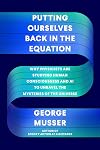
A splendid cornucopia of meaty ideas. After describing the structure of neural networks both natural and artificial, author Musser discusses two physics-of-the-mind theories, integrated information theory and predictive coding theory. The former is Giulio Tononi's well-known quantitative model of consciousness only, while the latter, previously unfamiliar to me, is introduced as "arguably the closest that neuroscientists have yet come to a grand unified theory of the mind" (p 67). Next, he show more provides a chapter on the notorious concept of alleged connections between consciousness and quantum mechanics (QM), wherein wavefunction collapse is either a cause or an effect. From this he is led to consider kinds of observer-dependent reality such as those in the Everettian (many-worlds), Rovellian (relational), and Fuchsian (QBist) QM interpretations. Continuing, he draws upon the domains of cosmology (citing ludicrous ideas like Boltzmann brains) and causation (reductionism vs emergentism, free will, agency theory) to argue that absence of the human element can make theories incomplete. His final numbered chapter is full of profound new ideas on time and space, too intricate for my powers of concise summarization. show less
Spooky Action at a Distance: The Phenomenon That Reimagines Space and Time--and What It Means for Black Holes, the Big Bang, and Theories of Everything by George Musser
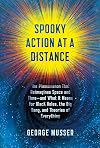
There's a common misconception that Einstein objected to quantum mechanics on the basis that he didn't accept the notion of uncertainty. But this was a misunderstanding, one exploited by the Copenhagen camp to bolster their viewpoint. What Einstein really objected to was the concept of nonlocality, what he derisively denoted as "spooky action at a distance". In one of the most famous scientific papers of the 20th century, he (along with two younger colleagues) proposed a thought experiment show more to elucidate the problem, involving a pair of particles that became entangled and seemed to communicate faster than the speed of light, which is strictly verboten under Relativity. Unfortunately for him, decades later these hypothetical interactions were demonstrated experimentally to be quite real, and really do behave in exactly as absurd a manner as Einstein scoffed at.
If your brain isn’t already melted at this point, hang on to your hat, because that's just the introduction to this psychotropic book. Although written in beguiling approachable language, with a minimum of technical jargon and virtually no equations, the concepts explored are far from simple. While it helps to have at least a vague familiarity with the basic tenets of quantum mechanics, relativity, black holes, and string theory, we are so close to the bleeding edge of physics that prior knowledge will only get us so far. Once we lose locality, foundational assumptions about causality, space, and time break down, leaving a chasm into which our understanding of reality is poised to plunge.
My biggest complaint about the book is that he mentions dark matter and dark energy only in passing at the end, and it wasn't made clear how they fit into the larger picture, even though they comprise 96% of the universe. Maybe he dismissed them as not being central to the themes under discussion, but if that was the case, why drop such a tantalizing tidbit just to sweep it under the rug. show less
If your brain isn’t already melted at this point, hang on to your hat, because that's just the introduction to this psychotropic book. Although written in beguiling approachable language, with a minimum of technical jargon and virtually no equations, the concepts explored are far from simple. While it helps to have at least a vague familiarity with the basic tenets of quantum mechanics, relativity, black holes, and string theory, we are so close to the bleeding edge of physics that prior knowledge will only get us so far. Once we lose locality, foundational assumptions about causality, space, and time break down, leaving a chasm into which our understanding of reality is poised to plunge.
My biggest complaint about the book is that he mentions dark matter and dark energy only in passing at the end, and it wasn't made clear how they fit into the larger picture, even though they comprise 96% of the universe. Maybe he dismissed them as not being central to the themes under discussion, but if that was the case, why drop such a tantalizing tidbit just to sweep it under the rug. show less
Spooky Action at a Distance: The Phenomenon That Reimagines Space and Time--and What It Means for Black Holes, the Big Bang, and Theories of Everything by George Musser
What is the fundamental nature of reality? Philosophers have been debating this question for well over two thousand years. They still are. In Spooky Action at a Distance, George Musser draws a direct line between the speculations of early Greek philosophers and those of modern thinkers. They're tackling the same kinds of fundamental questions: What is essentially real? What is emergent? What is perception? Take them out of their lab coats and put them in togas, and the advocates of loop show more quantum gravity, string theory (in its various forms), quantum graphity (sic), the S-matrix, and others, bear a striking resemblance to a bunch of debating Epicureans, Stoics, Skeptics, and Pythagoreans.
The title, Spooky Action at a Distance, refers to a strange property that seems to allow one subatomic particle to be instantly affected by another subatomic particle with which it has been 'entangled', no matter how far apart they may be. Imagine two billiard balls. After a brief meeting, you roll them away from one another. When they reach opposite ends of the pool table, you spin one clockwise. The other immediately spins to match. It's as if they're linked, as if the the space between them doesn't really exist. So, maybe it doesn't; not the way we normally think of it, anyway. Of course this doesn't really apply to big things like billiard balls because the strange effects seem to cancel out at large scales, but the effect is real, and it leads to questions about the nature of time, matter, and pretty much everything else.
We call investigators of reality 'physicists' now rather than 'philosophers'. The biggest difference seems to be whether or not they use esoteric equations to help them out. In that sense, this book is probably more philosophy than science, which is not a bad thing. It's implied that a lot of complicated math lies behind modern ideas, but Musser kindly refrains from exposing us to it.
But a brilliant mind is still a brilliant mind by any name, and they are looking for answers. What they all seem to agree on is that space and time, and pretty much everything we think of as 'reality', can't be quite what they appear to be. Not fundamentally, anyway. There's a deeper reality behind our familiar apparent reality. They're just not sure what it is, and from how it sounds, that's not likely to change anytime soon. The questions aren't easy. The answers aren't obvious, but the current speculations are fascinating, mind-bending. It may take another two thousand years before we (or maybe our robotic successors?) finally figure it all out. Maybe we never will, but it's important to try. There's no chance at all of finding answers if we don't ask questions. show less
The title, Spooky Action at a Distance, refers to a strange property that seems to allow one subatomic particle to be instantly affected by another subatomic particle with which it has been 'entangled', no matter how far apart they may be. Imagine two billiard balls. After a brief meeting, you roll them away from one another. When they reach opposite ends of the pool table, you spin one clockwise. The other immediately spins to match. It's as if they're linked, as if the the space between them doesn't really exist. So, maybe it doesn't; not the way we normally think of it, anyway. Of course this doesn't really apply to big things like billiard balls because the strange effects seem to cancel out at large scales, but the effect is real, and it leads to questions about the nature of time, matter, and pretty much everything else.
We call investigators of reality 'physicists' now rather than 'philosophers'. The biggest difference seems to be whether or not they use esoteric equations to help them out. In that sense, this book is probably more philosophy than science, which is not a bad thing. It's implied that a lot of complicated math lies behind modern ideas, but Musser kindly refrains from exposing us to it.
But a brilliant mind is still a brilliant mind by any name, and they are looking for answers. What they all seem to agree on is that space and time, and pretty much everything we think of as 'reality', can't be quite what they appear to be. Not fundamentally, anyway. There's a deeper reality behind our familiar apparent reality. They're just not sure what it is, and from how it sounds, that's not likely to change anytime soon. The questions aren't easy. The answers aren't obvious, but the current speculations are fascinating, mind-bending. It may take another two thousand years before we (or maybe our robotic successors?) finally figure it all out. Maybe we never will, but it's important to try. There's no chance at all of finding answers if we don't ask questions. show less
Spooky action at a distance : the phenomenon that reimagines space and time : and what it means for black holes, the big bang, and theories of everything by George Musser
Spooky Action at a Distance was an enlightening exploration into the history of non-locality in physics although there are several aspects to it and in many places in the text I was unsure exactly how the phenomenon being explained qualified as non-local. The premise of the book is that space, and likely time as well, are emergent properties of whatever is going on in a level below quantum mechanics and general relativity, but it couldn't in the end come up with more than a quick sketch of show more what a physics without space or time would look like. Still, I'm glad I read the book to see where the current frontier of physics is at. show less
Lists
Awards


You May Also Like


Associated Authors
Statistics
- Works
- 10
- Also by
- 1
- Members
- 436
- Popularity
- #56,113
- Rating
- 3.9
- Reviews
- 13
- ISBNs
- 30
- Languages
- 3
