
Brian Swimme
Author of The Universe Is a Green Dragon: A Cosmic Creation Story
About the Author
Image credit: Brian Swimme [credit: Foundation for Global Community]
Works by Brian Swimme
The Universe Story : From the Primordial Flaring Forth to the Ecozoic Era--A Celebration of the Unfolding of the Cosmos (1992) 267 copies, 4 reviews
A Walk Through Time: From Stardust to Us--The Evolution of Life on Earth (1998) 80 copies, 2 reviews
Associated Works
Tagged
Common Knowledge
- Canonical name
- Swimme, Brian
- Legal name
- Swimme, Brian Thomas
- Birthdate
- 1950-09-04
- Gender
- male
- Education
- University of Oregon (PhD|astrophysics|1978)
Santa Clara University
Bellarmine College Preparatory - Occupations
- evolutionary cosmologist
- Organizations
- California Institute of Integral Studies
University of Puget Sound
Holy Names University - Nationality
- USA
- Birthplace
- Seattle, Washington, USA
- Associated Place (for map)
- Washington, USA
Members
Reviews
The universe story: From the primordial flaring forth to the ecozoic era--a celebration of the unfolding of the cosmos by Brian Swimme

This book was disappointing. I expected that I would enjoy it, or at least glean something positive from it, but I just couldn't stand it. First off, this book is pretty epic in scope. It starts with the big bang and goes all the way to the modern era. My main problem with the book is this; it personifies everything. It is irritating to read about the universe itself having a will and sentience. What does it do with these qualities you ask? It goes and creates galaxies and other things. It show more speaks of single-celled organisms having a will. The science is accurate, which makes this even more aggravating. Step by step, it talks about how life developed. It talks about the "Cybernetic system" so many times that you can make a drinking game out of it.
When I say it personifies everything, it does so by giving everything a name. The supernova preceding the solar system and our sun? Let's call it Tiamat! The first living being is a prokaryotic cell? Why don't we call it Aries? No, not after the Greek God of War, silly; we named him after some Egyptian thing. Not to belittle Egyptian mythology, which is actually awesome, but when you combine the two ideas of science and mythology it just irritates me.
I am used to the idea of the Universe being the end result of a number of stochastic processes. Just random stuff being reined in by some basic laws like Gravitation and the three other fundamental forces. When you personify the universe, it should be really compelling, but it isn't. I understand that there is a delicate Goldilocks zone that makes our entire existence possible. If Gravity was just slightly stronger, if we were just slightly further from or closer to our Sun, Life would not have happened. That doesn't mean you need to explain it by gving the Universe sentience.
Thankfully I got this book from the Library and didn't pay anything for it. show less
When I say it personifies everything, it does so by giving everything a name. The supernova preceding the solar system and our sun? Let's call it Tiamat! The first living being is a prokaryotic cell? Why don't we call it Aries? No, not after the Greek God of War, silly; we named him after some Egyptian thing. Not to belittle Egyptian mythology, which is actually awesome, but when you combine the two ideas of science and mythology it just irritates me.
I am used to the idea of the Universe being the end result of a number of stochastic processes. Just random stuff being reined in by some basic laws like Gravitation and the three other fundamental forces. When you personify the universe, it should be really compelling, but it isn't. I understand that there is a delicate Goldilocks zone that makes our entire existence possible. If Gravity was just slightly stronger, if we were just slightly further from or closer to our Sun, Life would not have happened. That doesn't mean you need to explain it by gving the Universe sentience.
Thankfully I got this book from the Library and didn't pay anything for it. show less
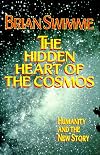
Brian Swimme’s The Hidden Heart of the Cosmos is one of the weirdest books I’ve read in a long time. In one fell swoop, he declares capitalism the new cult of our age and urges parents to replace evangelist doctrine with teachings of astronomy, science, and cosmology. His main invective is against the constant barrage of advertisements, product placement, and consumer behavior that gets ingrained into children, thereby teaching them that the meaning of life is in things and not ideas. show more While this is not an entirely crazy notion, his hippy-dippy awe of the universe sometime gets in the way of his message.
Swimme truly believes science has better lessons to teach than anything else. It has rules, champions rationality, and gives understanding (when it can). He believes that if people truly understood the workings of nature and the universe around them, then they would devote more of their lives to understanding more. He does a pretty good job of illustrating how earlier scientific revolutions played a large part in bettering society and how a new revolution is just what we need, but the purple prose surrounding the awe and majesty of the universe can be a little much. It’s a quick read, but it will leave your head swimming (sorry about the pun) in an odd philosophical fog. show less
Swimme truly believes science has better lessons to teach than anything else. It has rules, champions rationality, and gives understanding (when it can). He believes that if people truly understood the workings of nature and the universe around them, then they would devote more of their lives to understanding more. He does a pretty good job of illustrating how earlier scientific revolutions played a large part in bettering society and how a new revolution is just what we need, but the purple prose surrounding the awe and majesty of the universe can be a little much. It’s a quick read, but it will leave your head swimming (sorry about the pun) in an odd philosophical fog. show less
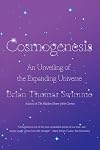
In many ways, this is an odd first book to choose from Brian Swimme's bibliography. I first learned of his work over a decade ago, when Bill Plotkin spoke of "The Universe Story," which Swimme co-authored with Thomas Berry. Since then, I've also heard great things about his "The Universe is a Green Dragon."
"Cosmogenesis" is a memoir, a look back over Swimme's life story. As a fan of the work of Berry, I'm especially drawn to the depictions of Berry, and the story of how this collaboration show more unfolded.
I don't mean to extrapolate Swimme's cosmology from a single book. That said, at times, his claims along the lines that "science has enabled us to be the first humans to become aware of the fourteen-billion-year journey of the universe" seems to center a Western understanding of cosmogenesis. I would posit that there have been many cultures with equally valid origin stories, and although I very much think it is worth diving in to the particulars that the contemporary scientific story has to offer, I don't think that this "Universe Story" has supremacy (or precedent) over the Universe Stories of other times and cultures.
If this is the your first look at Swimme, you might want to pick up one of his earlier texts first. If you're a dedicated fan, you'll love this inside look at Swimme's autobiography. show less
"Cosmogenesis" is a memoir, a look back over Swimme's life story. As a fan of the work of Berry, I'm especially drawn to the depictions of Berry, and the story of how this collaboration show more unfolded.
I don't mean to extrapolate Swimme's cosmology from a single book. That said, at times, his claims along the lines that "science has enabled us to be the first humans to become aware of the fourteen-billion-year journey of the universe" seems to center a Western understanding of cosmogenesis. I would posit that there have been many cultures with equally valid origin stories, and although I very much think it is worth diving in to the particulars that the contemporary scientific story has to offer, I don't think that this "Universe Story" has supremacy (or precedent) over the Universe Stories of other times and cultures.
If this is the your first look at Swimme, you might want to pick up one of his earlier texts first. If you're a dedicated fan, you'll love this inside look at Swimme's autobiography. show less
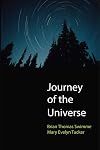
I quite enjoyed the description of the forming of the universe and the creation of the earth and life on earth. The way Swimme and Tucker used the word 'creativity' raised a certain number of questions which they didn't even attempt to answer. Creativity seems to imply a certain amount of intent. Intent implies consciousness. Are they implying there is a consciousness behind the universe? I did like the way the showed how we are all connected to the 'big bang' and to everything other thing, show more living and non-living in the universe and beyond. I was less than enthralled by the way they wrote about humans. show less
Lists
You May Also Like


Associated Authors
Statistics
- Works
- 19
- Also by
- 3
- Members
- 1,044
- Popularity
- #24,665
- Rating
- 3.7
- Reviews
- 14
- ISBNs
- 36
- Languages
- 7
- Favorited
- 2

