
Michael Z. Williamson
Author of The Hero
About the Author
Image credit: Michael Z. Williamson (2006)
Photo: Oleg Volk
Photo: Oleg Volk
Series
Works by Michael Z. Williamson
Associated Works
Free Nonfiction 2021 — Contributor, some editions — 2 copies
Tagged
Common Knowledge
- Canonical name
- Williamson, Michael Z.
- Birthdate
- 1967
- Gender
- male
- Nationality
- USA
UK (birth) - Places of residence
- Birkenhead, Cheshire, England, UK
Canada - Associated Place (for map)
- Birkenhead, Cheshire, England, UK
Members
Reviews
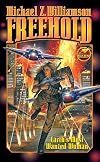
Take a poorly thought out Libertarian utopia, populate it with improbably good people, add some social aspects straight from the sweaty fantasies of teenage boys, array it against the Stupid Evil Welfare State of Earth, write a lot of shoot-'em-up while indulging in what appears to be a serious man-crush on Heinlein, and there you have it: summer pulp. Even if you like military science fiction, I'd probably recommend you go elsewhere.
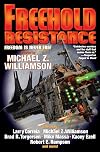
In my mind, this anthology, like ‘Forged in Blood’ before it, sets a new standard for single universe anthologies. Not only are all of the stories well crafted and shaped to fit, but they are also woven together into a whole that becomes greater than the sum. Three narrative threads are used to show how and where each tale fits within the greater story. The individual tales are made more a part of events than I have otherwise seen.
To make a comparison, most anthologies seem like a show more concert. All of the music is being performed from the same stage by the same musicians, and there may be other relationships between selections such as theme or composer, but each piece exists as a separate and wholly distinct work. So, too, do most anthologies seem made of separate pieces, somewhat harmonious, but distinct. This anthology is more like a musical. Each piece is separate but informs the whole, and is supported by a recurrent theme that drives the narrative. The simplicity of this description belies the complexity and virtuosity of the endeavor. show less
To make a comparison, most anthologies seem like a show more concert. All of the music is being performed from the same stage by the same musicians, and there may be other relationships between selections such as theme or composer, but each piece exists as a separate and wholly distinct work. So, too, do most anthologies seem made of separate pieces, somewhat harmonious, but distinct. This anthology is more like a musical. Each piece is separate but informs the whole, and is supported by a recurrent theme that drives the narrative. The simplicity of this description belies the complexity and virtuosity of the endeavor. show less
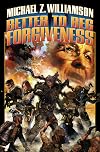
Better To Beg Forgiveness is a mess because the author is a loser. Not only a bad writer with suspect military credentials, but a hate-filled agenda where everyone is to be mistrusted, from the UN to the military chain of command to the regular army to the police to civilians in general and so on. In fact, this book is something like Somalia in space. The featureless bad guys are called "skinnies." I thought I was watching Black Hawk Down. Hey, this book was published in 2007. Somalia was show more long over by then. Which begs the next question. Why does the author use the phrase "property stealing communists" to describe some people? That’s even more out of date. Um, right wing much, Williamson? Watch a lot of Fox News? Are you sure your name isn’t John Ringo?
The only “science fiction” aspect to this book is the action takes place on another planet and the mercenaries have to travel through space to get there. How they accomplish that really isn’t described. Of course not. It’s only sci fi. Is it a spaceship? A flying saucer? A rocket? How the hell do they get there, Williamson? Otherwise, they ride in Volvos, shoot H&K guns and AKs, use regular explosive devices, etc. Where’s the “science fiction” in that scenario? What exactly is sci fi about this book? Frankly, this book is a fraud and it’s utter bullshit! To make matters worse, the author is so caught up in detail and in proving that ex-military contractors are “obviously” superior to military, regular army, police, etc., that he spends what seems like about 15 pages having his team execute a ballet-like dance of epic proportions in guarding their principle as he walks from his building to his vehicle, while they move in carefully choreographed steps, two at a time, each moving up to replace the next. It’s fucking beautiful, man. I bet he could fill a 900-page book with just these descriptions. Shit. What a pile of horseshit.
I got about 100 pages into this book and found that I just couldn’t get into it, obviously, no matter how much I tried. I like mercenary books. I love sci fi. I like huge odds. I hate stupidity and boredom and this book has plenty of that. I also hate feeling like I’m being manipulated by some right wing, Fox loving asshat with a political agenda for no good reason, ie, not to advance the story line. Don’t misunderstand. Sure, I’m a liberal, but I’m a gun loving liberal and that’s not an oxymoron. My wife and I are Democratic voters who own lots of guns and like to go to the range, etc. We just don’t like Fox News and the ilk who preach its gospel. So sure, I could have given this book more of a chance, but why? One hundred pages is more than enough to sell me on a book. If you haven’t done it by then, that’s all you get – I’m moving on to something better. If I want good military sci fi, I’ll read David Weber or Chris Bunch. As for me, Michael Z. Williamson will be permanently avoided from here on out. Lousy writer. show less
The only “science fiction” aspect to this book is the action takes place on another planet and the mercenaries have to travel through space to get there. How they accomplish that really isn’t described. Of course not. It’s only sci fi. Is it a spaceship? A flying saucer? A rocket? How the hell do they get there, Williamson? Otherwise, they ride in Volvos, shoot H&K guns and AKs, use regular explosive devices, etc. Where’s the “science fiction” in that scenario? What exactly is sci fi about this book? Frankly, this book is a fraud and it’s utter bullshit! To make matters worse, the author is so caught up in detail and in proving that ex-military contractors are “obviously” superior to military, regular army, police, etc., that he spends what seems like about 15 pages having his team execute a ballet-like dance of epic proportions in guarding their principle as he walks from his building to his vehicle, while they move in carefully choreographed steps, two at a time, each moving up to replace the next. It’s fucking beautiful, man. I bet he could fill a 900-page book with just these descriptions. Shit. What a pile of horseshit.
I got about 100 pages into this book and found that I just couldn’t get into it, obviously, no matter how much I tried. I like mercenary books. I love sci fi. I like huge odds. I hate stupidity and boredom and this book has plenty of that. I also hate feeling like I’m being manipulated by some right wing, Fox loving asshat with a political agenda for no good reason, ie, not to advance the story line. Don’t misunderstand. Sure, I’m a liberal, but I’m a gun loving liberal and that’s not an oxymoron. My wife and I are Democratic voters who own lots of guns and like to go to the range, etc. We just don’t like Fox News and the ilk who preach its gospel. So sure, I could have given this book more of a chance, but why? One hundred pages is more than enough to sell me on a book. If you haven’t done it by then, that’s all you get – I’m moving on to something better. If I want good military sci fi, I’ll read David Weber or Chris Bunch. As for me, Michael Z. Williamson will be permanently avoided from here on out. Lousy writer. show less
Well, I suppose you might like this if you are a libertarian extremist who can't get enough red meat. For the rest of us, this is a frustratingly preachy book that contains lots of politics and libertarian wish fulfillment but frequently forgets to, well, tell a story.
The target audience seems to be geeky young guys who just read Ayn Rand. It's basically a valentine to liberarianism; the good guys are a libertarian society that can do no wrong (and, of course, libertarian-ism is the answer show more to every human problem ever seen); the bad guys are a straw-man caricature of modern capitalism. There's lots of loving description of military equipment. And the women are all loose and have lots of sex with everyone. The libertarian society that's supposed to be the be-all and end-all of politics is not very plausible; for instance, as you read, see if you can tell how the society deals with kids and the elderly. Anyway, target audience: geeky young guys who can't get enough Ayn Rand; it's certainly not for people who like any amount of nuance or subtlety in their reading.
Sadly, the book is not very entertaining. The characters are boring. The plot doesn't get started until halfway through this already very long book, and even then it's just weak military SF without any particularly interesting tactics, strategy, or cleverness. Here's a tip: if you read the book, skip the first 25 chapters and start at chapter 26 (yes, that's page 365 in the paperback version). You won't miss much, and this will jump you into the start of the military action. But better yet, don't bother; the book isn't worth your time. show less
The target audience seems to be geeky young guys who just read Ayn Rand. It's basically a valentine to liberarianism; the good guys are a libertarian society that can do no wrong (and, of course, libertarian-ism is the answer show more to every human problem ever seen); the bad guys are a straw-man caricature of modern capitalism. There's lots of loving description of military equipment. And the women are all loose and have lots of sex with everyone. The libertarian society that's supposed to be the be-all and end-all of politics is not very plausible; for instance, as you read, see if you can tell how the society deals with kids and the elderly. Anyway, target audience: geeky young guys who can't get enough Ayn Rand; it's certainly not for people who like any amount of nuance or subtlety in their reading.
Sadly, the book is not very entertaining. The characters are boring. The plot doesn't get started until halfway through this already very long book, and even then it's just weak military SF without any particularly interesting tactics, strategy, or cleverness. Here's a tip: if you read the book, skip the first 25 chapters and start at chapter 26 (yes, that's page 365 in the paperback version). You won't miss much, and this will jump you into the start of the military action. But better yet, don't bother; the book isn't worth your time. show less
Lists
Awards


You May Also Like


Associated Authors
Statistics
- Works
- 37
- Also by
- 24
- Members
- 2,500
- Popularity
- #10,268
- Rating
- 3.6
- Reviews
- 41
- ISBNs
- 64
- Languages
- 2
- Favorited
- 2