
Joe Staton
Author of Huntress: Darknight Daughter
About the Author
Image credit: Luigi Novi
Works by Joe Staton
Showcase [1956] #96 (Doom Patrol) — Illustrator — 2 copies
Dick Tracy #4 (Shanda Fantasy Arts) — Author — 1 copy
Joker : Fini de rire 1 copy
Associated Works
9-11: The World's Finest Comic Book Writers & Artists Tell Stories to Remember (2002) — Illustrator — 256 copies, 1 review
The Big Book of the Weird Wild West: How the West was Really Won! (Factoid Books) (1998) — Illustrator — 117 copies
The Big Book of Little Criminals: 63 True Tales of the World's Most Incompetent Jailbirds! (1996) — Illustrator — 102 copies
The Big Book of Thugs: Tough as Nails True Tales of the World's Baddest Mobs, Gangs, and Ne'er do Wells! (Factoid Books) (1996) — Illustrator — 92 copies
Le Pays des elfes - Elfquest, tome 24 : L'Attaque des humains (1991) — Illustrator, some editions — 23 copies, 1 review
E-Man #2 — Illustrator, some editions — 3 copies
Star*Reach #6 — Illustrator — 3 copies
Baron Weirwulf's Haunted Library (Vol. 9, No. 45). October 1979. — Illustrator — 2 copies
E-Man #6 — Illustrator, some editions — 2 copies
Ghost Manor #73, March 1984 — Illustrator — 1 copy
Tagged
Common Knowledge
- Canonical name
- Staton, Joe
- Birthdate
- 1948-01-19
- Gender
- male
- Nationality
- USA
- Birthplace
- North Carolina, USA
- Associated Place (for map)
- North Carolina, USA
Members
Reviews

Access a version of the below that includes illustrations on my blog.
DC inches ever closer to plugging the gap between the last Legion of Super-Heroes Archive and The Great Darkness Saga with this, the second and final volume of Superboy and the Legion of Super-Heroes. (The just-annonced Before the Darkness series will continue from where this collection leaves off.) I'm glad this collection exists, but it's not the Legion's best material.
I don't know much behind-the-scenes information for show more this era, but the book gives every indication of being jerked around. First we have the five-part Earthwar saga scripted by Paul Levitz, where Earth is invaded by Khunds working for Mordru (to be honest, I don't remember who Mordru is). This is okay: it does nicely subvert your expectations at points, and the events are big... but they never feel big. When Levitz came back to the book for The Great Darkness Saga, he would do much better and more epic work than he did here, and it would feel meaningful to the characters in a way this sorely does not.
Then we get a couple issues written or co-written by Len Wein that read like inventory stories to me, with small references to the recent big events shoehorned in. I did kind of like the idea of "Savage Sanctuary!", where the Fatal Five kind of go legit, though the actual story got a bit stupid. The rule forbidding married couples to be in the Legion is rescinded, and thus Saturn Girl and Lightning Lad rejoin, and Lightning Lad is elected to leadership in short order, replacing Wildfire.
Then we have a couple stories by Gerry Conway that more directly deal with the aftermath of Earthwar-- suddenly Earth is a wreck in need of repair. These are okay, nothing special. (Brainiac is extra jerk-like, which I assume is to set up the next story, though.)
Then we have a couple stories by Steve Apollo (better known as Jim Starlin) that were clearly orignally written to slot in around the time of Earthwar, with some last-minute dialogue tweaks: lip service is given to the fact that Lightning Lad is leader, but he and Saturn Girl aren't in the story even though it supposedly features all active Legionnaires (even Tyroc turns up!); Wildfire is clearly in charge. In this story, Brainiac is revealed to be a murderer, having gone insane, and Matter-Eater Lad goes insane, too. Not a lot of it makes sense. I didn't really buy any of this, and why do we need another giant attack on Earth when we just had one?
Then Gerry Conway takes over permanently, dealing with the fallout of Apollo's story... but his stories are repetitive (three different ones are about people coming to take revenge on the Legion for slights, real or imagined) and contrived (the one where Superboy makes people think Legionnaires are dead by activating a latent chemical in their bloodstreams is particularly bad). Brainiac is healed in an entirely unconvincing way, and the Legion undertakes bizarre lengths to do it. The only thing I liked was the subplot about how R. J. Brande went bankrupt... but then realized he was a hoarder and gave away all his money.
(There's also a couple issues of DC Comics Presents by Levitz included, where Superman gets told by the Legion that he has to let Pete Ross's son be kidnapped by aliens to preserve future history. I found this kind of gross.)
Finally, the last issue writes out Superboy from the comic that used to bear his name (Superboy vol. 1 became Superboy and the Legion of Super-Heroes became Legion of Super-Heroes vol. 2). I liked how this was done, actually: Superboy finds out how his parents will die. The problem is that when he travels back to the 1950s, he loses his knowledge of future history only to regain it up returning to the 2970s. This means that every time he travels to the future from now on, he will be newly hit with the knowldge of how his parents die. Ouch! He promises to keep up his visits, but the Legion (okay, this part I like less) plant a telepathic block to stop him from doing so, so he flies off to the past for the last time.
Conway is often not a great writer (I found his run on All Star Comics around this same time pretty bleh), and Legion feels typical of his lesser output. Lots of bombast, not a lot of sense. Which you can kind of get away with in other comics, but Legion is trying to have an ongoing story with ongoing consequences, and those just don't play to Conway's strengths. There are some good artists on the book (e.g., Joe Staton, Jim Starlin), but it's no one's best work. James Sherman, who I really like, does the first couple issues but that's it. His characterful work could have kept this all a bit more grounded, I reckon. show less
DC inches ever closer to plugging the gap between the last Legion of Super-Heroes Archive and The Great Darkness Saga with this, the second and final volume of Superboy and the Legion of Super-Heroes. (The just-annonced Before the Darkness series will continue from where this collection leaves off.) I'm glad this collection exists, but it's not the Legion's best material.
I don't know much behind-the-scenes information for show more this era, but the book gives every indication of being jerked around. First we have the five-part Earthwar saga scripted by Paul Levitz, where Earth is invaded by Khunds working for Mordru (to be honest, I don't remember who Mordru is). This is okay: it does nicely subvert your expectations at points, and the events are big... but they never feel big. When Levitz came back to the book for The Great Darkness Saga, he would do much better and more epic work than he did here, and it would feel meaningful to the characters in a way this sorely does not.
Then we get a couple issues written or co-written by Len Wein that read like inventory stories to me, with small references to the recent big events shoehorned in. I did kind of like the idea of "Savage Sanctuary!", where the Fatal Five kind of go legit, though the actual story got a bit stupid. The rule forbidding married couples to be in the Legion is rescinded, and thus Saturn Girl and Lightning Lad rejoin, and Lightning Lad is elected to leadership in short order, replacing Wildfire.
Then we have a couple stories by Gerry Conway that more directly deal with the aftermath of Earthwar-- suddenly Earth is a wreck in need of repair. These are okay, nothing special. (Brainiac is extra jerk-like, which I assume is to set up the next story, though.)
Then we have a couple stories by Steve Apollo (better known as Jim Starlin) that were clearly orignally written to slot in around the time of Earthwar, with some last-minute dialogue tweaks: lip service is given to the fact that Lightning Lad is leader, but he and Saturn Girl aren't in the story even though it supposedly features all active Legionnaires (even Tyroc turns up!); Wildfire is clearly in charge. In this story, Brainiac is revealed to be a murderer, having gone insane, and Matter-Eater Lad goes insane, too. Not a lot of it makes sense. I didn't really buy any of this, and why do we need another giant attack on Earth when we just had one?
Then Gerry Conway takes over permanently, dealing with the fallout of Apollo's story... but his stories are repetitive (three different ones are about people coming to take revenge on the Legion for slights, real or imagined) and contrived (the one where Superboy makes people think Legionnaires are dead by activating a latent chemical in their bloodstreams is particularly bad). Brainiac is healed in an entirely unconvincing way, and the Legion undertakes bizarre lengths to do it. The only thing I liked was the subplot about how R. J. Brande went bankrupt... but then realized he was a hoarder and gave away all his money.
(There's also a couple issues of DC Comics Presents by Levitz included, where Superman gets told by the Legion that he has to let Pete Ross's son be kidnapped by aliens to preserve future history. I found this kind of gross.)
Finally, the last issue writes out Superboy from the comic that used to bear his name (Superboy vol. 1 became Superboy and the Legion of Super-Heroes became Legion of Super-Heroes vol. 2). I liked how this was done, actually: Superboy finds out how his parents will die. The problem is that when he travels back to the 1950s, he loses his knowledge of future history only to regain it up returning to the 2970s. This means that every time he travels to the future from now on, he will be newly hit with the knowldge of how his parents die. Ouch! He promises to keep up his visits, but the Legion (okay, this part I like less) plant a telepathic block to stop him from doing so, so he flies off to the past for the last time.
Conway is often not a great writer (I found his run on All Star Comics around this same time pretty bleh), and Legion feels typical of his lesser output. Lots of bombast, not a lot of sense. Which you can kind of get away with in other comics, but Legion is trying to have an ongoing story with ongoing consequences, and those just don't play to Conway's strengths. There are some good artists on the book (e.g., Joe Staton, Jim Starlin), but it's no one's best work. James Sherman, who I really like, does the first couple issues but that's it. His characterful work could have kept this all a bit more grounded, I reckon. show less

Access a version of the below that includes illustrations on my blog.
At the point this came out, the Justice Society had guested in a number of Crisis on Multiple Earths stories, but this was the first time they appeared as the stars of their own series since they were shunted out of All Star Comics back in 1951.
That said, this isn't that great. I mean, it's totally serviceable superhero action... but that's about it, with a couple exceptions. Gerry Conway and Paul Levitz have the sort of show more storytelling where the JSA is plunged from adventure into adventure: usually each storyline ends with a hook for the next already underway. But this actually makes the adventures seem small-- the pacing is never able to emphasize anything. It also makes it feel like these characters don't really have any lives outside of this title, since there's no gaps where they can live their own lives and have solo adventues. I mean, they literally don't, since none of them have ongoing series... but I would argue that they ought to feel like they do. Where do Sylvester Pemberton or Power Girl even live? What do they do when not superheroing? They feel more like, I dunno, the Teen Titans or the X-Men, than they do the multiversal equivalents of the Justice League.
Most of the original threats here aren't very interesting, either. Vulcan, the astronaut who's always on fire? Some underground people? (Why is it always with the underground people in comics?) The writing is a little inconsistent, too. No one seems to know if Power Girl can fly or just jump really far. (In the earliest Golden Age comics, Superman could just jump really far, but by this point, he was long able to fly, and Power Girl ought to have the same power set.) Sometimes the book seems to be about a subset of the JSA called the "All Star Super Squad" but this is pretty inconsistently indicated, and eventually fades away.
I did think it was interesting that the "parallel Earth" angle was occasionally pushed: this Earth has no apartheid in South Africa, for example. Not much was done with that, however.
That said, this comic has some interesting seeds and nuggets. I liked the development of Dick Grayson, now American ambassador to South Africa. I liked the introduction of Power Girl, even if she was sometimes written too broadly. (I think you can write a confident feminist, and not have her come off like this.) I liked the secret origin of the Justice Society. I liked the Wildcat focus issue. I liked the idea of the Star-Spangled Kid being out of time. (In execution, I didn't always understand it. Why was he so lonely? Weren't all of the Seven Soldiers of Victory out of time? Go hang out with them!) I liked the introduction of the Huntress. I liked the death of the Earth-Two Batman. I liked the explanation for why the JSA was inactive from 1951 to the mid-1960s.
You can see how later writers, especially Roy Thomas in the 1980s, would pick up and develop what was done here. There's the kernel of a good premise here, but (as it often is in mass-produced superhero comics) it will take a while for it to develop.
(A couple quibbles about this collected edition. It's clearly from the same "masters" as the Justice Society, Volume 1 and Volume 2 collections of 2006. Those collections replaced references to issue numbers from the original comics with ones to collections of that era. Now, those make no sense: they should have been updated again or (my preference) changed back to the originals. Also, it would have been nice if Justice League of America #171-72 had been included here, between Adventure Comics #465 and 466, since those issues of Adventure lead into the JSA's appearance in JLA and follow up on it. Also, I remember it as being rather good! Also also, I think choosing "All Star Comics" as the series imprint is weird; I feel like people are far more likely to find what they want and know what they're looking at with "Justice Society" branding. Collections of issues of Action Comics are never called "Action Comics" on the cover, and if they are, it's "Superman: Action Comics.")
The Justice Society and Earth-Two: Next in sequence » show less
At the point this came out, the Justice Society had guested in a number of Crisis on Multiple Earths stories, but this was the first time they appeared as the stars of their own series since they were shunted out of All Star Comics back in 1951.
That said, this isn't that great. I mean, it's totally serviceable superhero action... but that's about it, with a couple exceptions. Gerry Conway and Paul Levitz have the sort of show more storytelling where the JSA is plunged from adventure into adventure: usually each storyline ends with a hook for the next already underway. But this actually makes the adventures seem small-- the pacing is never able to emphasize anything. It also makes it feel like these characters don't really have any lives outside of this title, since there's no gaps where they can live their own lives and have solo adventues. I mean, they literally don't, since none of them have ongoing series... but I would argue that they ought to feel like they do. Where do Sylvester Pemberton or Power Girl even live? What do they do when not superheroing? They feel more like, I dunno, the Teen Titans or the X-Men, than they do the multiversal equivalents of the Justice League.
Most of the original threats here aren't very interesting, either. Vulcan, the astronaut who's always on fire? Some underground people? (Why is it always with the underground people in comics?) The writing is a little inconsistent, too. No one seems to know if Power Girl can fly or just jump really far. (In the earliest Golden Age comics, Superman could just jump really far, but by this point, he was long able to fly, and Power Girl ought to have the same power set.) Sometimes the book seems to be about a subset of the JSA called the "All Star Super Squad" but this is pretty inconsistently indicated, and eventually fades away.
I did think it was interesting that the "parallel Earth" angle was occasionally pushed: this Earth has no apartheid in South Africa, for example. Not much was done with that, however.
That said, this comic has some interesting seeds and nuggets. I liked the development of Dick Grayson, now American ambassador to South Africa. I liked the introduction of Power Girl, even if she was sometimes written too broadly. (I think you can write a confident feminist, and not have her come off like this.) I liked the secret origin of the Justice Society. I liked the Wildcat focus issue. I liked the idea of the Star-Spangled Kid being out of time. (In execution, I didn't always understand it. Why was he so lonely? Weren't all of the Seven Soldiers of Victory out of time? Go hang out with them!) I liked the introduction of the Huntress. I liked the death of the Earth-Two Batman. I liked the explanation for why the JSA was inactive from 1951 to the mid-1960s.
You can see how later writers, especially Roy Thomas in the 1980s, would pick up and develop what was done here. There's the kernel of a good premise here, but (as it often is in mass-produced superhero comics) it will take a while for it to develop.
(A couple quibbles about this collected edition. It's clearly from the same "masters" as the Justice Society, Volume 1 and Volume 2 collections of 2006. Those collections replaced references to issue numbers from the original comics with ones to collections of that era. Now, those make no sense: they should have been updated again or (my preference) changed back to the originals. Also, it would have been nice if Justice League of America #171-72 had been included here, between Adventure Comics #465 and 466, since those issues of Adventure lead into the JSA's appearance in JLA and follow up on it. Also, I remember it as being rather good! Also also, I think choosing "All Star Comics" as the series imprint is weird; I feel like people are far more likely to find what they want and know what they're looking at with "Justice Society" branding. Collections of issues of Action Comics are never called "Action Comics" on the cover, and if they are, it's "Superman: Action Comics.")
The Justice Society and Earth-Two: Next in sequence » show less
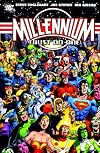
Millennium is the last DC crossover I'll read prior to Zero Hour: Crisis in Time!-- like Legends, it has some light connections to Crisis on Infinite Earths. In this case, that's the presence of Harbinger, having finished writing History of the DC Universe, and that the plot spins out of when the Guardians of the Universe departed the universe, which happened in the Crisis.
The plot of Millennium is that a Guardian and a Zamaron have decided to jump-start evolution on Earth so that humans can show more take the place of the Guardians, which they will do by picking ten (or eight, or seven, or some other number) of special humans. But the robotic Manhunter cult is opposed to this, and so they activate their hidden agents to destroy the special humans as well as superheroes in general. This means that anyone could be a Manhunter-- only in practice, the only significant Manhunter is Lana Lang (I don't know how this was resolved, because she's still around in later comics, and I assume not an evil android by that point). Most of the Manhunters are "revealed" as characters I've never heard of, and whose significance to the superheroes isn't really explained. There's also a hilarious scene where Booster Gold discovers a Manhunter by overhearing telling another Manhunter that he hopes he isn't discovered-- with security like that, no wonder they end up soundly whomped on.
The frustrating part of Millennium is that though it has a much more complicated plot than, say, Legends, we never get to see many of the important moments of this plot. One issue ends with heroes going off to attack the Manhunter home planet; the next begins with the planet having been destroyed, in an issue of some other comic book from 1988 that I'll never read. This means mostly you read about the heroes talking about what they have just done, or what they are going to be doing... but you never get to see them do it.
Meanwhile, the Guardian and the Zamaron tutor the chosen "New Guardians" in a lot of cod-mysticism that makes The Empire Strikes Back and Death Comes to Time look deep and complex. Then they "evolve"; as you might have guessed, "evolution" in this context means "assume the identity of a superhero that could have only been thought of in 1988." One of them becomes the superhero RAM-- Random Access Memory. His power is, of course, "computers".
Poor Harbinger doesn't fare well here-- her history is used by the Manhunters to discover the secret identities of the superheroes, and she gets tortured by the Manhunters. She's not quite the powerful, mystical being she was during the Crisis; she comes across as a pretty "ordinary" superhero, alas.
Famously, this is the book where it was established that in the DC universe, Britain is a fog-shrouded fascist dictatorship, which I find hilarious. I wonder if Paul Cornell dealt with this in Knight and Squire? Also Ronald Reagan makes a return appearance after Legends. Is it noteworthy that this is the third big DC story in a row (after Crisis on Infinite Earths and Legends) where Firestorm gets a decent amount of focus? Were they trying to push his solo book or what?
The art of Joe Staton and Ian Gibson is more stylized than is normal for a mainstream DC book, but I really liked it for that reason-- it gave this book a little more oomph than it might otherwise have had. But overall, Millennium is an exercise in eight issues of frustration.
DC Comics Crises: « Previous in sequence | Next in sequence » show less
The plot of Millennium is that a Guardian and a Zamaron have decided to jump-start evolution on Earth so that humans can show more take the place of the Guardians, which they will do by picking ten (or eight, or seven, or some other number) of special humans. But the robotic Manhunter cult is opposed to this, and so they activate their hidden agents to destroy the special humans as well as superheroes in general. This means that anyone could be a Manhunter-- only in practice, the only significant Manhunter is Lana Lang (I don't know how this was resolved, because she's still around in later comics, and I assume not an evil android by that point). Most of the Manhunters are "revealed" as characters I've never heard of, and whose significance to the superheroes isn't really explained. There's also a hilarious scene where Booster Gold discovers a Manhunter by overhearing telling another Manhunter that he hopes he isn't discovered-- with security like that, no wonder they end up soundly whomped on.
The frustrating part of Millennium is that though it has a much more complicated plot than, say, Legends, we never get to see many of the important moments of this plot. One issue ends with heroes going off to attack the Manhunter home planet; the next begins with the planet having been destroyed, in an issue of some other comic book from 1988 that I'll never read. This means mostly you read about the heroes talking about what they have just done, or what they are going to be doing... but you never get to see them do it.
Meanwhile, the Guardian and the Zamaron tutor the chosen "New Guardians" in a lot of cod-mysticism that makes The Empire Strikes Back and Death Comes to Time look deep and complex. Then they "evolve"; as you might have guessed, "evolution" in this context means "assume the identity of a superhero that could have only been thought of in 1988." One of them becomes the superhero RAM-- Random Access Memory. His power is, of course, "computers".
Poor Harbinger doesn't fare well here-- her history is used by the Manhunters to discover the secret identities of the superheroes, and she gets tortured by the Manhunters. She's not quite the powerful, mystical being she was during the Crisis; she comes across as a pretty "ordinary" superhero, alas.
Famously, this is the book where it was established that in the DC universe, Britain is a fog-shrouded fascist dictatorship, which I find hilarious. I wonder if Paul Cornell dealt with this in Knight and Squire? Also Ronald Reagan makes a return appearance after Legends. Is it noteworthy that this is the third big DC story in a row (after Crisis on Infinite Earths and Legends) where Firestorm gets a decent amount of focus? Were they trying to push his solo book or what?
The art of Joe Staton and Ian Gibson is more stylized than is normal for a mainstream DC book, but I really liked it for that reason-- it gave this book a little more oomph than it might otherwise have had. But overall, Millennium is an exercise in eight issues of frustration.
DC Comics Crises: « Previous in sequence | Next in sequence » show less

Access a version of the below that includes illustrations on my blog.
The Huntress was, I think, the first concept original to Earth-Two to receive an ongoing feature since Earth-Two became Earth-Two, i.e., since the end of the Golden Age and the return of its characters as alternate reality denizens in the Silver Age. It demonstrates the potential of the concept: the Huntress is a character who could only exist on Earth-Two, a young woman trying to find her own way in the world while living show more up to the legacies of her superhero father and supervillain mother. You couldn't tell this story on Earth-One, but this kind of thing would become the backbone of Earth-Two stories, and then with the integration of Earth-Two, into DC's approach to its superheroes in general.
The individual stories here are probably nothing special, but they work. Helena works at a public-interest law firm by day and fights crime by night. There's a nice sense that this is all grounded in the social realities of Gotham; you've read much more fanciful Batman-adjacent stories. The Huntress was always a feature in an anthology title, so the stories are typically serialized across installments of about eight pages, which keeps them moving briskly. I couldn't single any one story out, but I know that as I read them, I was always interested and engaged.
Part of that is because of Joe Staton. Staton, I think, is a now-neglected heavyweight of 1980s comics, an era where he did good work on Legion of Super-Heroes, Green Lantern, Action Comics, and Millennium (among, I'm sure, others). I always like his atmospheric style, but it's particularly suited to adventures in Gotham City at night, sometimes blocky, but with Helena's athleticism and attractiveness always clear.
This volume collects the first five years of Huntress solo adventures, all of the ones written by Paul Levitz. Joey Cavalieri took over writing the character after that, with Staton continuing on art at first, up until the point the character was obliterated by the Crisis,* but none of that material has been collected. Unfortunately, as I'm willing to track down some pretty random stuff, but buying a ton of issues of Wonder Woman because of a back-up feature doesn't really appeal.
The Justice Society and Earth-Two: « Previous in sequence | Next in sequence »
* Well, beyond, actually, as Cavalieri also wrote the 1989-90 ongoing series that introduced the post-Crisis Huntress, who had no relationship to Bruce Wayne or Selina Kyle. show less
The Huntress was, I think, the first concept original to Earth-Two to receive an ongoing feature since Earth-Two became Earth-Two, i.e., since the end of the Golden Age and the return of its characters as alternate reality denizens in the Silver Age. It demonstrates the potential of the concept: the Huntress is a character who could only exist on Earth-Two, a young woman trying to find her own way in the world while living show more up to the legacies of her superhero father and supervillain mother. You couldn't tell this story on Earth-One, but this kind of thing would become the backbone of Earth-Two stories, and then with the integration of Earth-Two, into DC's approach to its superheroes in general.
The individual stories here are probably nothing special, but they work. Helena works at a public-interest law firm by day and fights crime by night. There's a nice sense that this is all grounded in the social realities of Gotham; you've read much more fanciful Batman-adjacent stories. The Huntress was always a feature in an anthology title, so the stories are typically serialized across installments of about eight pages, which keeps them moving briskly. I couldn't single any one story out, but I know that as I read them, I was always interested and engaged.
Part of that is because of Joe Staton. Staton, I think, is a now-neglected heavyweight of 1980s comics, an era where he did good work on Legion of Super-Heroes, Green Lantern, Action Comics, and Millennium (among, I'm sure, others). I always like his atmospheric style, but it's particularly suited to adventures in Gotham City at night, sometimes blocky, but with Helena's athleticism and attractiveness always clear.
This volume collects the first five years of Huntress solo adventures, all of the ones written by Paul Levitz. Joey Cavalieri took over writing the character after that, with Staton continuing on art at first, up until the point the character was obliterated by the Crisis,* but none of that material has been collected. Unfortunately, as I'm willing to track down some pretty random stuff, but buying a ton of issues of Wonder Woman because of a back-up feature doesn't really appeal.
The Justice Society and Earth-Two: « Previous in sequence | Next in sequence »
* Well, beyond, actually, as Cavalieri also wrote the 1989-90 ongoing series that introduced the post-Crisis Huntress, who had no relationship to Bruce Wayne or Selina Kyle. show less
Lists
You May Also Like
Associated Authors
Statistics
- Works
- 39
- Also by
- 86
- Members
- 391
- Popularity
- #61,940
- Rating
- 3.7
- Reviews
- 18
- ISBNs
- 21