
George Sheehan (1918–1993)
Author of Running & Being: The Total Experience
About the Author
Image credit: George Sheehan [credit: Find A Grave user Kat]
Works by George Sheehan
Personal Best: The Foremost Philosopher of Fitness Shares Techniques and Tactics for Success and Self-Liberation (1989) 51 copies
George Sheehan on Running to Win: How to Achieve the Physical, Mental and Spiritual Victories of Running (1992) 46 copies
Tagged
Common Knowledge
- Birthdate
- 1918-11-05
- Date of death
- 1993-11-01
- Gender
- male
- Education
- Manhattan College
Long Island College of Medicine - Occupations
- physician
columnist - Organizations
- United States Navy
Runner's World
Christian Brothers Academy - Relationships
- Sheehan, Andrew (son)
- Nationality
- USA
- Birthplace
- Brooklyn, New York, USA
- Places of residence
- New York, New York, USA
Rumson, New Jersey, USA - Place of death
- Ocean Grove, New Jersey, USA
- Burial location
- Mount Olivet Cemetery, Middletown, New Jersey, USA
- Associated Place (for map)
- New Jersey, USA
Members
Reviews

I didn't know what to think of this book when it came across my desk. Everyone knows George Sheehan is a renowned expert on distance running. Everyone also knows he isn't exactly the friendliest of runners. What I didn't know was how funny he would be in Running and Being. Part philosophy, part psychology, part memoir, and all about running, Running and Being was above all else, entertaining. Amidst the advice about pace, hills, racing, losing, injuries, and accomplishments there is humor, show more sarcasm and wit. Even the illustrations are funny.
Here are two examples of nonrunning humor: "I was born with the dread that someone would punch me in the nose or, even worse, put his arm around me" (p 26), and "I never smoked. Buying something and then setting it on fire is incomprehensible" (p 47). Crack me up.
Despite Sheehan's "keep away" attitude I found his advice to be warm, solid and comforting. If words could actually be all those things. I consider his expertise on the subject of putting one foot in front of another to be priceless. show less
Here are two examples of nonrunning humor: "I was born with the dread that someone would punch me in the nose or, even worse, put his arm around me" (p 26), and "I never smoked. Buying something and then setting it on fire is incomprehensible" (p 47). Crack me up.
Despite Sheehan's "keep away" attitude I found his advice to be warm, solid and comforting. If words could actually be all those things. I consider his expertise on the subject of putting one foot in front of another to be priceless. show less

One of those books that defined the movement.
I was rather late in reading this book. I read it again it was serialized in Marathon and Beyond. A decade after that reading it I still recall some of the concepts that he outlined.
"Man's fourth unalienable right is time-out. This pause, this breather, this break in the action is what makes life, liberty and the pursuit of happiness possible. Without the time-out, I would not know what life to lead, how to use my liberty or what happiness to show more pursue. At the moment I forget whence I came, why I am here and where I am going, it is the right to call "Time" that saves me."
"I find this truth to be self-evident. I see it every weekend on television. When winning and losing hangs in the balance, when the play gets ragged and the players fatigued, when the game plan has been forgotten and the athletes demoralized, the time-out works wonders. I've seen courage replace fear and purpose take the place of indecision. I've seen teams come back relaxed and composed and confident, all because of the time-out."
"And so when I am losing my head and all about me are keeping theirs, when I am filled with the frustrations and anxieties of my daily routine, when I am no longer living my own life but simply reacting to others, I look for a time-out, whether it is 60 minutes or 60 seconds."
"That time-out, that hour a day that belongs to me, just remain inviolate. No excuse, no friend, no cause, no duty, can come between me and that hour and whatever I might want to do with it. Mostly I take that hour and run with it, and thereby revive and restore and replenish the man I am."
"The 60-second time-outs, on the other hand, cannot be programmed. I take them where I find them. At a stop-light, I could fume and sputter about getting there instead of being here. but it is much better to read a book. Or do isometric exercises for my stomach muscles. Or take the opportunity to recharge my senses with colors and odors and sounds, or to see the geometry of the buildings, the pattern of the trees, the movement of the people, or to see familiar objects as if for the first time. And soon my red lights become too short."
"Too soon I am being whistled back into the game. Too soon I begin to forget once again I am animal, artist, mystic, clown, that I am really concerned with quite simple things with things that only come when I finally loose the reigns and become calm and relaxed and cease my tense activity, when I stop counting and measuring and comparing and weighing." show less
I was rather late in reading this book. I read it again it was serialized in Marathon and Beyond. A decade after that reading it I still recall some of the concepts that he outlined.
"Man's fourth unalienable right is time-out. This pause, this breather, this break in the action is what makes life, liberty and the pursuit of happiness possible. Without the time-out, I would not know what life to lead, how to use my liberty or what happiness to show more pursue. At the moment I forget whence I came, why I am here and where I am going, it is the right to call "Time" that saves me."
"I find this truth to be self-evident. I see it every weekend on television. When winning and losing hangs in the balance, when the play gets ragged and the players fatigued, when the game plan has been forgotten and the athletes demoralized, the time-out works wonders. I've seen courage replace fear and purpose take the place of indecision. I've seen teams come back relaxed and composed and confident, all because of the time-out."
"And so when I am losing my head and all about me are keeping theirs, when I am filled with the frustrations and anxieties of my daily routine, when I am no longer living my own life but simply reacting to others, I look for a time-out, whether it is 60 minutes or 60 seconds."
"That time-out, that hour a day that belongs to me, just remain inviolate. No excuse, no friend, no cause, no duty, can come between me and that hour and whatever I might want to do with it. Mostly I take that hour and run with it, and thereby revive and restore and replenish the man I am."
"The 60-second time-outs, on the other hand, cannot be programmed. I take them where I find them. At a stop-light, I could fume and sputter about getting there instead of being here. but it is much better to read a book. Or do isometric exercises for my stomach muscles. Or take the opportunity to recharge my senses with colors and odors and sounds, or to see the geometry of the buildings, the pattern of the trees, the movement of the people, or to see familiar objects as if for the first time. And soon my red lights become too short."
"Too soon I am being whistled back into the game. Too soon I begin to forget once again I am animal, artist, mystic, clown, that I am really concerned with quite simple things with things that only come when I finally loose the reigns and become calm and relaxed and cease my tense activity, when I stop counting and measuring and comparing and weighing." show less
This was a hilarious book. Crazy over-the-top paeans to physical fitness as the ultimate virtue, wild claims about spirituality and its connection to running, and an insistence that every long-distance runner shares the same totally Asperger's traits as the author. I giggled all the way through.
That said, the sections that are actual memoirs of races or discussions of the nuts-and-bolts of running are solid - among other things, the author gives a dead-on description of hypercorticism while show more pointing out that there was no current science to explain "staleness" resulting from overtraining.
It's not a book I'd recommend - it's way too scattered, hyperbolic, and dated to really hang together - but it was a funny read. show less
That said, the sections that are actual memoirs of races or discussions of the nuts-and-bolts of running are solid - among other things, the author gives a dead-on description of hypercorticism while show more pointing out that there was no current science to explain "staleness" resulting from overtraining.
It's not a book I'd recommend - it's way too scattered, hyperbolic, and dated to really hang together - but it was a funny read. show less
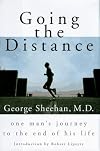
Going the Distance is a truly great read looking into the final years of a mans life. I've been a lifelong runner and was familiar with Dr. Sheehan's columns in Runner's World but I had not read any of his books. This book would appeal to the non-runner as well as the runner. Dr. Sheehan is truly a great philosopher is this read. He pulls no punches in the description of his battle with terminal cancer. While it's a very sad book it's also inspiring people to focus on what's important in show more life. He openly admitted he had neglected his family over the years but had reconciled during his illness. The real beauty of this book is his examination of the thought process and realization of his diminishing physical attributes. A seasoned marathon runner he enjoyed a fitness lifestyle that was taken away. Similarly, he examins the struggle with religion and the afterlife. What matters the most was his courage to write till the very end. Here I have read his book 17 yrs after his death and I found it truly inspiring. show less
Awards

You May Also Like


Statistics
- Works
- 13
- Members
- 544
- Popularity
- #45,826
- Rating
- 3.8
- Reviews
- 10
- ISBNs
- 39
- Languages
- 2
- Favorited
- 2
