
Mo Willems
Author of Don't Let the Pigeon Drive the Bus!
About the Author
Mo Willems was born on February 11, 1968. After graduating from New York University's Tisch School for the Arts, he spent a year traveling around the world drawing a cartoon every day, which were published in the book You Can Never Find a Rickshaw When it Monsoons. For nine seasons, he worked as a show more writer and animator for PBS' Sesame Street, where he received 6 Emmy Awards for his writing. During this time, he also served as a weekly commentator for BBC Radio and created two animated series, Nickelodeon's The Off-Beats and Cartoon Network's Sheep in the Big City. While working as head writer for Cartoon Network's Codename: Kids Next Door, he began writing and drawing books for children. He received three Caldecott Honor Awards for Don't Let the Pigeon Drive the Bus! in 2004; Knuffle Bunny: A Cautionary Tale in 2005; and Knuffle Bunny Too: A Case of Mistaken Identity in 2008. He also created the Elephant and Piggie series for Easy Readers, which were awarded the Theodor Seuss Geisel Medal in 2008 and 2009. His drawings, wire sculptures, and ceramics have been exhibited in numerous galleries and museums across the nation. Occasionally he serves as the Radio Cartoonist for NPR's All Things Considered. He voices and produces animated cartoons based on his books with Weston Woods studios. The animated Knuffle Bunny was awarded Best Film during the New York International Children's Film Festival in 2008 and received the Andrew Carnegie Medal in 2007. His title Happy Pig Day made Publisher's Weekly Best Seller List for 2011. In 2012 his title Goldilocks and The Three Dinosaurs made The New York Times Best Seller List. In 2013 his titles: That is Not a Good Idea!, Let's Go for a Drive! and I'm a Frog! made the New York Times Best Seller List. In 2014 The Pigeons Need a Bath! and Waiting Is Not Easy! made the New York Times Best Seller List. (Bowker Author Biography) show less
Series
Works by Mo Willems
You Can Never Find a Rickshaw When It Monsoons - The World on One Cartoon a Day (2006) 244 copies, 3 reviews
Elephant & Piggie: The Complete Collection (Includes 2 Bookends) (An Elephant and Piggie Book) (2018) 153 copies
Pigeon Series 7 Book Set : Don't Let the Pigeon Drive the Bus / Stay up Late. Pigeon Finds a Hot Dog ....and 4 More Titles (2009) 24 copies
The Wonderful World of Elephant & Piggie Series 10 Books Collection Box Set by Mo Willems (2020) 7 copies
My Friend is Sad / Today I Will Fly! 4 copies
We really like cooking slop! : the elephant & piggie cookbook : 50 do-together recipes for meals, snacks, dessert, and more (2026) 2 copies
Don't Let the Pigeon series 1 copy
Lazy Day Doodles 1 copy
Pigeon Pack (3 Books) (The Pigeon Finds a Hotdog; Don't Let Pigeon Stay Up Late; The Pigeon Wants a Puppy) (2010) 1 copy
Books 1 copy
Sheep in the Big City: Season 1 — Creator — 1 copy
Sheep in the Big City: Season 2 — Creator — 1 copy
Happy Pig Day! 1 copy
Associated Works
9-11: The World's Finest Comic Book Writers & Artists Tell Stories to Remember (2002) — Contributor — 256 copies, 1 review
Every Man for Himself: Ten Original Stories About Being a Guy (2005) — Contributor — 102 copies, 7 reviews
Tagged
Common Knowledge
- Birthdate
- 1968-02-11
- Gender
- male
- Education
- New York University, Tisch School of the Arts
Trinity Episcopal School
Isidore Newman School - Occupations
- animator
illustrator
children's book author - Awards and honors
- Theodor Suess Geisel Medal (2008, 2009)
Caldecott Honor (2004, 2005, 2008 - Short biography
- Mo Willems was born on February 11 in 1968 and raised in New Orleans. He attended Tisch School of the Arts through New York University, graduating cum laude. He began his career as a writer and animator for Sesame Street, and then went on to create two cartoon series: "The Off-Beats" for Nickelodeon's "Kablam!" and "Sheep in the Big City" for Cartoon Network. Since 2003, Willems has authored numerous books for young children.
- Nationality
- USA
- Birthplace
- New Orleans, Louisiana, USA
- Places of residence
- New Orleans, Louisiana, USA
Northampton, Massachusetts, USA - Associated Place (for map)
- USA
Members
Discussions
Anyone a else Mo Willems Fan? in Children's Literature (May 2015)
Reviews

Willems departs from his usual comic fare in this ode to the many people that inspire and contribute to the creation of art in young people.
Each spread in the first half of the book states a causal effect: “Because a man named Ludwig wrote beautiful music— / a man named Franz was inspired to create his own. // Because many years later, people wanted to hear Franz’s beautiful music— / they formed an orchestra.” Musicians who have practiced diligently are invited to participate, show more workers make sure the concert hall is ready, and ushers open the doors. This chain continues as each person contributes to the culmination of a present-day grand orchestral performance at which a little tawny-brown–skinned girl is present, “because” her uncle has caught a cold and given her his ticket. This little girl is changed by this experience, and in the second half of the book, she grows up to create her own music that then inspires another child, who listens outside. Debut illustrator Ren’s delicate cartoon art depicts both a realistic multicultural community and magical representations of music and inspiration. Both the protagonist and the child who hears her are depicted borne aloft by tendrils of colored music.
While many books celebrate the arts and creativity, this one stands out for recognizing the importance of community support; from the orchestra librarian to the music lovers who purchase tickets, everyone contributes to the culture of creativity. (Picture book. 4-8) show less
Each spread in the first half of the book states a causal effect: “Because a man named Ludwig wrote beautiful music— / a man named Franz was inspired to create his own. // Because many years later, people wanted to hear Franz’s beautiful music— / they formed an orchestra.” Musicians who have practiced diligently are invited to participate, show more workers make sure the concert hall is ready, and ushers open the doors. This chain continues as each person contributes to the culmination of a present-day grand orchestral performance at which a little tawny-brown–skinned girl is present, “because” her uncle has caught a cold and given her his ticket. This little girl is changed by this experience, and in the second half of the book, she grows up to create her own music that then inspires another child, who listens outside. Debut illustrator Ren’s delicate cartoon art depicts both a realistic multicultural community and magical representations of music and inspiration. Both the protagonist and the child who hears her are depicted borne aloft by tendrils of colored music.
While many books celebrate the arts and creativity, this one stands out for recognizing the importance of community support; from the orchestra librarian to the music lovers who purchase tickets, everyone contributes to the culture of creativity. (Picture book. 4-8) show less

I cannot tell you how hilarious I find it that this adorable picture-book by Mo Willems - author of the Caldecott Honor Book Don't Let the Pigeon Drive the Bus - has aroused the ire of the fundamentalist pseudo-science crowd, who perceive, in its tale of a young boy who refuses to trust the evidence of his own eyes, when it contradicts something he already believes, an attack on science, and an argument for behavioral conformity.
Yes. Because, the argument runs, Reginald von Hoobie-Doobie show more (great name, Mo Willems!) stops brow-beating the other members of his community, ceases to protest (protest!) at the very existence of another, and begins to act like a human being (one who eats chocolate-chip cookies), he must therefore have imbibed the "opiate of the masses." Don't believe me? Check out the amazon review that sneers at Edwina's "cliched" niceness, and maintains that the message here is that research and protest are a silly means of trying to correct the common knowledge, and buck the "status quo." Or the review which claims that Willems is promoting a "corrupted thought process" in which popular belief is preferable to scientific fact.
Well then, here are the facts: In this story, a young man finds that the reality of the world around him does not conform to the received wisdom contained in his books - a source he is predisposed to trust. Rather than precipitating a period of further investigation - an effort to reconcile new evidence with existing theory - this contradiction leads our hero into a frantic effort to shore up what he already believes (that dinosaurs are extinct), and to convince those around him to believe the same. The fact that this belief runs counter to the lived experience of all, in the form of their daily interaction with Edwina, is precisely the point, and the source of the humor that seems to have escaped the reviewers mentioned above. In one hysterical scene, Reginald actually parades around with a sign that reads "This is not happening!"
Of course, there is also an emotional component to this story, and I could see someone coming away from it with the idea that Willems' is offering an affirmation of the importance of feeling, as a way of understanding the world. But the irony, of course, of the criticism leveled at Edwina, the Dinosaur Who Didn't Know She Was Extinct, is that its protagonist displays many of those characteristics which are (rightly) decried in the religious zealot: an insistence on the "book" as an authority on reality, to the exclusion of new evidence (think creationism); an intolerance for the views of others, and belief that it is given to us to "enlighten" them (think proselytizing missionary work); and a deeply-felt sense of affront, that the existence of others contradicts the "right" way of being (think homophobia).
Willems' crime isn't that he's anti-science, it's that he demonstrates how scientists and researchers can be anti-science. And he does it with humor! Lord, how I love the subversive potential of children's literature! How I love Mo Willems! show less
Yes. Because, the argument runs, Reginald von Hoobie-Doobie show more (great name, Mo Willems!) stops brow-beating the other members of his community, ceases to protest (protest!) at the very existence of another, and begins to act like a human being (one who eats chocolate-chip cookies), he must therefore have imbibed the "opiate of the masses." Don't believe me? Check out the amazon review that sneers at Edwina's "cliched" niceness, and maintains that the message here is that research and protest are a silly means of trying to correct the common knowledge, and buck the "status quo." Or the review which claims that Willems is promoting a "corrupted thought process" in which popular belief is preferable to scientific fact.
Well then, here are the facts: In this story, a young man finds that the reality of the world around him does not conform to the received wisdom contained in his books - a source he is predisposed to trust. Rather than precipitating a period of further investigation - an effort to reconcile new evidence with existing theory - this contradiction leads our hero into a frantic effort to shore up what he already believes (that dinosaurs are extinct), and to convince those around him to believe the same. The fact that this belief runs counter to the lived experience of all, in the form of their daily interaction with Edwina, is precisely the point, and the source of the humor that seems to have escaped the reviewers mentioned above. In one hysterical scene, Reginald actually parades around with a sign that reads "This is not happening!"
Of course, there is also an emotional component to this story, and I could see someone coming away from it with the idea that Willems' is offering an affirmation of the importance of feeling, as a way of understanding the world. But the irony, of course, of the criticism leveled at Edwina, the Dinosaur Who Didn't Know She Was Extinct, is that its protagonist displays many of those characteristics which are (rightly) decried in the religious zealot: an insistence on the "book" as an authority on reality, to the exclusion of new evidence (think creationism); an intolerance for the views of others, and belief that it is given to us to "enlighten" them (think proselytizing missionary work); and a deeply-felt sense of affront, that the existence of others contradicts the "right" way of being (think homophobia).
Willems' crime isn't that he's anti-science, it's that he demonstrates how scientists and researchers can be anti-science. And he does it with humor! Lord, how I love the subversive potential of children's literature! How I love Mo Willems! show less

Children's picture-book superstar Mo Willems (of bus-driving pigeon fame and confirmed disregard for the "fourth wall") here entices budding readers into the pleasures of literacy by demonstrating the power of text to exert mind control. You will now think of a banana.
Further significance of the story might be found in the notion that Elephant and Piggie acquire agency by becoming conscious of their own containment in narrative. Their final yea-saying is an aspiration to eternal recurrence.
Further significance of the story might be found in the notion that Elephant and Piggie acquire agency by becoming conscious of their own containment in narrative. Their final yea-saying is an aspiration to eternal recurrence.
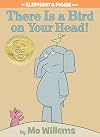
Learning to read is hard work, but main characters Elephant and Piggie make it far more interesting than most early readers do. Written in dialogue bubbles, the book follows elephant Gerald and his friend Piggie as one bird and then a pair of birds nest on his head. Gerald is unable to see what is happening, and illustrations and dialogue make the book inexplicably funny, even after re-readings. The vocabulary and sentence structure is kept simple, but punctuation and the aforementioned show more speech bubbles keep it from feeling repetitive. Simple but expressive illustrations give readers clues to the meaning of the words and the emotions that go with them. And at fifty-seven pages hardcover, There is a Bird on Your Head feels more like a ‘real’ book than many early readers do. While it is designed for children learning to read, it could also be used as a great practice for punctuation and reading aloud, due to Willems’ use of exclamation marks and question marks. A good addition to school, public, and private libraries. This is a well-designed early reader that I predict will be around for a while. show less
Lists
Book List (1)
Back to School (1)
Reading Rainbow (1)
ABC (1)
Five in a Row (1)
Five in a Row (1)
Road Trip (1)
Youth: DEI (1)
Elephants in Books (20)
For My Kids (4)
Storytime (3)
Summer (1)
Guilty Pleasures (2)
Awards


You May Also Like


Associated Authors
Statistics
- Works
- 153
- Also by
- 16
- Members
- 138,815
- Popularity
- #46
- Rating
- 4.3
- Reviews
- 3,799
- ISBNs
- 1,071
- Languages
- 14
- Favorited
- 92

