

Sandra Newman (1) (1965–)
Author of Julia
For other authors named Sandra Newman, see the disambiguation page.
About the Author
Image credit: Author Sandra Newman at the 2019 Texas Book Festival in Austin, Texas, United States. By Larry D. Moore, CC BY-SA 4.0, https://commons.wikimedia.org/w/index.php?curid=84502452
Works by Sandra Newman
How Not to Write a Novel: 200 Classic Mistakes and How to Avoid Them - A Misstep-by-Misstep Guide (2008) 685 copies, 30 reviews
The Western Lit Survival Kit: An Irreverent Guide to the Classics, from Homer to Faulkner (2012) 159 copies, 29 reviews
Associated Works
Tagged
Common Knowledge
- Birthdate
- 1965-11-06
- Gender
- female
- Nationality
- USA
- Birthplace
- Boston, Massachusetts, USA
- Map Location
- USA
Members
Reviews

This book is clearly one of those polarizing experiences. It seems like readers are divided into two campus: those who loved it with the fire of multiple five-star ratings, and those who were turned off by the "language" and couldn't get past the first 50 pages. I'd like to respectfully propose a third camp: the camp of many, frustrating unanswered questions. This book enraged me and engrossed me, but it often confused me, too, and it wasn't due to the language.
Maybe I am the wrong audience show more for this since I don't read a ton of fiction in this genre (which I'll loosely define as postapocalyptic dystopia). But I had problems with consistency and unanswered questions that relate to the world-building. Things that kept nagging me and wouldn't let me fully immerse myself in the story. Such as:
-How is it possible that after 80 years books are "dust" but cans of beef-a-roni are still edible?
-How is it possible that Ice Cream can read (and learned to do so from those non-existent pulverized books, because it appears this society doesn't create written artifacts) but can't understand "sleeper English," i.e., standard English, i.e., the language of the books she learned to read from.
-How is it possible that when Ice Cream first gets to the Spanish-speaking former city of New York she needs an interpreter, but after she's been there for 2 weeks, everyone she meets suddenly speaks her language?
-How is it possible for a disease that's not transmissible through normal physical contact (people with posies continue to work until they're incapacitated and no one catches it from them) to infect everyone on earth? Posies, which shares many characteristics with HIV/AIDS, infects 100% of the world's population (cured Russians excepted). Is it actually possible for a non-contagious disease to infect the entire world? (I'm not a doctor, but it doesn't seem like it.)
-Where did all the white people go? At the beginning of the book it states that they were evacuated, but they're not in the US, they're not in South America or Africa or, we learn at the end, in Europe ("you think because the Europeans are brown like you, they will help you?"). They are not all dead, or every "sleeper" house would contain corpses. Where are they?
-Why do the Russians just want to conquer territories to get slaves for their armies and not to exploit natural or manmade resources in the conquered territories?
-And so on.
All that said, this book was still pretty awesome. I really admired Ice Cream by the end of the book. I also liked the invented language Newman created. Though it was slow going for the first few chapters, I quickly got used to it. Sometimes I just can't turn off my brain, which can be a deficit when reading this type of speculative fiction. show less
Maybe I am the wrong audience show more for this since I don't read a ton of fiction in this genre (which I'll loosely define as postapocalyptic dystopia). But I had problems with consistency and unanswered questions that relate to the world-building. Things that kept nagging me and wouldn't let me fully immerse myself in the story. Such as:
-How is it possible that after 80 years books are "dust" but cans of beef-a-roni are still edible?
-How is it possible that Ice Cream can read (and learned to do so from those non-existent pulverized books, because it appears this society doesn't create written artifacts) but can't understand "sleeper English," i.e., standard English, i.e., the language of the books she learned to read from.
-How is it possible that when Ice Cream first gets to the Spanish-speaking former city of New York she needs an interpreter, but after she's been there for 2 weeks, everyone she meets suddenly speaks her language?
-How is it possible for a disease that's not transmissible through normal physical contact (people with posies continue to work until they're incapacitated and no one catches it from them) to infect everyone on earth? Posies, which shares many characteristics with HIV/AIDS, infects 100% of the world's population (cured Russians excepted). Is it actually possible for a non-contagious disease to infect the entire world? (I'm not a doctor, but it doesn't seem like it.)
-Where did all the white people go? At the beginning of the book it states that they were evacuated, but they're not in the US, they're not in South America or Africa or, we learn at the end, in Europe ("you think because the Europeans are brown like you, they will help you?"). They are not all dead, or every "sleeper" house would contain corpses. Where are they?
-Why do the Russians just want to conquer territories to get slaves for their armies and not to exploit natural or manmade resources in the conquered territories?
-And so on.
All that said, this book was still pretty awesome. I really admired Ice Cream by the end of the book. I also liked the invented language Newman created. Though it was slow going for the first few chapters, I quickly got used to it. Sometimes I just can't turn off my brain, which can be a deficit when reading this type of speculative fiction. show less
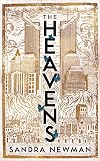
As far as real life is concerned, whenever I wake up, I often feel the world has changed. I don't think it's because of my dreams but despite them. We were taught in the spiritual 1960s that we were responsible for everything, even the war in Vietnam. Or was it that we had to take responsibility for everything? (did someone change this while I slept?) Because, at the same time, believing everything was about you is called "Ideas of Reference" and is a symptom of mental illness.
I should have show more written this review when I finished the book, which was a while ago but at the time it wasn't published yet and I feared it still might change, like reality did for Kate whenever she awoke. So, I'm rereading it now to remind me what it's like and I'm laughing, inappropriately, it turns out since the World Trade towers just fell (in the book, I mean) but it's so good and funny.
A writer can change reality intentionally, when the reality is a book. Emilia, who I'd just learned was a real person, wrote at a time when women weren't allowed to change reality or even publish books, but the world has changed since then and she was part of changing it by being a woman who wrote a book so that part turns out to be non-fiction.
And, we write our dreams, because who else could be writing them? And Shakespeare wrote histories, and in this book, inhabited them in HIS dreams. And sometimes I feel like I'm not in the same reality as everyone around me and other times I merely wish it and the world feels like a big psychiatric hospital. Ms. Newman's writing captures all this ambiguity in a time when people are so sure of themselves and think it's OTHER people who live in a bubble.
If you have to look for a moral to the story, it's that technology is limited by our egos. We want to save the world but really we want to be saviors. Instead, the zen goal of being Nothing Special is the only way out. Emilia's enlightenment comes like in a zen story, suddenly and illogically like an off key note in a song. show less
I should have show more written this review when I finished the book, which was a while ago but at the time it wasn't published yet and I feared it still might change, like reality did for Kate whenever she awoke. So, I'm rereading it now to remind me what it's like and I'm laughing, inappropriately, it turns out since the World Trade towers just fell (in the book, I mean) but it's so good and funny.
A writer can change reality intentionally, when the reality is a book. Emilia, who I'd just learned was a real person, wrote at a time when women weren't allowed to change reality or even publish books, but the world has changed since then and she was part of changing it by being a woman who wrote a book so that part turns out to be non-fiction.
And, we write our dreams, because who else could be writing them? And Shakespeare wrote histories, and in this book, inhabited them in HIS dreams. And sometimes I feel like I'm not in the same reality as everyone around me and other times I merely wish it and the world feels like a big psychiatric hospital. Ms. Newman's writing captures all this ambiguity in a time when people are so sure of themselves and think it's OTHER people who live in a bubble.
If you have to look for a moral to the story, it's that technology is limited by our egos. We want to save the world but really we want to be saviors. Instead, the zen goal of being Nothing Special is the only way out. Emilia's enlightenment comes like in a zen story, suddenly and illogically like an off key note in a song. show less
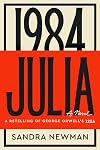
Reworkings of famous and well-loved literature always seem to have a tough double task: they must chart fresh ground while also remaining recognizably faithful to the source material. Come to think of it, this may well be an example of the key concept of doublethink: the need to hold contradictory ideas simultaneously, believing in both with all one’s being.
Sandra Newman’s excellent Julia mostly meets this twin challenge, in my opinion. I have read the original novel perhaps a dozen show more times over the years, dating back to my pre-Library Thing days. In fact, I wrote critical essays on 1984 in both college and graduate school. So, when I came across scenes in Julia in which Julia and Winston interact, the dialogue was so familiar and spot-on that I never did go back and check the original as I thought going in that I might. I did purchase a new edition of 1984 alongside Julia, though it was disappointing for various reasons and I have added it to the sell pile.
Anyway, while this is not by any means The Greatest Novel Ever Written™️, it is a superb accomplishment, indeed a tour de force. I will keep myself from describing specific convergences and divergences from 1984 so as to avoid spoilers, but perhaps I can summarize this simply by praising this novel’s expansive exploration of the gaslighting that lies at the heart of doublethink and the Party’s control. I loved reading this, and I suspect that whenever I deign to read 1984 again, I will surely read this again soon after. show less
Sandra Newman’s excellent Julia mostly meets this twin challenge, in my opinion. I have read the original novel perhaps a dozen show more times over the years, dating back to my pre-Library Thing days. In fact, I wrote critical essays on 1984 in both college and graduate school. So, when I came across scenes in Julia in which Julia and Winston interact, the dialogue was so familiar and spot-on that I never did go back and check the original as I thought going in that I might. I did purchase a new edition of 1984 alongside Julia, though it was disappointing for various reasons and I have added it to the sell pile.
Anyway, while this is not by any means The Greatest Novel Ever Written™️, it is a superb accomplishment, indeed a tour de force. I will keep myself from describing specific convergences and divergences from 1984 so as to avoid spoilers, but perhaps I can summarize this simply by praising this novel’s expansive exploration of the gaslighting that lies at the heart of doublethink and the Party’s control. I loved reading this, and I suspect that whenever I deign to read 1984 again, I will surely read this again soon after. show less
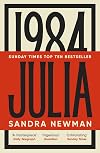
The Sunday Times bestseller list strikes again! I ploughed through 1984 to read this feminist retelling of Orwell's novel, and honestly, I found Julia's story even more depressing (apart from the Terminator 2 style 'the sequel must make everything right' ending).
I'm not sure what Sandra Newman was trying to do with Julia, the girlfriend of Winston Smith (and based on Orwell's wife Sonia), but the character suffers from 'everywoman' syndrome, in my view, and has had all her edges shaved off. show more In 1984, Julia quips that she would have shoved Winston's wife off a cliff and is very forthright and proactive in organising their meetings - here, she comes across as a bleeding heart victim of abuse who is manipulated by 'the Party' into setting up Winston: 'She was not, as she was last time, the object of deception, but one of the deceivers.'
I did like that the love note passed to Winston started as a love note to Julia from another woman - although Julia still gushes about big strong men and finds Winston handsome, which was never part of his original description! - but the flipping of the flat above the shop and the meeting with O'Brien was a bit laboured. I found Julia spikier and more elusive in the original text a and whereas I welcomed her backstory, the retelling takes away a lot of Julia's agency. The author wants everyone to love Julia - she's popular at the Ministry, works alongside the proles on the black market, and is singled out by the Party - but who is Julia? Why is she drawn to Winston? Whose side is she on? She doesn't really seem to have a strong moral compass - in any direction - and then to throw in thepregnancy trope with the implication that Julia is happy to think she is having Big Brother's baby! was just bizarre. I know the original book is set in alternative post-war London but a modern take on the character shouldn't share the same dated ambitions.
Some clever building on Orwell's concise world-building but I prefer Julia v 1.0. show less
I'm not sure what Sandra Newman was trying to do with Julia, the girlfriend of Winston Smith (and based on Orwell's wife Sonia), but the character suffers from 'everywoman' syndrome, in my view, and has had all her edges shaved off. show more In 1984, Julia quips that she would have shoved Winston's wife off a cliff and is very forthright and proactive in organising their meetings - here, she comes across as a bleeding heart victim of abuse who is manipulated by 'the Party' into setting up Winston: 'She was not, as she was last time, the object of deception, but one of the deceivers.'
I did like that the love note passed to Winston started as a love note to Julia from another woman - although Julia still gushes about big strong men and finds Winston handsome, which was never part of his original description! - but the flipping of the flat above the shop and the meeting with O'Brien was a bit laboured. I found Julia spikier and more elusive in the original text a and whereas I welcomed her backstory, the retelling takes away a lot of Julia's agency. The author wants everyone to love Julia - she's popular at the Ministry, works alongside the proles on the black market, and is singled out by the Party - but who is Julia? Why is she drawn to Winston? Whose side is she on? She doesn't really seem to have a strong moral compass - in any direction - and then to throw in the
Some clever building on Orwell's concise world-building but I prefer Julia v 1.0. show less
Lists
Awards


You May Also Like
Associated Authors
Statistics
- Works
- 10
- Also by
- 2
- Members
- 2,922
- Popularity
- #8,765
- Rating
- 3.7
- Reviews
- 141
- ISBNs
- 116
- Languages
- 11

