

Ronald J. Allen
Author of Patterns of Preaching: A Sermon Sampler
About the Author
Ronald J. Allen is the Nettie Sweeney and Hugh Th. Miller Professor of Preaching and New Testament at Christian Theological Seminary in Indianapolis.
Works by Ronald J. Allen
Thinking Theologically: The Preacher As Theologian (Elements of Preaching) (2007) 68 copies, 1 review
Theology for Preaching: Authority, Truth, and Knowledge of God in a Postmodern Ethos (1997) 41 copies
Constitutional Criminal Procedure: An Examination of the Fourth, Fifth, and Sixth Amendments and Related Areas (Law Scho (1995) 16 copies
Under the Oak Tree: The Church as Community of Conversation in a Conflicted and Pluralistic World (2013) — Editor; Contributor — 6 copies
You Never Step into the Same Pulpit Twice: Preaching from a Perspective of Process Theology (2022) 5 copies
Preaching : an essential guide 5 copies
Criminal Procedure: Investigation and the Right to Counsel [Connected eBook with Study Center] (Aspen Casebook) (2020) 4 copies
Preaching the Manifold Grace of God, Volume 1: Theologies of Preaching in Historical Theological Families (2022) 4 copies
Preaching the Manifold Grace of God, Volume 2: Theologies of Preaching in the Early Twenty-First Century (2022) 3 copies
Associated Works
Tagged
Common Knowledge
Members
Reviews
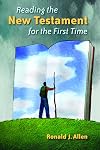
For over a century, Gideons International has placed millions of Bibles in hotel rooms around the world and has distributed countless others, particularly pocket New Testaments, on college campuses, in prisons, and elsewhere. Part of the rationale for the effort is to evangelize, believing that some might become Christians simply by reading through the Bible on their own.
The practicality of this approach, though, is questionable, which may come as a surprise to those who learned Bible show more stories from parents and Sunday School teachers before they ever tried to read the scriptures on their own. For those who approach the Bible, especially the New Testament, without much religious background, it can be an intimidating text to read and understand.
Ronald Allen, a professor at Christian Theological Seminary in Indianapolis, tries to offer an encouraging introduction in "Reading the New Testament for the First Time." Clearly he believes that some people, at least in the American culture, will read the New Testament out of curiosity and might appreciate some help in understanding the ancient writings.
Personally, I find it rather odd to imagine there is much market for this book. While I'm sure there are people who would like to read the New Testament without pushy church folks scrambling to get them to join their congregations or tell them exactly what they're supposed to believe, I can't imagine them reaching for this book. Maybe they might seek out some form of "The Bible for Dummies," but probably not a book from a religious publisher.
This is just as well. Whatever "Reading the New Testament for the First Time" might be, it is not a book for first-time readers of the Bible. It starts off reasonably well, with a brief and inviting introduction followed by a chapter explaining what a reader will encounter in the New Testaments (divisions into books, chapters, and verses; kinds of writings; how the New Testament was transmitted from ancient times to the present). After this, though, it quickly develops into a book that will likely confuse a new reader more completely than trying to read Matthew 1 in the King James Version.
Frankly, this was surprising, as I know that Allen has an excellent reputation for good teaching and writing. (Also, my colleagues who know him tell me he is a genuinely kind person.) But as a pastor, I found his approach consistently baffling, raising issues that seem mostly tangential, especially for first-time readers, and overlooking helpful context (maybe to keep the book short?) all too often. Worse, although Allen claims to write in a conversational way, "avoiding technical language," too often he seems more worried about colleagues criticizing him for oversimplification than offering clear (if oversimplified) entry points for new readers.
This is most apparent in Allen's persistent talk about "the Realm of God," in place of the Kingdom of God. While there are certain reasons to appreciate an attempt to use non-gendered language, and while it is also clear that American readers have little understanding of what a kingdom is, I find it inconceivable that this is the time and place for such language adjustment. If we are trying to make someone comfortable reading the New Testament for the first time, it is important to use the actual words they will find in their reading, especially something so often mentioned as the Kingdom of God. Allen's unwillingness to adjust his preferred language to meet his readers where they are is troubling; worse, this unwillingness furthers the presumed first-time reader's assumption that the New Testament might be too challenging to even begin.
Allen's ill-conceived intended audience makes "Reading the New Testament for the First Time" unhelpful for another group that seems more likely to purchase such a book -- a church study group seeking some friendly help in learning to read the Bible better. Most such readers would decide the book is not for them in the first chapter that explains things they already know; few would likely make it beyond chapter 2, which includes one of the oddest synopses of the Hebrew Scriptures that I have ever encountered.
Unfortunately, this book is a maddening, disheartening mess. While it is clear that Allen knows his subject matter, too often he has no real audience to share that knowledge with. He goes from defining seminary to asking his reader "to take a moment and write down what you think was at the core of Jesus' message" before beginning his introduction to the story of Jesus. If someone is looking for help in reading the New Testament for the first time, he or she is unlikely to find much here.
This review is also published at http://alongthispilgrimsjourney.blogspot.com/2012/12/book-review-reading-new-tes... show less
The practicality of this approach, though, is questionable, which may come as a surprise to those who learned Bible show more stories from parents and Sunday School teachers before they ever tried to read the scriptures on their own. For those who approach the Bible, especially the New Testament, without much religious background, it can be an intimidating text to read and understand.
Ronald Allen, a professor at Christian Theological Seminary in Indianapolis, tries to offer an encouraging introduction in "Reading the New Testament for the First Time." Clearly he believes that some people, at least in the American culture, will read the New Testament out of curiosity and might appreciate some help in understanding the ancient writings.
Personally, I find it rather odd to imagine there is much market for this book. While I'm sure there are people who would like to read the New Testament without pushy church folks scrambling to get them to join their congregations or tell them exactly what they're supposed to believe, I can't imagine them reaching for this book. Maybe they might seek out some form of "The Bible for Dummies," but probably not a book from a religious publisher.
This is just as well. Whatever "Reading the New Testament for the First Time" might be, it is not a book for first-time readers of the Bible. It starts off reasonably well, with a brief and inviting introduction followed by a chapter explaining what a reader will encounter in the New Testaments (divisions into books, chapters, and verses; kinds of writings; how the New Testament was transmitted from ancient times to the present). After this, though, it quickly develops into a book that will likely confuse a new reader more completely than trying to read Matthew 1 in the King James Version.
Frankly, this was surprising, as I know that Allen has an excellent reputation for good teaching and writing. (Also, my colleagues who know him tell me he is a genuinely kind person.) But as a pastor, I found his approach consistently baffling, raising issues that seem mostly tangential, especially for first-time readers, and overlooking helpful context (maybe to keep the book short?) all too often. Worse, although Allen claims to write in a conversational way, "avoiding technical language," too often he seems more worried about colleagues criticizing him for oversimplification than offering clear (if oversimplified) entry points for new readers.
This is most apparent in Allen's persistent talk about "the Realm of God," in place of the Kingdom of God. While there are certain reasons to appreciate an attempt to use non-gendered language, and while it is also clear that American readers have little understanding of what a kingdom is, I find it inconceivable that this is the time and place for such language adjustment. If we are trying to make someone comfortable reading the New Testament for the first time, it is important to use the actual words they will find in their reading, especially something so often mentioned as the Kingdom of God. Allen's unwillingness to adjust his preferred language to meet his readers where they are is troubling; worse, this unwillingness furthers the presumed first-time reader's assumption that the New Testament might be too challenging to even begin.
Allen's ill-conceived intended audience makes "Reading the New Testament for the First Time" unhelpful for another group that seems more likely to purchase such a book -- a church study group seeking some friendly help in learning to read the Bible better. Most such readers would decide the book is not for them in the first chapter that explains things they already know; few would likely make it beyond chapter 2, which includes one of the oddest synopses of the Hebrew Scriptures that I have ever encountered.
Unfortunately, this book is a maddening, disheartening mess. While it is clear that Allen knows his subject matter, too often he has no real audience to share that knowledge with. He goes from defining seminary to asking his reader "to take a moment and write down what you think was at the core of Jesus' message" before beginning his introduction to the story of Jesus. If someone is looking for help in reading the New Testament for the first time, he or she is unlikely to find much here.
This review is also published at http://alongthispilgrimsjourney.blogspot.com/2012/12/book-review-reading-new-tes... show less
 This review was written for LibraryThing Early Reviewers.
Right at the beginning, the author says, "This book is for people brand new to the New Testament." Just by scanning the table of contents, readers would discover that the book provides a quick overview of the New Testament story -- Jesus(chapter 4), the early church (chapter 5), Paul (chapter 6), and the letters of Paul and others.
The book is not a survey of the New Testaments books, nor a bible study guide; rather, it presents the background for a proper understanding of the organization of show more the New Testament. While there are controversy in research and understanding (for example, the authenticity of Paul's letter, and the intent of the Book of Revelation, etc.), the author does not shy away from stating his own view.
Over all, this book is helpful in providing an updated research in the understanding of the background of the New Testament. The questions for discussion at the end of each chapter are good guides for serious bible readers and probably college level students. show less
The book is not a survey of the New Testaments books, nor a bible study guide; rather, it presents the background for a proper understanding of the organization of show more the New Testament. While there are controversy in research and understanding (for example, the authenticity of Paul's letter, and the intent of the Book of Revelation, etc.), the author does not shy away from stating his own view.
Over all, this book is helpful in providing an updated research in the understanding of the background of the New Testament. The questions for discussion at the end of each chapter are good guides for serious bible readers and probably college level students. show less
This review was written for LibraryThing Early Reviewers.I received this book as a proof edition through Early Reviewers.
The title is an apt description. This book explains (in a a fairly basic manner) what the New Testament is, how it is used, how it can be approached, and issues related to it. It's a basic introduction. I think the author was trying to be fair to many different approaches of interpretation, historical criticism, and scholarship. However, some of the interpretational background material might of been too much for a "First Time" show more reader of the New Testament. I'm envisioning the audience of this book to be a literate college level educated person who has never read the New Testament. Probably a common scenario in a University these days...
You can glimpse the author's impetus to fashion part of this book in the following quote from the chapter: Some Big Ideas in and around the New Testament.
"Several of the following comments are based on a shift in perspective that is taking place in our time. Christians have typically thought of the New Testament as being concerned first and foremost with the standing of the individual before God. Does God love me and will God save me? Or am I condemned?
However, in the past number of years, teachers of the New Testament have increasingly realized that people in the time of the New Testament were concerned not just about the individual's relationship with God but about the community of faith and the larger world. In their different ways, the New Testament authors seek to assure their faith communities that God is at work to provide security in their social wold and in the natural world. Of course, in the Realm of God, individuals are fully accepted and loved. However, the New Testament writers in continuity with early Jewish concern, God's blessing will encompass both humankind and all of nature." (142-143) show less
The title is an apt description. This book explains (in a a fairly basic manner) what the New Testament is, how it is used, how it can be approached, and issues related to it. It's a basic introduction. I think the author was trying to be fair to many different approaches of interpretation, historical criticism, and scholarship. However, some of the interpretational background material might of been too much for a "First Time" show more reader of the New Testament. I'm envisioning the audience of this book to be a literate college level educated person who has never read the New Testament. Probably a common scenario in a University these days...
You can glimpse the author's impetus to fashion part of this book in the following quote from the chapter: Some Big Ideas in and around the New Testament.
"Several of the following comments are based on a shift in perspective that is taking place in our time. Christians have typically thought of the New Testament as being concerned first and foremost with the standing of the individual before God. Does God love me and will God save me? Or am I condemned?
However, in the past number of years, teachers of the New Testament have increasingly realized that people in the time of the New Testament were concerned not just about the individual's relationship with God but about the community of faith and the larger world. In their different ways, the New Testament authors seek to assure their faith communities that God is at work to provide security in their social wold and in the natural world. Of course, in the Realm of God, individuals are fully accepted and loved. However, the New Testament writers in continuity with early Jewish concern, God's blessing will encompass both humankind and all of nature." (142-143) show less
This review was written for LibraryThing Early Reviewers.Full disclosure: did a quick read on this one. I found the first 4 or so chapters to be very helpful, and filled with excellent background information re. the New Testament. However, the following chapters are a huge disappointment, mainly as a result of absolutely no mention of what the purpose of Jesus dying on the cross was. Simply stated, I think the whole point of the New Testament was missed, and that can be seen as you hear the author describe his 2 "options" for the authority of the NT.
This review was written for LibraryThing Early Reviewers.You May Also Like


Associated Authors
Statistics
- Works
- 59
- Also by
- 1
- Members
- 1,126
- Popularity
- #22,819
- Rating
- 3.4
- Reviews
- 11
- ISBNs
- 100
