
David R. Samson
Author of Our Tribal Future: How to Channel Our Foundational Human Instincts into a Force for Good
Works by David R. Samson
Our Tribal Future: How to Channel Our Foundational Human Instincts into a Force for Good (2023) 33 copies, 6 reviews
Tagged
Common Knowledge
There is no Common Knowledge data for this author yet. You can help.
Members
Reviews
Our Tribal Future: How to Channel Our Foundational Human Instincts into a Force for Good by David R. Samson
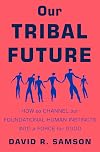
Contempt Is The Dissolver Of Unions. Yes, that is a particularly memorable line from the book - and a warning. Here, Samson discusses the history, biology, and sociology of our "Tribe Drive" - ongoing and apparently bleeding edge research in all three fields - and shows how it has brought us to where we are... and how we can better utilize it to achieve a more peaceable and prosperous future for all. Yes, some of this book is a touch... out there... for some, such as Samson's admitting to show more basing some of his thinking of this topic on his use of psychedelic mushrooms, peyote, and similar compounds. And yes, there are things here that partisans left and right will likely complain about - some legitimately, some less so. And yes, in ultimately recommending a form of at minimum confederation of federated governments - if not outright anarchism, which he discusses without ever using the term, yet never precludes that the groups he discusses could become official "governments" - perhaps Samson is even a touch idealistic. And yet, the documentation is solid at around 20% of the text (not counting footnote discussions at the end of each chapter, which may bump that to around 22-25% of the text). Further, the book lays bare in scientific terms that which I've largely understood and have been advocating at various points for the last 15 years or so, through my own active political activism days and into my efforts to promote reading and literacy now.
Overall an intriguing, thought out book and one that adds greatly to the overall conversation around groups, governments, coalitions, and politics, and thus one that anyone who seeks to truly understand and use these concepts truly needs to read and understand. Very much recommended. show less
Overall an intriguing, thought out book and one that adds greatly to the overall conversation around groups, governments, coalitions, and politics, and thus one that anyone who seeks to truly understand and use these concepts truly needs to read and understand. Very much recommended. show less
Our Tribal Future: How to Channel Our Foundational Human Instincts into a Force for Good by David R. Samson
Our Tribal Future informs us about the human nature of forming groups and how this need influences our behavior. The word tribalism often brings about a bad connotation. However, tribalism is a successful survival mechanism that is part of human evolution. Samson explains our instinct to band together in tribes has brought humans together in remarkable ways. With a complicated subject, Samson has broken down this complex subject into simpler sections with plenty of examples. I was very show more intrigued by the guiding question of " How do we trust people who aren't family?" When we feel like we are in a group with a commonality, humans can accomplish amazing things, but what brings us together as a group can also make us feel differently about other groups and can lead to hatred of anyone perceived as an other or outsider. With this revelation, Samson also gives us the tools to look into ourselves to see our affiliations and how they are affecting our perceptions. I enjoyed the information on building your own tribe and the benefits of living in a tribe.
This book was received for free in return for an honest review. show less
This book was received for free in return for an honest review. show less
Our Tribal Future: How to Channel Our Foundational Human Instincts into a Force for Good by David R. Samson
This book looks at how humans evolved to develop a "tribal drive", largely as a mechanism to determine who we could or could not trust. This drive affects our behaviour and, more broadly, our politics. The author argues that there is a fundamental human instinct to trust those who are like us. Symbols, such as flags, or behaviours can demonstrate commonalities and elicit trust. Unfortunately, they can also show differences that, at worse, lead to hatred and violence. Social media reinforces show more tribalism by creating a sense of belonging to certain groups -- a sense which is often false.
The author encourages readers to fight tribalism on an individual level, which is where people have most control. We should examine who we identify with and strive to be open to change and to diverse opinions.
While reading the book, I struggled to understand the message, especially when reading the chapters on how to create and nurture our tribes. I'm still not sure why we should do so. We might feel safer but what stops our tribes from succumbing to the downsides of tribalism? So, I've learned about evolutionary anthropology but am unsure how this knowledge can lead to change at a societal level. show less
The author encourages readers to fight tribalism on an individual level, which is where people have most control. We should examine who we identify with and strive to be open to change and to diverse opinions.
While reading the book, I struggled to understand the message, especially when reading the chapters on how to create and nurture our tribes. I'm still not sure why we should do so. We might feel safer but what stops our tribes from succumbing to the downsides of tribalism? So, I've learned about evolutionary anthropology but am unsure how this knowledge can lead to change at a societal level. show less
Our Tribal Future: How to Channel Our Foundational Human Instincts into a Force for Good by David R. Samson
Gift from JC via Amazon. I have alternated between loving this book and hating the book. Having finished it, I am still weighing my perceptions of it. It seems to fit in with Clayton Crockett's "Energy and Change", but on a different level. I appreciated him personalizing the book by talking about his father, about he grew up, and about how he 'immunized' himself. I have some problems with his use of 'tribal' but he did provide his definition of it and other terms.
Awards

Statistics
- Works
- 2
- Members
- 39
- Popularity
- #376,656
- Rating
- 3.9
- Reviews
- 6
- ISBNs
- 4