
Ramon Bachs
Author of Generation M
About the Author
Works by Ramon Bachs
Fiction Squad 1 copy
Associated Works
Dungeons & Dragons: Evil At Baldur's Gate (DUNGEONS & DRAGONS Baldur's Gate) (2018) — Illustrator — 40 copies, 1 review
Secret Wars Journal (2015) #1 (of 5) — Illustrator — 2 copies
Tagged
Common Knowledge
- Nationality
- Spain
- Associated Place (for map)
- Spain
Members
Reviews

Access a version of the below that includes illustrations on my blog.
Legends: Black Panther (this is clearly what the cover and title page call it, but everyone calls this book Black Panther Legends for some reason) was a four-issue miniseries telling key moments from the history of the Black Panther. We get the death of T'Challa's father at the hands of Klaw, T'Challa meeting Storm for the first time, T'Challa facing down his uncle to acquire the throne, and the first visit of the show more Fantastic Four to Wakanda.
To be honest, I don't really get the point of this. I think when you're retelling an origin story, you need to be able to add something new or different; this is aimed at a younger audience, judging by the art style, but is still supposed to be the mainstream Marvel Universe versions of the characters (according to the League of Comic Geeks website, anyway), not an alternate continuity (like the YA-aimed Marvel Action stories are). But in that case, we'd just gotten a new version of the Black Panther's origin just three years prior! And that version, I really liked; it effectively wove a bunch of disparate elements we'd seen over the years into a coherent whole.
This version just retells some stuff we've seen before in ways I found less effective and less interesting. In particular, I found this version of how T'Chaka died at the hands of Ulysses Klaw not as well done and emotional as the Rise of the Black Panther version, and this version of how T'Challa met and fell in love with Storm boringly simple compared to the version in Eric Jerome Dickey's Storm miniseries. And devoting a whole issue to T'Challa's battle against his uncle to regain the throne (a battle which is purely ceremonial and which his uncle wants him to win, though admittedly his uncle doesn't know it's T'Challa in disguise) seemed overly drawn out and pointless; when I got to the end of that issue, I was very surprised, because so little had happened surely twenty pages hadn't gone by! I also really did not like that it wasn't T'Challa who invited the Fantastic Four to Wakanda in this telling; I think it really undermines the character.
The one thing I did like here was the focus on T'Challa's adoptive brother, Hunter, who was a major character during Priest's run on the title. He's a character we haven't seen much of since, and it's nice to see him folded into the character's origins retroactively. (I don't remember much of Hunter in Rise.) Unfortunately, this thread kind of fizzles out because Hunter plays little role in the final issue.
So, if you're looking for a modern, accessible origin for the Black Panther, I think you're much better off sticking to the only slightly older Rise of the Black Panther version. This one has little to add. show less
Legends: Black Panther (this is clearly what the cover and title page call it, but everyone calls this book Black Panther Legends for some reason) was a four-issue miniseries telling key moments from the history of the Black Panther. We get the death of T'Challa's father at the hands of Klaw, T'Challa meeting Storm for the first time, T'Challa facing down his uncle to acquire the throne, and the first visit of the show more Fantastic Four to Wakanda.
To be honest, I don't really get the point of this. I think when you're retelling an origin story, you need to be able to add something new or different; this is aimed at a younger audience, judging by the art style, but is still supposed to be the mainstream Marvel Universe versions of the characters (according to the League of Comic Geeks website, anyway), not an alternate continuity (like the YA-aimed Marvel Action stories are). But in that case, we'd just gotten a new version of the Black Panther's origin just three years prior! And that version, I really liked; it effectively wove a bunch of disparate elements we'd seen over the years into a coherent whole.
This version just retells some stuff we've seen before in ways I found less effective and less interesting. In particular, I found this version of how T'Chaka died at the hands of Ulysses Klaw not as well done and emotional as the Rise of the Black Panther version, and this version of how T'Challa met and fell in love with Storm boringly simple compared to the version in Eric Jerome Dickey's Storm miniseries. And devoting a whole issue to T'Challa's battle against his uncle to regain the throne (a battle which is purely ceremonial and which his uncle wants him to win, though admittedly his uncle doesn't know it's T'Challa in disguise) seemed overly drawn out and pointless; when I got to the end of that issue, I was very surprised, because so little had happened surely twenty pages hadn't gone by! I also really did not like that it wasn't T'Challa who invited the Fantastic Four to Wakanda in this telling; I think it really undermines the character.
The one thing I did like here was the focus on T'Challa's adoptive brother, Hunter, who was a major character during Priest's run on the title. He's a character we haven't seen much of since, and it's nice to see him folded into the character's origins retroactively. (I don't remember much of Hunter in Rise.) Unfortunately, this thread kind of fizzles out because Hunter plays little role in the final issue.
So, if you're looking for a modern, accessible origin for the Black Panther, I think you're much better off sticking to the only slightly older Rise of the Black Panther version. This one has little to add. show less
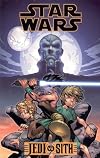
This one is rather bleak story.
After years and years of conflict Jedi and Sith are reduced to the small armies scavenging food and materiel on the devastated world of Ruusan. Although they speak between themselves as if they are mighty commanders and lords (you gotta love Bane commenting "Now everybody is a lord?") these armies are gutted by long attrition warfare on surface of Ruusan.
In order to deprive their opponents of any Force-wielders as reinforcements both sides heavily recruit show more everybody with Force talent they can find. They recruit everybody - both adults and kids. This might be off putting to some but it does make sense - history has shown that Dark Side is very adept at recruiting people to its cause so Jedi (although it makes their commander Hoth sick) are aware that Sith must not be allowed to reinforce their ranks.
And so we come to follow our "mighty" trio - Tomcat, Bug and Rain. Together they will experience both horrors of war (particularly bloody reception they receive when they arrive to Ruusan) and their failings as persons - some will fight to the death for their ideals, some will prove to be of traitorous spirit while others will find their calling in most unexpected places.
This is not story of hope but story where both sides - Brotherhood of Darkness and Army of Light - are aware that to break the stalemate everything needs to go. Both sides are aware that they are no longer forces fighting out of ideals but for mere survival and it is better to perish on the battlefield then to live with shame. And so from the utter destruction modern Sith and new Jedi order will rise.
Some will compare this book with novels of Darth Bane and story does complement the novels but if you expect Darth bane to play major role here you will be disappointed. He does appear but only in the background because he has his own agenda to attend to and decision of warring parties [that he utterly detests] to wipe themselves out he welcomes with his whole heart.
I liked it a lot, especially because of depictions of war and unnecessary sacrifices and the ways immature people see war - in songs and epics it is usually depicted as something noble, idealistic but on the ground, no matter if one is civilian or member of warring factions, war is nothing but constant worry about survival.
Recommended to all Star Wars fans. show less
After years and years of conflict Jedi and Sith are reduced to the small armies scavenging food and materiel on the devastated world of Ruusan. Although they speak between themselves as if they are mighty commanders and lords (you gotta love Bane commenting "Now everybody is a lord?") these armies are gutted by long attrition warfare on surface of Ruusan.
In order to deprive their opponents of any Force-wielders as reinforcements both sides heavily recruit show more everybody with Force talent they can find. They recruit everybody - both adults and kids. This might be off putting to some but it does make sense - history has shown that Dark Side is very adept at recruiting people to its cause so Jedi (although it makes their commander Hoth sick) are aware that Sith must not be allowed to reinforce their ranks.
And so we come to follow our "mighty" trio - Tomcat, Bug and Rain. Together they will experience both horrors of war (particularly bloody reception they receive when they arrive to Ruusan) and their failings as persons - some will fight to the death for their ideals, some will prove to be of traitorous spirit while others will find their calling in most unexpected places.
This is not story of hope but story where both sides - Brotherhood of Darkness and Army of Light - are aware that to break the stalemate everything needs to go. Both sides are aware that they are no longer forces fighting out of ideals but for mere survival and it is better to perish on the battlefield then to live with shame. And so from the utter destruction modern Sith and new Jedi order will rise.
Some will compare this book with novels of Darth Bane and story does complement the novels but if you expect Darth bane to play major role here you will be disappointed. He does appear but only in the background because he has his own agenda to attend to and decision of warring parties [that he utterly detests] to wipe themselves out he welcomes with his whole heart.
I liked it a lot, especially because of depictions of war and unnecessary sacrifices and the ways immature people see war - in songs and epics it is usually depicted as something noble, idealistic but on the ground, no matter if one is civilian or member of warring factions, war is nothing but constant worry about survival.
Recommended to all Star Wars fans. show less

This collection looks at how M Day has affected some of the non-flashy mutants - people who could fly or had gills or had green skin or could play basketball really well due to their mutation. Some died after they lost their mutations, some were devastated by the loss, and some were actually happy that they had a chance for a "normal life" now. And Sally Floyd, jaded newspaper reporter, is ready to tell their stories.
She's up against Congressman Sykes, who tries to disguise his hatred for show more mutants under "concern" for the safety of Americans. There's a good undercurrent here about whether feeling safe is worth giving up your civil rights (or making others give up their civil rights), which was definitely a sign of the times (the Patriot Act, for example). And there's a serial killer who is going around killing former mutants. And Sally herself is slowly self-destructing after the death of her only child, Minnie.
I thought that this story was really well done. I liked the character of Sally - she's brash and says what she's thinking, even though it tends to get her in trouble quite frequently. And she's one of the few people who are willing to defend mutants and ex-mutants, especially since Sykes is tapping into a well of anti-mutant emotion. And there's a good cross section of characters here whom she interviews. Overall, it's a much more well-rounded picture of what M Day would have meant to the "average" mutant in the Marvel Universe. show less
She's up against Congressman Sykes, who tries to disguise his hatred for show more mutants under "concern" for the safety of Americans. There's a good undercurrent here about whether feeling safe is worth giving up your civil rights (or making others give up their civil rights), which was definitely a sign of the times (the Patriot Act, for example). And there's a serial killer who is going around killing former mutants. And Sally herself is slowly self-destructing after the death of her only child, Minnie.
I thought that this story was really well done. I liked the character of Sally - she's brash and says what she's thinking, even though it tends to get her in trouble quite frequently. And she's one of the few people who are willing to defend mutants and ex-mutants, especially since Sykes is tapping into a well of anti-mutant emotion. And there's a good cross section of characters here whom she interviews. Overall, it's a much more well-rounded picture of what M Day would have meant to the "average" mutant in the Marvel Universe. show less

Access a version of the below that discusses the series in full and includes illustrations on my blog.
There's some okay stuff here—I particularly liked the appearance of the Mole Man, the original nemesis of the Fantastic Four, who kidnaps Kid Kaiju to get his help resurrecting his army of monsters. It's always a neat move to make an old, somewhat pathetic, villain into a figure of sympathy, and Cullen Bunn does it well here. But the big conspiracy of monsters largely left me cold. Elsa is show more present, but contributes little, and seems pretty watered down from her characterization in Nextwave and Marvel Zombies (though I did like the bit where she becomes queen of some insect monsters). Some of the artists are pretty bad.
One other big issue is that Kei summons five monsters into existence to be a team of his own... but while five big monsters might look okay (I don't think of the series's myriad artists ever had the knack of making me interested in monster fights), their lack of meaningful characterization (they are, after all, monsters) means you have a lot of characters that it's just not possible to actually be interested in.
Elsa Bloodstone: « Previous in sequence | Next in sequence » show less
There's some okay stuff here—I particularly liked the appearance of the Mole Man, the original nemesis of the Fantastic Four, who kidnaps Kid Kaiju to get his help resurrecting his army of monsters. It's always a neat move to make an old, somewhat pathetic, villain into a figure of sympathy, and Cullen Bunn does it well here. But the big conspiracy of monsters largely left me cold. Elsa is show more present, but contributes little, and seems pretty watered down from her characterization in Nextwave and Marvel Zombies (though I did like the bit where she becomes queen of some insect monsters). Some of the artists are pretty bad.
One other big issue is that Kei summons five monsters into existence to be a team of his own... but while five big monsters might look okay (I don't think of the series's myriad artists ever had the knack of making me interested in monster fights), their lack of meaningful characterization (they are, after all, monsters) means you have a lot of characters that it's just not possible to actually be interested in.
Elsa Bloodstone: « Previous in sequence | Next in sequence » show less
You May Also Like
Associated Authors
Statistics
- Works
- 14
- Also by
- 15
- Members
- 243
- Popularity
- #93,556
- Rating
- 3.8
- Reviews
- 6
- ISBNs
- 16
- Languages
- 4