
Jeffrey Rosen
Author of The Supreme Court: The Personalities and Rivalries That Defined America
About the Author
Jeffrey Rosen is a law professor at The George Washington University.
Image credit: The Aspen Institute
Works by Jeffrey Rosen
The Supreme Court: The Personalities and Rivalries That Defined America (2007) 319 copies, 12 reviews
Conversations with RBG: Ruth Bader Ginsburg on Life, Love, Liberty, and Law (2019) 296 copies, 11 reviews
The Pursuit of Happiness: How Classical Writers on Virtue Inspired the Lives of the Founders and Defined America (2024) 141 copies, 1 review
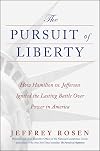
The Pursuit of Liberty: How Hamilton vs. Jefferson Ignited the Lasting Battle over Power in America (2025) 82 copies, 12 reviews
Associated Works
Tagged
Common Knowledge
- Birthdate
- 1964-02-13
- Gender
- male
- Organizations
- George Washington University
The New Republic - Agent
- Lynn Chu
- Short biography
- Jeffrey Rosen is a professor at law at George Washington University and the legal affairs editor of The New Republic. His articles have appeared in many publictions, including The New York Times Magazine, The Atlantic Monthly, and The New Yorker. He is a frequent contributor to National Public Radio and lives in Washington, D.C. [adapted from The Supreme
Court (2007)] - Nationality
- USA
- Places of residence
- Washington, D.C., USA
- Associated Place (for map)
- D.C., USA
Members
Reviews
The Pursuit of Liberty: How Hamilton vs. Jefferson Ignited the Lasting Battle Over Power in America by Jeffrey Rosen

Thomas Jefferson and Alexander Hamilton held opposing views on most things, but particularly on how the Constitution should be interpreted. This book starts with brief biographies of the two men. It then traces those opposing views through US history, up to the present day. The book is dry, but I wasn’t bored by it. I am primarily in the Hamilton camp. He held the view that “the greatest threat to the American experiment, was an authoritarian demagogue like Caesar, who might flatter the show more people, overthrow popular elections, and consolidate power in his own hands.”
My main takeaway from this book is that president’s, judges etc. just claim to be following the views set forth by Jefferson or Hamilton, but they are really just using that as justification for doing what they want to do. (Note that that is not the position of the author of this book. It was only my impression.) My other takeaway is that we have had some truly horrible presidents in this country. Strangely, that gives me some small hope that we may survive the worst of them all.
I received a free copy of this book from the publisher. show less
My main takeaway from this book is that president’s, judges etc. just claim to be following the views set forth by Jefferson or Hamilton, but they are really just using that as justification for doing what they want to do. (Note that that is not the position of the author of this book. It was only my impression.) My other takeaway is that we have had some truly horrible presidents in this country. Strangely, that gives me some small hope that we may survive the worst of them all.
I received a free copy of this book from the publisher. show less
 This review was written for LibraryThing Early Reviewers.
The Pursuit of Liberty: How Hamilton vs. Jefferson Ignited the Lasting Battle Over Power in America by Jeffrey Rosen
I received this book as part of a LibraryThing Giveaway before official publication.
Jeffrey Rosen sets out--like others before him--to trace what he calls the "pervasive" debate between Jefferson and Hamilton over the nature of the constitution of 1787, as well as power and liberty in our federal republic. This debate, Rosen claims--like others before him--can "explain nearly everything--not only American political history but also our constitutional, intellectual, economic, and social show more history." What follows his claim is a 300+ page political and legal history of that debate (very little time is really spent with intellectual, economic, or social history) up to the present day. Nearly the first half of the book chronicles the debate in its original setting, while at least one of the principals was still living. After this, the remaining six chapters are devoted to swirling through the rest of American history to tease out the theme.
Highlights here are especially blistering descriptions of Woodrow Wilson and Franklin Roosevelt. While trying to remain a bit above the fray, the author's partisan participation in some of the more recent episodes, from Bork to the Clinton impeachment, certainly bleeds through at times. But, the thing that really detracts from the credibility of the author are the sheer number of errors throughout the text. A brief "highlight" reel includes: 1) suggesting Jefferson was at the Constitutional Convention; 2) suggesting a Federal government existed during Shays' Rebellion; 3) suggesting Jeffersonian anti-semitism without bothering to establish it; 4) that accused witches at Salem had been burned; 5) suggesting Napoleon's need for money post disaster in Haiti--leading to the Louisiana Purchase--was related to already long-abandoned ambitions in Egypt; 6) calling William Crawford of Georgia "Henry Crawford of Virginia"; 7) suggesting James Garfield's success in the Union army got him elected to the Ohio Senate in 1859; 8) suggesting Wilson's "New Freedom" proposed minimizing the role of the federal government somewhere; 9) suggesting Wilson supported government dominated by Congress and congressional committee; 10) lauding the civil rights heroics of Brandeis and Holmes without any discussion of Buck v. Bell; 11) getting the New Deal chronology wrong in terms of whether Social Security was passed before or after the 1936 election; 12) suggesting FDR's justices were devoted to the Bill of Rights (surprising, I'm sure, to Japanese-Americans); 13) suggesting FDR died in August 1945; 14) suggesting that the party realignment in the South happened after 1948, rather than in 1980 (the South still largely voted for LBJ in 1964; and Carter in 1976); 15) claims that Reagan reacted to an LBJ speech in 1965 during a televised address in October 1964.
There are others, some more minor, some interpretive. The overall impact though is one of sloppiness and unfamiliarity with some elementary chronology and causation. This undermines the authority of other claims throughout the book.
Much of the historiographical discussion is wildly out of date--which is unfortunate given all the recent and excellent scholarship on the two main players here, as well as the other epochs of American history involved in this book.
While I appreciate, as a historian of the founding and revolutionary eras, the attempt to bring the Jefferson/Hamilton split to the wider public and to show its continuing relevance, Rosen's book takes too long to get the legacy half and fails--until the last moment--to point out two really important caveats to his general thesis. The first is that while Jefferson and Hamilton did very sharply disagree on many things, the were quite close and even in lockstep on others--as we might expect two revolutionary figures who worked on the same side and towards the same end to be. The second is the presence of antithetical ideas and actors on the scene that Jefferson & Hamilton united against--illiberal ideas and unscrupulous and unprincipled men. With so much focus on the divisions in the 1790s, Rosen loses the broader connection between Jefferson and Hamilton in the revolutionary Enlightenment that largely separates both men increasingly from their later 19th century (and onwards) descendants in ways that make the invocations of either man seem cynical, hollow, opportunistic, and unconvincing. This, it seems to me, was a missed opportunity--and a place where the intellectual, economic, and social history approaches might have proved somewhat valuable. show less
Jeffrey Rosen sets out--like others before him--to trace what he calls the "pervasive" debate between Jefferson and Hamilton over the nature of the constitution of 1787, as well as power and liberty in our federal republic. This debate, Rosen claims--like others before him--can "explain nearly everything--not only American political history but also our constitutional, intellectual, economic, and social show more history." What follows his claim is a 300+ page political and legal history of that debate (very little time is really spent with intellectual, economic, or social history) up to the present day. Nearly the first half of the book chronicles the debate in its original setting, while at least one of the principals was still living. After this, the remaining six chapters are devoted to swirling through the rest of American history to tease out the theme.
Highlights here are especially blistering descriptions of Woodrow Wilson and Franklin Roosevelt. While trying to remain a bit above the fray, the author's partisan participation in some of the more recent episodes, from Bork to the Clinton impeachment, certainly bleeds through at times. But, the thing that really detracts from the credibility of the author are the sheer number of errors throughout the text. A brief "highlight" reel includes: 1) suggesting Jefferson was at the Constitutional Convention; 2) suggesting a Federal government existed during Shays' Rebellion; 3) suggesting Jeffersonian anti-semitism without bothering to establish it; 4) that accused witches at Salem had been burned; 5) suggesting Napoleon's need for money post disaster in Haiti--leading to the Louisiana Purchase--was related to already long-abandoned ambitions in Egypt; 6) calling William Crawford of Georgia "Henry Crawford of Virginia"; 7) suggesting James Garfield's success in the Union army got him elected to the Ohio Senate in 1859; 8) suggesting Wilson's "New Freedom" proposed minimizing the role of the federal government somewhere; 9) suggesting Wilson supported government dominated by Congress and congressional committee; 10) lauding the civil rights heroics of Brandeis and Holmes without any discussion of Buck v. Bell; 11) getting the New Deal chronology wrong in terms of whether Social Security was passed before or after the 1936 election; 12) suggesting FDR's justices were devoted to the Bill of Rights (surprising, I'm sure, to Japanese-Americans); 13) suggesting FDR died in August 1945; 14) suggesting that the party realignment in the South happened after 1948, rather than in 1980 (the South still largely voted for LBJ in 1964; and Carter in 1976); 15) claims that Reagan reacted to an LBJ speech in 1965 during a televised address in October 1964.
There are others, some more minor, some interpretive. The overall impact though is one of sloppiness and unfamiliarity with some elementary chronology and causation. This undermines the authority of other claims throughout the book.
Much of the historiographical discussion is wildly out of date--which is unfortunate given all the recent and excellent scholarship on the two main players here, as well as the other epochs of American history involved in this book.
While I appreciate, as a historian of the founding and revolutionary eras, the attempt to bring the Jefferson/Hamilton split to the wider public and to show its continuing relevance, Rosen's book takes too long to get the legacy half and fails--until the last moment--to point out two really important caveats to his general thesis. The first is that while Jefferson and Hamilton did very sharply disagree on many things, the were quite close and even in lockstep on others--as we might expect two revolutionary figures who worked on the same side and towards the same end to be. The second is the presence of antithetical ideas and actors on the scene that Jefferson & Hamilton united against--illiberal ideas and unscrupulous and unprincipled men. With so much focus on the divisions in the 1790s, Rosen loses the broader connection between Jefferson and Hamilton in the revolutionary Enlightenment that largely separates both men increasingly from their later 19th century (and onwards) descendants in ways that make the invocations of either man seem cynical, hollow, opportunistic, and unconvincing. This, it seems to me, was a missed opportunity--and a place where the intellectual, economic, and social history approaches might have proved somewhat valuable. show less
This review was written for LibraryThing Early Reviewers.The Pursuit of Liberty: How Hamilton vs. Jefferson Ignited the Lasting Battle Over Power in America by Jeffrey Rosen
The first thing I looked for, and found, in this book was this all-important sentence toward the end of the introduction: "In telling the stories of these battles ... I've tried to avoid taking sides ..." All authors are (or should be) human, and some bias is understandable, but when I'm looking at a history book I want to know ahead of time if the author is going to be trying to weight the evidence to support a point of view. Those like me can rest assured that in this book Jeffrey Rosen show more does his best to do what he said: avoid taking sides.
The book starts with an in-depth look at the differences between Jefferson's and Hamilton's points of view in the 18th century. I must say that one thing he makes abundantly clear, without intending to, is that we do an abysmally poor job of teaching history in the US. I learned more about the early days of the country in the first two chapters than I did from first grade through high school. That alone makes this book worth reading!
The author then proceeds to take us through the years, showing how the various presidents and others since that time have invoked the premises of both men, sometimes twisting them entirely to suit their needs. I found it fascinating and, if I'd had two full days available, I might have read it straight through. I highly recommend it to anyone who has an interest in the history of politics in the US.
(As an aside, given the era in which I read it, I also found myself wondering a lot about polarization. We seem to have reached a point where the extremists on both sides of any argument hold sway, with no consideration of the possibility that both sides can be right and both sides can be wrong at the same time. Although the author isn't trying to make this point, it shows up many times throughout the narrative. This is definitely a "thinking person's" book, not light reading!) show less
The book starts with an in-depth look at the differences between Jefferson's and Hamilton's points of view in the 18th century. I must say that one thing he makes abundantly clear, without intending to, is that we do an abysmally poor job of teaching history in the US. I learned more about the early days of the country in the first two chapters than I did from first grade through high school. That alone makes this book worth reading!
The author then proceeds to take us through the years, showing how the various presidents and others since that time have invoked the premises of both men, sometimes twisting them entirely to suit their needs. I found it fascinating and, if I'd had two full days available, I might have read it straight through. I highly recommend it to anyone who has an interest in the history of politics in the US.
(As an aside, given the era in which I read it, I also found myself wondering a lot about polarization. We seem to have reached a point where the extremists on both sides of any argument hold sway, with no consideration of the possibility that both sides can be right and both sides can be wrong at the same time. Although the author isn't trying to make this point, it shows up many times throughout the narrative. This is definitely a "thinking person's" book, not light reading!) show less
This review was written for LibraryThing Early Reviewers.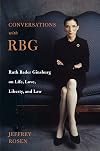
I admit my knowledge and understanding of the Supreme Court is barely adequate, based mostly on headline news and gleanings from my readings in history and biographies.
With some trepidation, I proceeded to read Conversations with RBG, worried it would be 'over my head.'
I was immediately pleased to find Jeffrey Rosen's book was informative, with a good sense of Justice Ruth Bader Ginsberg's personality and ideas about "life, love, liberty, and law," and yet accessible to a general reader like show more myself. Most of the cases discussed were quite well known, although in Rosen's chapter introductions there were references to cases outside of my knowledge.
Each chapter is a transcript of a conversation between Rosen and RBG that took place over time, focusing on one aspect of her life or career. The conversations consider landmark Supreme Court cases but also consider the present and future of the Court.
Rosen and RBG bonded over a shared love of opera. Classical music and opera are RBG's passion, bringing beauty, joy, and therapeutic escape into her workaholic life.
I appreciated learning about her early cases working with the American Civil Liberties Union and the Women's Rights Project.
RBG endeavored for laws that were neutral in regards to sex, so that men and women had the same, equal protections.
I think that men and women, shoulder to shoulder, will work together to make this a better world.~RBG quoted in Conversations with RBG
All the landmark cases are addressed from RBG's landmark cases to her dissenting votes. A very interesting chapter concerns RBG's meeting with Margaret Atwood. Also discussed is how RBG became a cultural icon, memorialized in opera and social media memes.
Rosen asked, "What's the worst ruling" the current Court has produced, and she answered Citizens United. "I think the notion that we have all the democracy that money can buy strays fo far from what our democracy is supposed to be."
I read in the newspaper today that Virginia passed the Equal Rights Amendment, which RBG had supported. Last night I had read about Rosen asking if the ERA might be revived in correlation with the 100th anniversary of the Nineteenth Amendment. RBG replied that because some states withdrew their ratification "it would be better to start over."
I appreciated RBG's philosophy of the court being "a reactive institution." She believes the Court should respect the legislative judgment of Congress.
RBG is hopeful, understanding that the American democratic experiment is an ever-evolving process.
"I am an originalist; I think we're constantly forming a more perfect Union, which is what the Founders intended. As bad as things may be, there are better than they once were. These are not the best of times, but think of how many bad time's I've experienced in my long lig.e Starting with the Second World War...then Senator Joe McCarthy...Then Vietnam. Somehow, we have gotten over the worst of times."~RBG in Conversations with RBG by Jeffrey Rosen
I won a free book from the publisher through LibraryThing. My review is fair and unbiased. show less
With some trepidation, I proceeded to read Conversations with RBG, worried it would be 'over my head.'
I was immediately pleased to find Jeffrey Rosen's book was informative, with a good sense of Justice Ruth Bader Ginsberg's personality and ideas about "life, love, liberty, and law," and yet accessible to a general reader like show more myself. Most of the cases discussed were quite well known, although in Rosen's chapter introductions there were references to cases outside of my knowledge.
Each chapter is a transcript of a conversation between Rosen and RBG that took place over time, focusing on one aspect of her life or career. The conversations consider landmark Supreme Court cases but also consider the present and future of the Court.
Rosen and RBG bonded over a shared love of opera. Classical music and opera are RBG's passion, bringing beauty, joy, and therapeutic escape into her workaholic life.
I appreciated learning about her early cases working with the American Civil Liberties Union and the Women's Rights Project.
RBG endeavored for laws that were neutral in regards to sex, so that men and women had the same, equal protections.
I think that men and women, shoulder to shoulder, will work together to make this a better world.~RBG quoted in Conversations with RBG
All the landmark cases are addressed from RBG's landmark cases to her dissenting votes. A very interesting chapter concerns RBG's meeting with Margaret Atwood. Also discussed is how RBG became a cultural icon, memorialized in opera and social media memes.
Rosen asked, "What's the worst ruling" the current Court has produced, and she answered Citizens United. "I think the notion that we have all the democracy that money can buy strays fo far from what our democracy is supposed to be."
I read in the newspaper today that Virginia passed the Equal Rights Amendment, which RBG had supported. Last night I had read about Rosen asking if the ERA might be revived in correlation with the 100th anniversary of the Nineteenth Amendment. RBG replied that because some states withdrew their ratification "it would be better to start over."
I appreciated RBG's philosophy of the court being "a reactive institution." She believes the Court should respect the legislative judgment of Congress.
RBG is hopeful, understanding that the American democratic experiment is an ever-evolving process.
"I am an originalist; I think we're constantly forming a more perfect Union, which is what the Founders intended. As bad as things may be, there are better than they once were. These are not the best of times, but think of how many bad time's I've experienced in my long lig.e Starting with the Second World War...then Senator Joe McCarthy...Then Vietnam. Somehow, we have gotten over the worst of times."~RBG in Conversations with RBG by Jeffrey Rosen
I won a free book from the publisher through LibraryThing. My review is fair and unbiased. show less
This review was written for LibraryThing Early Reviewers.Lists
Awards


You May Also Like


Associated Authors
Statistics
- Works
- 13
- Also by
- 7
- Members
- 1,357
- Popularity
- #18,943
- Rating
- 3.9
- Reviews
- 42
- ISBNs
- 55
