
Paul C. Vitz
Author of Psychology as Religion: The Cult of Self-Worship
About the Author
Paul C. Vitz is professor emeritus of psychology at New York University and senior scholar and professor at Divine Mercy University, Sterling, Va.
Works by Paul C. Vitz
Philosophical Virtues and Psychological Strengths (2013) — Editor; Author; Author — 32 copies, 1 review
Tagged
Common Knowledge
- Legal name
- Vitz, Paul Clayton
- Birthdate
- 1935
- Gender
- male
Members
Reviews

A forthright and thought-provoking critique of modern psychology. A devastating indictment of the 'me' generation. All those who are interested in psychology and religion and the relationship between the 2 will benefit greatly from this book.

The first book by a competent psychologist which analyzes the latest trends in the psychology of selfism over against the wider field of basic human values, personal and social. A devastating indictment of the me generation. All those who are interested in psychology and religion and the relationship between the two will benefit greatly from this book.
A critique of secular humanism as a cult of self-worship--"selfism", with social science practitioners as priests of "Psychology as Religion". Polemic against the admittedly broad spectrum of "existentialists", singling out four "most important self-theorists", who are incidentally quite influential because "scientific" - Eric Fromm, Carl Rogers, Abraham Maslow, Rollo May. Seems to argue that Self-help is anti-Christian since "the family is a basic Christian concept", and "a universal show more cross-cultural concept". (48) show less
(First reviewed at Blogcritics at http://blogcritics.org/archives/2005/04/05/000148.php)
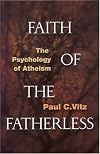
Paul C. Vitz published "Faith of the Fatherless, The Psychology of Atheism" (1999) to question the projection theory of religion. He turns Freud's version of the theory back on Freud by questioning the relationships of many leading atheist thinkers with their fathers. The projection theory attempts to explain the prevalence of religious beliefs in all human societies in terms of individual and collective show more psychology. In its simplest form, the theory is that human beings invented God and invested him with attributes corresponding to the conventional morality of any given culture. Ludwig Feuerbach, the German Romantic philosopher theorized that human beings unconsciously respond to the uncertainty of life by dreaming of a powerful god and projecting human attributes onto the dream-image. Marx, a student of Feurbach, used a variation of the same idea in his communist attack on religion as the opiate of the masses. Freud put the theory in terms of wish fulfillment. He said humans fulfilled powerful emotional wishes for safety against powerful forces in an impersonal universe - responding to rational fears by irrational beliefs in a non-existent being. The theory, in all of its variations, has become part of the conventional wisdom of the anti-religious.
Ironically, the projection theory is an atheist extrapolation of certain streams of religious thought. There has been a tension between prophecy and priesthood within Judaism, Christianity, Islam and other religions, with an awareness that religion is often allied with mighty and the wealthy against the interests of the common person and that religious arguments are often made in support of purely political and economic positions. At a deeper level, human beings have a rich history of religious diversity. Most religions have a set of explanations - ignorance, sin and the confusing work of diabolic powers - for why other people happen to be worshipping idols and false gods. The idea that other people might be corrected by rational discourse and led to the truth is closely related to the religious idea of converting and saving the heathen. It is rooted in the ideas that God has endowed the stranger with the capacity to know the truth, and that God loves the stranger enough to want to save him. Within the history of ideas, the atheist version of rationalism seems to have been taken from the religious version.
The projection theory is a piece of romantic speculation. There is no scientific evidence to support it. In fact, the historical and anthropological evidence is against it. Freud particularly assumed that all "primitive" or natural religions believed in male paternal gods, which was a wildly incorrect, culturally biased assumption.
Dr. Vitz's point is that religion and religious belief seems to be the normal social and psychological condition of human beings, and that the ideas, invented by a few radical thinkers, that religion is a mass psychological abnormality, and that diverse human societies are evolving or progressing into a superior, universal, rational, non-religious society are speculative. Atheists makes large assumptions - ideological, very nearly religious assumptions - about what it is to be human.
Dr. Vitz's responds to projection theory in several different ways. He explains it, he summarizes the evidence against it and he discusses the logical flaws. He devotes the longest section of his book to a review of the lives of various atheists and theists. He suggests that many atheists had troubled relationships with their fathers and that atheist thinkers tend to project their anger at their (absent or abusive fathers) into a psychological and philosophical attack on God. This section of the book is interesting for the biographical details, but somewhat confusing. As Dr. Vitz has written elsewhere, Freud's psychoanalytic theories have been largely discredited. Dr. Vitz's review of the relationships between atheist and theist thinkers and their fathers is, at least superficially, psychoanalytic. Since the Freudian theory has a strong hold on the public imagination, Dr. Vitz's work has value in demystifying and refuting the Freudian approach to religion. This section of the book might suggest that Dr. Vitz agrees with Freud and other projectionists who suggest that religious belief or disbelief are dictated by psychological forces. However Dr. Vitz takes care to say elsewhere that while people go through the process of examining their beliefs with their own baggage - our experiences, temperament and values - we are all free to make choices and decisions.
His discussion of the lives of leading atheist thinkers is less Freudian than Augustinian. It reflects a sensitivity to the way that feeling influence judgment. His discussion underlines the fact that philosophy is a creative and narrative pursuit, and that atheist writers bring the arrogance and narcissism of autonomous creative work into play. They may write passionately and brilliantly, but they are biased witnesses when it comes to seeing and telling the truth. They are emotionally committed their own sense of themselves, to a set of feelings based in irrational beliefs and emotional sensations. They are capable of vast acts of rationalization to maintain their sense of their own rectitude and intellectual superiority.
He has a short concluding chapter on the prevailing culture of superficial atheism in universities, the learned professions, and Western culture. This chapter is credible because Dr. Vitz is an accomplished and respected academic himself. His critique is not the typical anti-intellectualism of the American Christian fundamentalist put off by the mention of Darwin in biology class or the absence of references to God in physics class. He offers a mature and balanced personal discussion of the prevalence of atheist assumptions within academic culture in philosophy and the social sciences - disciplines that claim to be value free, but which operate within powerful ideological presuppositions. In passing, I noticed that he mentions Mortimer Adler (a writer I have reviewed in my own blog and at Blogcritics) with respect and affection.
He finishes with a short chapter stating his main conclusions. He thinks that relying on the projection theory of religion is essentially ad hominem in the context of rational argument. It has limited logical value as an argument for or against atheism. He suggests that the projection theory is basically valid, not in its own terms, but as an atheist's version of the religious insight into idolatry - the creation of objects of worship. He thinks that the Rationalist and Romantic atheists of the 18th and 19th century did not manage to get free of religion. They managed to substitute worship of psychological abstractions such the human will and the human ego for the worship of God. The great atheists were great egoists, and they worshipped projections of their own egos. Their legacy is an ideology and culture of self-absorbed narcissism. show less
Paul C. Vitz published "Faith of the Fatherless, The Psychology of Atheism" (1999) to question the projection theory of religion. He turns Freud's version of the theory back on Freud by questioning the relationships of many leading atheist thinkers with their fathers. The projection theory attempts to explain the prevalence of religious beliefs in all human societies in terms of individual and collective show more psychology. In its simplest form, the theory is that human beings invented God and invested him with attributes corresponding to the conventional morality of any given culture. Ludwig Feuerbach, the German Romantic philosopher theorized that human beings unconsciously respond to the uncertainty of life by dreaming of a powerful god and projecting human attributes onto the dream-image. Marx, a student of Feurbach, used a variation of the same idea in his communist attack on religion as the opiate of the masses. Freud put the theory in terms of wish fulfillment. He said humans fulfilled powerful emotional wishes for safety against powerful forces in an impersonal universe - responding to rational fears by irrational beliefs in a non-existent being. The theory, in all of its variations, has become part of the conventional wisdom of the anti-religious.
Ironically, the projection theory is an atheist extrapolation of certain streams of religious thought. There has been a tension between prophecy and priesthood within Judaism, Christianity, Islam and other religions, with an awareness that religion is often allied with mighty and the wealthy against the interests of the common person and that religious arguments are often made in support of purely political and economic positions. At a deeper level, human beings have a rich history of religious diversity. Most religions have a set of explanations - ignorance, sin and the confusing work of diabolic powers - for why other people happen to be worshipping idols and false gods. The idea that other people might be corrected by rational discourse and led to the truth is closely related to the religious idea of converting and saving the heathen. It is rooted in the ideas that God has endowed the stranger with the capacity to know the truth, and that God loves the stranger enough to want to save him. Within the history of ideas, the atheist version of rationalism seems to have been taken from the religious version.
The projection theory is a piece of romantic speculation. There is no scientific evidence to support it. In fact, the historical and anthropological evidence is against it. Freud particularly assumed that all "primitive" or natural religions believed in male paternal gods, which was a wildly incorrect, culturally biased assumption.
Dr. Vitz's point is that religion and religious belief seems to be the normal social and psychological condition of human beings, and that the ideas, invented by a few radical thinkers, that religion is a mass psychological abnormality, and that diverse human societies are evolving or progressing into a superior, universal, rational, non-religious society are speculative. Atheists makes large assumptions - ideological, very nearly religious assumptions - about what it is to be human.
Dr. Vitz's responds to projection theory in several different ways. He explains it, he summarizes the evidence against it and he discusses the logical flaws. He devotes the longest section of his book to a review of the lives of various atheists and theists. He suggests that many atheists had troubled relationships with their fathers and that atheist thinkers tend to project their anger at their (absent or abusive fathers) into a psychological and philosophical attack on God. This section of the book is interesting for the biographical details, but somewhat confusing. As Dr. Vitz has written elsewhere, Freud's psychoanalytic theories have been largely discredited. Dr. Vitz's review of the relationships between atheist and theist thinkers and their fathers is, at least superficially, psychoanalytic. Since the Freudian theory has a strong hold on the public imagination, Dr. Vitz's work has value in demystifying and refuting the Freudian approach to religion. This section of the book might suggest that Dr. Vitz agrees with Freud and other projectionists who suggest that religious belief or disbelief are dictated by psychological forces. However Dr. Vitz takes care to say elsewhere that while people go through the process of examining their beliefs with their own baggage - our experiences, temperament and values - we are all free to make choices and decisions.
His discussion of the lives of leading atheist thinkers is less Freudian than Augustinian. It reflects a sensitivity to the way that feeling influence judgment. His discussion underlines the fact that philosophy is a creative and narrative pursuit, and that atheist writers bring the arrogance and narcissism of autonomous creative work into play. They may write passionately and brilliantly, but they are biased witnesses when it comes to seeing and telling the truth. They are emotionally committed their own sense of themselves, to a set of feelings based in irrational beliefs and emotional sensations. They are capable of vast acts of rationalization to maintain their sense of their own rectitude and intellectual superiority.
He has a short concluding chapter on the prevailing culture of superficial atheism in universities, the learned professions, and Western culture. This chapter is credible because Dr. Vitz is an accomplished and respected academic himself. His critique is not the typical anti-intellectualism of the American Christian fundamentalist put off by the mention of Darwin in biology class or the absence of references to God in physics class. He offers a mature and balanced personal discussion of the prevalence of atheist assumptions within academic culture in philosophy and the social sciences - disciplines that claim to be value free, but which operate within powerful ideological presuppositions. In passing, I noticed that he mentions Mortimer Adler (a writer I have reviewed in my own blog and at Blogcritics) with respect and affection.
He finishes with a short chapter stating his main conclusions. He thinks that relying on the projection theory of religion is essentially ad hominem in the context of rational argument. It has limited logical value as an argument for or against atheism. He suggests that the projection theory is basically valid, not in its own terms, but as an atheist's version of the religious insight into idolatry - the creation of objects of worship. He thinks that the Rationalist and Romantic atheists of the 18th and 19th century did not manage to get free of religion. They managed to substitute worship of psychological abstractions such the human will and the human ego for the worship of God. The great atheists were great egoists, and they worshipped projections of their own egos. Their legacy is an ideology and culture of self-absorbed narcissism. show less
You May Also Like


Associated Authors
Statistics
- Works
- 10
- Members
- 825
- Popularity
- #30,924
- Rating
- 3.4
- Reviews
- 9
- ISBNs
- 24
- Favorited
- 1