
Greg Capullo
Author of Batman Volume 1: The Court of Owls
About the Author
Gregory Capullo is an American comic book artist and penciller, best known for his work on Quasar, X-Force, Angela, and Spawn. Greg Capullo also published his own creator-owned comic, The Creech, published through Image Comics. These were two three-issue miniseries. Apart from comics, Capullo has show more been involved in several projects such as pencilling for the Korn album Follow the Leader and the Disturbed album, Ten Thousand Fists, and being part of the crew who worked on the animated sequences in the 2002 film The Dangerous Lives of Altar Boys. Capullo began work for Marvel Comics where he worked on Quasar, X-Force, and What If?. He worked with Marvel Comics for three years on various works. Todd McFarlane who co-founded Image Comics, noticed Capullo¿s work on X-Force, and convinced him to become the penciller on McFarlane¿s comic, Spawn. Capullo's first issue of the book was #16, then took over as pencil artist with issue #26. Capullo has since done the over art and pencils for many Image publications, including various Spawn tie-ins and variants, and Capullo¿s own miniseries, The Creech. Capullo helped McFarlane in creating the artwork now seen on the two Halo 3-themed controllers. Capullo provides layouts for Image's Haunt, which debuted in October 2009. Capullo left the ongoing Haunt title in order to take on the art duties on Batman as part of DC Comics' 2011 company-wide title relaunch, The New 52, which paired him with writer Scott Snyder. His title Batman Vol. 2: The City of Owls (the New 52) made The New York Times Best Seller List in 2013. (Bowker Author Biography) show less
Series
Works by Greg Capullo
X-Force (1991) #17 - X-Cutioner's Song, Part 8: Sleeping With the Enemy (1992) — Illustrator — 11 copies
Associated Works
The Joker 80th Anniversary 100-Page Super Spectacular (2020) #1 (Batman (2016-)) (2020) — Cover artist — 15 copies
What If...? [1989] #2 - What If Daredevil Had Killed the Kingpin? (1989) — Illustrator, some editions — 4 copies
Tagged
Common Knowledge
- Canonical name
- Capullo, Greg
- Legal name
- Capullo, Gregory
- Birthdate
- 1962-03-30
- Gender
- male
- Occupations
- comic book artist
- Nationality
- USA
- Associated Place (for map)
- USA
Members
Reviews
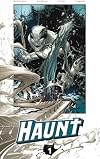
I think it's safe to say now that I don't like Robert Kirkman's storytelling. The Walking Dead left me cold (no pun intended), Outcast could have potential but not enough to keep me coming back for more, and this... Well, this is just bad. The pacing is wildly fast and sporadic, to the point that I felt I had missed huge chunks of story; none of the characters are all that fleshed out; Haunt feels like the love child of 90s Spawn and Venom. Basically, what this really feels like to me is all show more the terrible aspects of McFarlane's writing and character development with Kirkman valiantly trying to shine it up a bit, and it does not work. Needless to say, I will not be pursuing this series further, nor much else by Kirkman. show less
Batman (2011-2016) Vol. 1: The Court of Owls (Batman Graphic Novel) (English Edition) by Scott Snyder
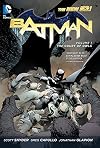
I’m coming into this with very little knowledge of any recent Batman plot points, characters, and story arcs so perhaps my view is naive - but I thought this was excellent!
I was somewhat familiar with the whole Court of Owls premise from the TV show Gotham, but I think it’s all done much better here. It’s unsettling to see how badly Batman is roughed up (physically and mentally) by them in their underground layer, and the fact that it’s only going to get worse is blowing my mind. show more What a great cliffhanger ending for this first volume!
The art is also detailed and brutal, and does some fun things with layouts and panel formats. I tore through these first few issues in a single sitting, and I’m already reserving the next few from the library. Great stuff! show less
I was somewhat familiar with the whole Court of Owls premise from the TV show Gotham, but I think it’s all done much better here. It’s unsettling to see how badly Batman is roughed up (physically and mentally) by them in their underground layer, and the fact that it’s only going to get worse is blowing my mind. show more What a great cliffhanger ending for this first volume!
The art is also detailed and brutal, and does some fun things with layouts and panel formats. I tore through these first few issues in a single sitting, and I’m already reserving the next few from the library. Great stuff! show less
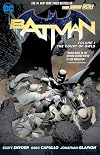
A terrific Batman story. The visuals are incredible, the lining and colors are so creative and beautiful that I often would pause on a page just to soak it all in. A great, classic trope of a hidden society done well. The concept of what a city is, who owns it, how it changes over time, the history of it was another layer of intrigue added on top of the usual Batman being Batman. Can't wait to dive into more Batman, it's comfort food for trying times.

Access a version of the below that includes illustrations on my blog.
This book gives snapshots of the early lives of a number of superheroes, framed by two parts of a Batman origin story. Someday I will read the full Batman: Zero Year story, but I liked what I got of it here. The book opens with Bruce Wayne as Batman taking down the Red Hood Gang, in what seems to be one of his first real superheroic actions. It's hard to judge the writing, since I only have a snippet of the story, but I show more really enjoyed Greg Capullo's art and Fco Plascencia's colors. This is a moody Gotham, but in a very different way to that of Frank Miller and David Mazzucchelli. This is a harsh, dynamic, neon Gotham-- a purifying crucible for the weird. The story ends with a little epilogue that introduces the idea that a giant storm is about to hit Gotham... and some fellow calling himself the Riddler has deactivated the electrical grid.
This provides the setup for the stories that follow, as various young heroes who either live in Gotham or come to render aid to Gotham each has their own experiences during the hurricane. I think there are about twenty-five different stories, and as you might imagine, that results in quite a range of quality, andI don't think I could point to any I found outright terrible, though many are somewhat generic, which is perhaps worse.
I'll focus on the positive here. The best stories were the ones that approached the storm as a testing ground or a crucible, a horrific event that allowed the hero in question to demonstrate who they really were deep down. The very best was, unfortunately, the first of these, a story of Superman. Eager to prove he can do something other than smack on criminals well below his weight class, young Clark Kent flies to Gotham to battle nature itself, and learns that there are limits even to his own power, as much as he still attempts to be the best person he can possibly be. It's a dynamic, involving story: Aaron Kuder does surprisingly good action sequences, and Greg Pak really captures Clark.
I also really enjoyed the story of young Barbara Gordon. With her dad having to do police stuff, Barbara is left at home to protect her brother-- but when their apartment gets evacuated, this turns out to be harder than she thought. There's no big moment where she decides she's going to be a superhero one day; it's simply Barbara deciding to stand up for what she believes in and protect her fellow human beings because it's impossible for her to imagine doing anything else. It's a well-drawn, well-scripted story of how we find who we are during the darkest of times. Literally!
There's also a James Gordon story. It's a little too focused on cop corruption, and not very focused on the storm, but it has its moments, and some of them are great. But then, I always like a little bit of James Gordon. The Kate Kane (the future Batwoman) story isn't very complicated, but it is a good depiction of two women finding their way toward heroism.
The ones I found less effective were either the ones that seemed to contrive the situation to make this moment significant in the life of its hero, or the ones where the fact that there was a giant storm came across as nothing more than incidental set dressing. An example would be the Flash tale: though it makes sense for policewoman Maggie Sawyer from nearby Metropolis to be deployed in Gotham to help out, or for Marine John Stewart to be sent in to help evacuate, it stretched my belief that that an unpowered forensic scientist would be sent to Gotham all the way from Missouri or Ohio (or wherever Central City is), and I sort of rolled my eyes when it turns out that this is when Barry meets Iris West for the first time. Plus the story is all about a weird drug, and very little about the city's crisis. Not that it's a bad story, and given that it's partially drawn by Francis Manapul, it certainly looks good, but it didn't take advantage of the setting in a compelling way.
I didn't care for a significant part of Green Arrow's backstory happening to occur in this place at this time, but Andrea Sorrentino's amazing artwork almost makes me want to pick up the Green Arrow comic book again. The backup tale from the same issue shouldn't have been included here, though, as it has nothing to do with the Zero Year story beyond taking place "in the past."
What's weird about the book is how it ends, with another chapter of Snyder and Capullo's Batman story... but one that clearly takes place before the two dozen stories you've just read, as the storm hasn't hit yet! But it ends with Batman being abducted, so it's unclear to me how it lines up with Batman's cameos through Zero Year (he appears in the Jim Gordon, Green Arrow, and Batwing stories, for example). Maybe this is explained in the next issue, but if so, why wasn't it included here, and why weren't these tales put in order?
Overall, though, this is a surprisingly effective glimpse at a formative time in the new new new DC universe.
DC Comics Crises: « Previous in sequence | Next in sequence » show less
This book gives snapshots of the early lives of a number of superheroes, framed by two parts of a Batman origin story. Someday I will read the full Batman: Zero Year story, but I liked what I got of it here. The book opens with Bruce Wayne as Batman taking down the Red Hood Gang, in what seems to be one of his first real superheroic actions. It's hard to judge the writing, since I only have a snippet of the story, but I show more really enjoyed Greg Capullo's art and Fco Plascencia's colors. This is a moody Gotham, but in a very different way to that of Frank Miller and David Mazzucchelli. This is a harsh, dynamic, neon Gotham-- a purifying crucible for the weird. The story ends with a little epilogue that introduces the idea that a giant storm is about to hit Gotham... and some fellow calling himself the Riddler has deactivated the electrical grid.
This provides the setup for the stories that follow, as various young heroes who either live in Gotham or come to render aid to Gotham each has their own experiences during the hurricane. I think there are about twenty-five different stories, and as you might imagine, that results in quite a range of quality, andI don't think I could point to any I found outright terrible, though many are somewhat generic, which is perhaps worse.
I'll focus on the positive here. The best stories were the ones that approached the storm as a testing ground or a crucible, a horrific event that allowed the hero in question to demonstrate who they really were deep down. The very best was, unfortunately, the first of these, a story of Superman. Eager to prove he can do something other than smack on criminals well below his weight class, young Clark Kent flies to Gotham to battle nature itself, and learns that there are limits even to his own power, as much as he still attempts to be the best person he can possibly be. It's a dynamic, involving story: Aaron Kuder does surprisingly good action sequences, and Greg Pak really captures Clark.
I also really enjoyed the story of young Barbara Gordon. With her dad having to do police stuff, Barbara is left at home to protect her brother-- but when their apartment gets evacuated, this turns out to be harder than she thought. There's no big moment where she decides she's going to be a superhero one day; it's simply Barbara deciding to stand up for what she believes in and protect her fellow human beings because it's impossible for her to imagine doing anything else. It's a well-drawn, well-scripted story of how we find who we are during the darkest of times. Literally!
There's also a James Gordon story. It's a little too focused on cop corruption, and not very focused on the storm, but it has its moments, and some of them are great. But then, I always like a little bit of James Gordon. The Kate Kane (the future Batwoman) story isn't very complicated, but it is a good depiction of two women finding their way toward heroism.
The ones I found less effective were either the ones that seemed to contrive the situation to make this moment significant in the life of its hero, or the ones where the fact that there was a giant storm came across as nothing more than incidental set dressing. An example would be the Flash tale: though it makes sense for policewoman Maggie Sawyer from nearby Metropolis to be deployed in Gotham to help out, or for Marine John Stewart to be sent in to help evacuate, it stretched my belief that that an unpowered forensic scientist would be sent to Gotham all the way from Missouri or Ohio (or wherever Central City is), and I sort of rolled my eyes when it turns out that this is when Barry meets Iris West for the first time. Plus the story is all about a weird drug, and very little about the city's crisis. Not that it's a bad story, and given that it's partially drawn by Francis Manapul, it certainly looks good, but it didn't take advantage of the setting in a compelling way.
I didn't care for a significant part of Green Arrow's backstory happening to occur in this place at this time, but Andrea Sorrentino's amazing artwork almost makes me want to pick up the Green Arrow comic book again. The backup tale from the same issue shouldn't have been included here, though, as it has nothing to do with the Zero Year story beyond taking place "in the past."
What's weird about the book is how it ends, with another chapter of Snyder and Capullo's Batman story... but one that clearly takes place before the two dozen stories you've just read, as the storm hasn't hit yet! But it ends with Batman being abducted, so it's unclear to me how it lines up with Batman's cameos through Zero Year (he appears in the Jim Gordon, Green Arrow, and Batwing stories, for example). Maybe this is explained in the next issue, but if so, why wasn't it included here, and why weren't these tales put in order?
Overall, though, this is a surprisingly effective glimpse at a formative time in the new new new DC universe.
DC Comics Crises: « Previous in sequence | Next in sequence » show less
Lists
Awards


You May Also Like
Associated Authors
Statistics
- Works
- 40
- Also by
- 38
- Members
- 2,836
- Popularity
- #9,044
- Rating
- 3.9
- Reviews
- 72
- ISBNs
- 94
- Languages
- 10
- Favorited
- 1