
Richie Chevat
Author of The Omnivore's Dilemma: Young Readers Edition
About the Author
Richie Chevat is an author and adapter of books. His works include the Ghostwriter Mysteries, Magic School Bus activity books, and The Marbles Book and the Marbles. (Bowker Author Biography)
Works by Richie Chevat
Associated Works
Tagged
Common Knowledge
- Canonical name
- Chevat, Richie
- Gender
- male
Members
Reviews
A Queer History of the United States for Young People (ReVisioning American History for Young People) by Richie Chevat
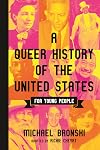
This book literally put me in a reading slump and at this point I can't finish it. Just the thought of going back to it exhausts me. Nothing in the first 50 pages really stuck out to me as good and so much of it was a problem. Obviously, the biggest and most unsurmountable problem for me was the lack of and dismissal of asexuality and aromanticism. As an aroace woman, seeing asexuality and aromanticism included in a general queer history is obviously gonna be incredibly important to me and show more the fact that they were completely left out and except for the one moment when they were dismissed as a phase, left a horrible taste in my mouth for this book and I just can't handle trying to go back to it. Literally the only inclusion of asexuality in the entire book (aromanticism isn't mentioned even once) is an entry in the glossary at the back of the book which not only uses scare quotes around the word asexuality, but also claims that "asexuality is a temporary feeling." My very permanent asexuality is gonna become a very permanent boot in someone's ass for writing that bullshit.
Beyond the aroace problem, this book used really exclusionist language, which, again, is super frustrating to see in a book about queer history. They continually used the phrase "men and women" rather than just saying "people," even after they finally acknowledged nonbinary identities. The short definitions of the main identities in the LGBT acronym included in the introduction were very lacking and simplistic. There was a throwaway line at the end of the bisexual section kind of acknowledging pansexuality without acknowledging the nuance of why individuals choose to use one term over the other. Intersexuality isn't really mentioned at all. Nonbinary identities are glossed over at best.
From the little that I was able to stomach reading, I just could not ever recommend this to anyone, let alone young people who are starting to figure out their identities and have questions about what options there are available to them. The language was too simplistic and infantalizing - news flash! young people aren't dumb and are in fact capable of understanding a lot of nuance, especially in regards to identity and talking down to them is not going to gain you any readers. The dismissal of so many different queer identities and their roles in American history was infuriating and again does such a major disservice to readers. I was so excited when I first heard about this book but it ended up being just an absolutely abysmal book that I am genuinely gutted to have read.
I do find myself wondering how much of the problems I had with this book were the fault of the author and how much was the fault of the adaptor. I'm sure my problem with the authors talking down to the audience was the fault of the adapter, but did the original have similar problems with the exclusionist language and the absence of so many queer identities or was that a problem of adapting it for young people? I probably will try to read the original at some point very far in the future when I can forget this super shitty edition. show less
Beyond the aroace problem, this book used really exclusionist language, which, again, is super frustrating to see in a book about queer history. They continually used the phrase "men and women" rather than just saying "people," even after they finally acknowledged nonbinary identities. The short definitions of the main identities in the LGBT acronym included in the introduction were very lacking and simplistic. There was a throwaway line at the end of the bisexual section kind of acknowledging pansexuality without acknowledging the nuance of why individuals choose to use one term over the other. Intersexuality isn't really mentioned at all. Nonbinary identities are glossed over at best.
From the little that I was able to stomach reading, I just could not ever recommend this to anyone, let alone young people who are starting to figure out their identities and have questions about what options there are available to them. The language was too simplistic and infantalizing - news flash! young people aren't dumb and are in fact capable of understanding a lot of nuance, especially in regards to identity and talking down to them is not going to gain you any readers. The dismissal of so many different queer identities and their roles in American history was infuriating and again does such a major disservice to readers. I was so excited when I first heard about this book but it ended up being just an absolutely abysmal book that I am genuinely gutted to have read.
I do find myself wondering how much of the problems I had with this book were the fault of the author and how much was the fault of the adaptor. I'm sure my problem with the authors talking down to the audience was the fault of the adapter, but did the original have similar problems with the exclusionist language and the absence of so many queer identities or was that a problem of adapting it for young people? I probably will try to read the original at some point very far in the future when I can forget this super shitty edition. show less
 This review was written for LibraryThing Early Reviewers.
A Queer History of the United States for Young People (ReVisioning History for Young People) by Richie Chevat
Oh what a mess of a book. As other reviews have noted, there's a great deal of confusion around language in this book--it doesn't seem to know what to do with trans people in general, conflating trans-ness with sexuality in some parts and separating it with others (which theoretically I'd be fine with except for the inconsistency of it all--it feels more like a mistake than a political move.)
I think my biggest beef with it all (beyond yknow the nationalism of tying up queer history with US show more history and in particular with American myths about ourselves, which I think we should be questioning, but it also like makes sense given the title,) is the inconsistency overall in methodology with regards to whether or not we can call someone from the past "gay" or "trans." The authors (and I'm unclear how much of this is the original text itself or the way it's been adjusted for "young people" (more on that later)) lay out that we can't do this, which is of course a valid way of approaching queer history, but then in the actual chapters there's a lot of flopping back and forth on whether or not we can claim a history from these people. As an example, when talking about Emily Dickinson, the text reads "However she may have thought of herself, Emily Dickinson was certainly a woman who loved other women." It all feels very like trying to have your cake and eat it too, and while I understand the tension--to offer youth a history grounded in an awareness of the way that our ideas about sex and sexuality have changed over time--I don't think this is a good way of approaching it (and I think settling a history in individuals is also a bad way of going about it, but yknow here we are I guess.)
The other issue I have is who this book is aimed at. I assumed (and picked up the book based on the idea that) this book is aimed at young teens, maybe ages 12+. The book itself seems to indicate it's aimed at people in their late teens and early twenties--not in terms of how the language is written (I still thought it was aimed at 12 year olds reading it!) but with an actual phrasing that comes late in the text. And while I wouldn't discourage an 18 year old from reading this book (I wouldn't discourage anyone from reading anything!) I think you can probably read a much better queer history book for adults and get a better sense of the history.
Overall this was most disappointing because young people deserve better than this! I haven't yet found a good replacement (and I might have to write it >.>) but I wouldn't recommend this, especially as the first contact a person might have with queer history. show less
I think my biggest beef with it all (beyond yknow the nationalism of tying up queer history with US show more history and in particular with American myths about ourselves, which I think we should be questioning, but it also like makes sense given the title,) is the inconsistency overall in methodology with regards to whether or not we can call someone from the past "gay" or "trans." The authors (and I'm unclear how much of this is the original text itself or the way it's been adjusted for "young people" (more on that later)) lay out that we can't do this, which is of course a valid way of approaching queer history, but then in the actual chapters there's a lot of flopping back and forth on whether or not we can claim a history from these people. As an example, when talking about Emily Dickinson, the text reads "However she may have thought of herself, Emily Dickinson was certainly a woman who loved other women." It all feels very like trying to have your cake and eat it too, and while I understand the tension--to offer youth a history grounded in an awareness of the way that our ideas about sex and sexuality have changed over time--I don't think this is a good way of approaching it (and I think settling a history in individuals is also a bad way of going about it, but yknow here we are I guess.)
The other issue I have is who this book is aimed at. I assumed (and picked up the book based on the idea that) this book is aimed at young teens, maybe ages 12+. The book itself seems to indicate it's aimed at people in their late teens and early twenties--not in terms of how the language is written (I still thought it was aimed at 12 year olds reading it!) but with an actual phrasing that comes late in the text. And while I wouldn't discourage an 18 year old from reading this book (I wouldn't discourage anyone from reading anything!) I think you can probably read a much better queer history book for adults and get a better sense of the history.
Overall this was most disappointing because young people deserve better than this! I haven't yet found a good replacement (and I might have to write it >.>) but I wouldn't recommend this, especially as the first contact a person might have with queer history. show less
A Queer History of the United States for Young People (ReVisioning American History for Young People) by Richie Chevat
This is a great idea for a book and it is a terrific effort to provide young people with info on LGBTQ persons throughout American history. The author, Bronshi is well qualified to write this book and his knowledge and understanding of the topic is apparent. I particularly liked that he first provides an overview and then offers individual biographies of men and women who were LGBTQ throughout history and made a difference in American culture and society.
If you know a youngster who is show more struggling with his or her sexuality or sexual identity this is a good place to start reading for them and can lead to important discussions. If you are heterosexual and want to know more about the LGBTQ community this is a good book for you. Hopefully, libraries and bookstores across America will carry a copy of this very interesting and informative book! show less
If you know a youngster who is show more struggling with his or her sexuality or sexual identity this is a good place to start reading for them and can lead to important discussions. If you are heterosexual and want to know more about the LGBTQ community this is a good book for you. Hopefully, libraries and bookstores across America will carry a copy of this very interesting and informative book! show less
This review was written for LibraryThing Early Reviewers.A Queer History of the United States for Young People (ReVisioning American History for Young People) by Richie Chevat
A review of this interesting little book needs to lead off with a couple of disclaimers. First off, this isn't really a "queer history," per se -- rather, it's mostly a series of 30-odd vignettes about noteworthy folks in American history who (probably, at least) happened to be queer. Secondly, the book professes to be "for young people" ... and while the essays serve as a great Queer History primer for anyone who's middle school-age or above, it's written in a style that would make the show more subject interesting and accessible to many adults, as well.
The biographical vignette themselves are balanced and straightforward, and accurate as far as I can tell. The subject-matter balance isn't perfect, due in part to the way sexuality was known and expressed over time -- more people of letters in the earlier years, and more social and political activists in later years. Most of the individual stories are pretty intriguing, though, and the format makes it easy to pick up the book during a few spare minutes, and read one free-standing story at a time. When you're made it through them all, it would be hard not to capture the main message of the volume -- that queer folks have been an integral part of our society and culture from the beginning.
For that, this book gets five stars from me. Reading some of the other reviews, I honestly think it's a little sad and misguided that some other folks see this book as exclusionary and insufficient. I disagree with that view pretty strongly, and it reminds me that in this social-media age, it's pretty much impossible to write or do *anything* without pissing at least someone off. But so it goes. show less
The biographical vignette themselves are balanced and straightforward, and accurate as far as I can tell. The subject-matter balance isn't perfect, due in part to the way sexuality was known and expressed over time -- more people of letters in the earlier years, and more social and political activists in later years. Most of the individual stories are pretty intriguing, though, and the format makes it easy to pick up the book during a few spare minutes, and read one free-standing story at a time. When you're made it through them all, it would be hard not to capture the main message of the volume -- that queer folks have been an integral part of our society and culture from the beginning.
For that, this book gets five stars from me. Reading some of the other reviews, I honestly think it's a little sad and misguided that some other folks see this book as exclusionary and insufficient. I disagree with that view pretty strongly, and it reminds me that in this social-media age, it's pretty much impossible to write or do *anything* without pissing at least someone off. But so it goes. show less
This review was written for LibraryThing Early Reviewers.Lists
Awards


You May Also Like


Associated Authors
Statistics
- Works
- 27
- Also by
- 2
- Members
- 1,591
- Popularity
- #16,217
- Rating
- 3.9
- Reviews
- 29
- ISBNs
- 45
- Languages
- 1
