
Rainer Metzger
Author of Vincent Van Gogh: Vision and Reality (Taschen Art Series)
About the Author
Rainer Metzger is a lecturer at the Kunstuniversitat Linz, Stuttgart University, and the Academy of Art in Karlsruhe.
Image credit: via Babelio.com
Series
Works by Rainer Metzger
Tagged
Common Knowledge
- Canonical name
- Metzger, Rainer
- Birthdate
- 1961-07-03
- Gender
- male
- Education
- University of Munich (Ph.D|1994)
- Occupations
- art historian
professor
journalist
art critic
curator - Organizations
- Kunstakademie Karlsruhe
Der Standard - Nationality
- Germany
- Birthplace
- Geisenhausen Niederbayern, Germany
- Places of residence
- Karlsruhe, Germany
- Associated Place (for map)
- Germany
Members
Reviews
Most of the art books about Gustav Klimt focus on his paintings - both landscapes and portraits predominantly, with mention of his friezes - but I was pleasantly surprised to find that this book focused on the sketches. The whole point of most artist's work are the final, finished paintings, but without the preliminary sketches they may never reach thse final masterpieces. By showcasing the plethora of Klimt's studio sketches Metzger is able to delve into his artistic processes, discussing show more the hedonistic atmosphere of his studio, the male erotic gaze (a predominant theme in Klimt's work), and hte contrasts between his various artistic phases (both finished and in situ). Most of the time I can't be bothered with the author's commentary, choosing instead to consume the artwork wholesale, but Metzger's text engages decently with the artwork and he keeps his language from being too academic. At times his discussion is a little overly detailed when discussing the artistic social atmosphere during Klimt's lifetime, but these details do give a more personal touch by engaging with the primary sources who were speaking about Klimt and his artwork during his lifetime. My only real criticism of this book is that the sheer volume of material becomes slightly monotonous after a while - there's only so many butts and naked ladies I need to see, even if each of the sketches are wonderful in their own regard. show less

As the title says, every known painting by Vincent van Gogh is presented here, nearly all in color, well-reproduced and many full-page. But more than that, the authors analyze van Gogh's life story throughout every stage of his artistic development (and this is a more complex and multi-layered artistic growth than I had realized). I was especially fascinated by his fascination with Japanese art, and the last few months of his life. This was his most productive period (he painted over 80 show more works in his last 2 months), with probably some of his best work, and perhaps his happiest period. And yet he shot himself on July 27, 1890, dying 2 days later, his last words reportedly "I wish it were all over now". The author tries quite a lot of psychoanalysis through Vincent's letters and art, and he may be on the mark when he says that the artist killed himself when he realized that he could never again have the simple life he craved (although he only sold one painting in his lifetime, he had been gaining growing recognition in the art world). Also, he may have wanted to help his brother Theo's flagging fortunes by means of the old artistic truism, that an artist's works rise dramatically in value after his death. And he did dote on his brother and nephew. The works here that stand out most to me are: pg 138; "Skull With Burning Cigarette", painted during a period of fairly routine human portraits, this stands out as no other picture in van Gogh's body of work. It was used as the book cover of a David Sedaris book, and I didn't even realize until now that it was a van Gogh. pg. 520, "Starry Night", his most famous work and a vivid one that swirls as though it will move off the canvas in a shower of color. pg. 690, "Wheat Field with Crows", painted near the end of his life, and often analyzed for clues to Vincent's frame of mind before he killed himself, with its disturbing imagery of crows flapping into the foreground toward the viewer over a turbulent field of wheat with a gash of a road cutting through it, to ultimately disappear. This is one of the most emotionally powerful paintings I know, and one can see the point that this is not the work of a stable soul. show less
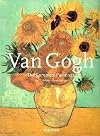
As much as I love having a complete collection of Van Gogh's work in a single volume, I was not completely impressed with this book. Unlike Taschen's publication which covers the work of Leonardo Da Vinci, this paperback version isn't split into two volumes (even though it is intellectually split) so it becomes pretty unwieldy without the strength of a proper binding. It's not quite as physically big as I expect an art book of this magnitude to be as well, so I feel that some of the show more reproduction size was a bit too small to get a proper feeling for the luscious texture of Van Gogh's brushwork. Further hindering full-size reproductions was the overabundance of text, which traces what feels like every second of the artist's life - a useful quality for a biography, but I honestly couldn't care less about a lot of the detail that the writer went in to and found it to be extremely overwhelming. After about 100 pages I gave up on reading completely and focused instead on just enjoying the paintings, since that's what I came for anyways! show less
Die Stadt: Vom antiken Athen bis zu den Megacitys : Eine Weltgeschichte in Geschichten by Rainer Metzger

Hardly a 'Weltgeschichte' since only the last two are outside of Europe. There are also a few women mentioned. After all, you can't mention Abélard without Héloise. Mascha Kaléko (Berlin of the 1930s). Lina Bo Bardi (São Paulo after WWII). One gets the feeling that he suddenly realized that he was 3/4 through writting the book and it was all about famous white males. So let's throw in a few not famous people who are either non-white or non-male.
You May Also Like


Associated Authors
Statistics
- Works
- 29
- Members
- 3,527
- Popularity
- #7,200
- Rating
- 4.1
- Reviews
- 27
- ISBNs
- 231
- Languages
- 18