
Hans Urs von Balthasar (1905–1988)
Author of Prayer
About the Author
Hans Urs Von Balthasar, (1905-1988), a man of towering intellect and extraordinary culture and the author of vast theological works, is widely recognized as one of the most influential figures in theology from the twentieth century to the present. He is best known for his major work The Glory of show more the Lord, his multivolume trilogy on the beautiful, the good, and the true. show less
Series
Works by Hans Urs von Balthasar
The Glory of the Lord: A Theological Aesthetics, Vol. 1: Seeing the Form (1983) — Author — 338 copies
The Glory of the Lord: A Theological Aesthetics, Vol. 2: Studies in Theological Style: Clerical Styles (1984) 160 copies
The Glory of the Lord: A Theological Aesthetics, Vol. 3: Studies in Theological Style: Lay Styles (1986) 157 copies
The Glory of the Lord: A Theological Aesthetics, Vol. 4: The Realm of Metaphysics in Antiquity (1987) 144 copies
Two Sisters in the Spirit: Therese of Lisieux and Elizabeth of the Trinity (1990) 140 copies, 1 review
Theo-Drama: Theological Dramatic Theory, Volume 3: Dramatis Personae: Persons in Christ (1993) 118 copies
Theo-Drama: Theological Dramatic Theory, Volume 2: Dramatis Personae: Man in God (1976) — Author — 117 copies
The Glory of the Lord: A Theological Aesthetics, Vol. 6: Theology: The Old Covenant (1991) 116 copies
The Glory of the Lord: A Theological Aesthetics, Vol. 7: Theology: The New Covenant (1985) 115 copies
The Glory of the Lord: A Theological Aesthetics, Vol. 5: The Realm of Metaphysics in the Modern Age (1985) 114 copies
Theo-Logic: Theological Logical Theory, Volume 3: The Spirit of the Truth (1987) 77 copies, 1 review
You Crown the Year With Your Goodness: Sermons Throughout the Liturgical Year (1989) 71 copies, 1 review
Test Everything: Hold Fast to What is Good: An Interview with Hans Urs Von Balthasar (1989) 57 copies
Paul Struggles With His Congregation: The Pastoral Message of the Letters of the Corinthians (1992) 45 copies
Tragedy Under Grace: Reinhold Schneider on the Experience of the West (Communio Books) (1997) 29 copies
Wer ist die Kirche? 3 copies
Parole et mystère chez Origène 3 copies
Theo-Logic, Vol. 1: The Truth of the World: Theological Logical Theory: The Spirit Of Truth (2001) 2 copies
Teología de la Historia 2 copies
Cattolico 2 copies
Scandal of the Incarnation: Irenaeus against the Heresies by Hans Urs von Balthasar (1990-12-31) 2 copies
H2: ISponsa Verbi 2 copies
Via Crucis con Giovanni Paolo II, Venerdì Santo 1988 — Composer — 2 copies
3,2: Theologie 2 copies
La meditazione 2 copies
Lo sviluppo dell'idea musicale-Testimonianza per Mozart-Anti-Prometeo. Il musicale nell'estetica teologica di Hans Urs von Balthasar (1995) 2 copies
Mysterium Paschale 1 copy
Burleigh, Michael 1 copy
Two Sisters in the Spirit 1 copy
Retour au centre 1 copy
nuovo patto 1 copy
Esprit et Feu' 1: L'ame 1 copy
Lettera ai sacerdoti — Author — 1 copy
Dialogo 1 copy
Ensayos teológicos II 1 copy
Mysterium Christi 1 copy
Explorations in theology: Vol 1 Spouse of the Word, Vol. 2 Spouse of the Word, Vol 3 Creator Spirit 1 copy
Problemas de la iglesia hoy 1 copy
Eucarestia: dono d'amore 1 copy
Un papa nutrito di preghiera per questa Chiesa offesa e ferita: colloquio Vittorio Messori, Hans Urs von Balthasar — Author — 1 copy
Le chrétien et l'angoisse 1 copy
Maria 1 copy
Co je na církvi to katolické 1 copy
La Sacra Scrittura 1 copy
Prier 1 copy
Associated Works
Meditations on the Tarot: A Journey into Christian Hermeticism (1985) — Afterword, some editions — 513 copies, 6 reviews
Die dunkle Nacht und die Gedichte — Translator, some editions — 1 copy
Tagged
Common Knowledge
- Other names
- VON BALTHASAR, Hans Urs
- Birthdate
- 1905-08-12
- Date of death
- 1988-06-26
- Gender
- male
- Education
- University of Zurich (PhD)
- Occupations
- priest (Catholic)
theologian - Organizations
- Society of Jesus
Community of St. John (Johannesgemeinschaft) - Relationships
- Von Speyr, Adrienne (friend)
Ratzinger, Joseph (colleague) - Nationality
- Switzerland
- Birthplace
- Lucerne, Switzerland
- Places of residence
- Lucerne, Switzerland (birth)
Basel, Switzerland - Place of death
- Basel, Switzerland
- Burial location
- Hofkirche cemetery, Lucerne, Switzerland
- Associated Place (for map)
- Switzerland
Members
Reviews
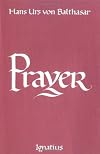
This is THE book on prayer for me. I have read a dozen or so theologians/scholars over the past few months and Balthasar takes the cake. He has a deeply theological view of prayer that contrasts my upbringing in the faith that at times it felt like we believed in two separate gods! I'll take Balthasar's over what I was given in my youth. I highly recommend this book for an introduction to prayer, however, I would add the caveat that it is aimed more towards seminary-level students. Do not show more let that detract you though, I do believe anyone could pick this up who is willing to push through some deep theology. show less
The book really gets going in Chapter 3. Chapters 1-2 are very rough going, a literary criticism of schools of thought Balthasar disagrees with. What was difficult was the name dropping unfamiliar people in history, written with the assumption the reader will have a base knowledge/recognition of. I did not, and further, when I looked into these people and their works/beliefs, I didn't find it that helpful to grasping the core thesis of Balthasar's book.
Sorry to Balthasar, but I think the show more first 2 chapters are worth skipping entirely. They're very discouraging before getting to the core of Balthasar's beautiful work.
My favorite portion was when Balthasar compares God to artwork -- similar in that they cannot be reduced to knowledge (a sort of control) but only encountered in a Thou sense (Martin Buber).
How beautiful is this: "In both cases the ‘understanding’ of that which reveals itself cannot be subsumed under categories of knowledge which imply control... To dissolve the magic of beauty into some ‘truth’ that lies behind or beyond the appearance, is to banish beauty altogether and simply shows that its specific quality has never been felt" (45). show less
Sorry to Balthasar, but I think the show more first 2 chapters are worth skipping entirely. They're very discouraging before getting to the core of Balthasar's beautiful work.
My favorite portion was when Balthasar compares God to artwork -- similar in that they cannot be reduced to knowledge (a sort of control) but only encountered in a Thou sense (Martin Buber).
How beautiful is this: "In both cases the ‘understanding’ of that which reveals itself cannot be subsumed under categories of knowledge which imply control... To dissolve the magic of beauty into some ‘truth’ that lies behind or beyond the appearance, is to banish beauty altogether and simply shows that its specific quality has never been felt" (45). show less
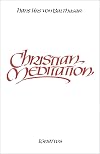
This thin volume, written by the late great Swiss Catholic Theologian, von Balthasar, discusses Christian Meditiation (hence, the title). By this, von Balthasar doesn't mean extended silent prayer, centering prayer, days of solitude, etc. Instead, this is Word-centered meditation, where one encounters Triune God through the pages of scripture.
This book is short but difficult to read, and I am not sure I would recommend it to anyone who doesn't at least have a sense of where Balthasar is show more writing from. It explicates a theological and Christological reading of scripture informed by a meditative approach given to Balthasar by his early Jesuit instruction. It is therefore peppered with references to the Spiritual Exercises of St. Ignatius.
I really liked this book and found myself reading passages slowly and going back and rereading them to make sure I got them. Others of Balthasar's shorter works, do not seem this dense to me. What I particularly appreciated was that although Balthasar's focus was on what we call 'Scriptural meditation,' he was clear that the focus was not the written word. Instead, he advocated for a meditative practice which is centered on an encounter with Christ in the text. This meant he wasn't antagonistic to other meditative practices, but he does find the spiritual exegesis and Ignatian approaches most helpful in focusing on the Christological character of the Bible.
The final chapter on Union, is divided into " the Marian Way," "the Ecclesial Way" and "The Paths to the World." Certainly as a protestant I adjust some of what Balthasar has to say here, but I found it a helpful approach to looking for Christ in our personal adoration of him (the Marian way), hearing him through the liturgy with the church (ecclesial way), and being attentive to the Mission of the Triune God and where Jesus is speaking in the world (Paths to the World). Perhaps a good way to think of it is the personal, communal and missional. These are dimensions which I want my little rule to lead me into.
Even so, come Lord Jesus. show less
This book is short but difficult to read, and I am not sure I would recommend it to anyone who doesn't at least have a sense of where Balthasar is show more writing from. It explicates a theological and Christological reading of scripture informed by a meditative approach given to Balthasar by his early Jesuit instruction. It is therefore peppered with references to the Spiritual Exercises of St. Ignatius.
I really liked this book and found myself reading passages slowly and going back and rereading them to make sure I got them. Others of Balthasar's shorter works, do not seem this dense to me. What I particularly appreciated was that although Balthasar's focus was on what we call 'Scriptural meditation,' he was clear that the focus was not the written word. Instead, he advocated for a meditative practice which is centered on an encounter with Christ in the text. This meant he wasn't antagonistic to other meditative practices, but he does find the spiritual exegesis and Ignatian approaches most helpful in focusing on the Christological character of the Bible.
The final chapter on Union, is divided into " the Marian Way," "the Ecclesial Way" and "The Paths to the World." Certainly as a protestant I adjust some of what Balthasar has to say here, but I found it a helpful approach to looking for Christ in our personal adoration of him (the Marian way), hearing him through the liturgy with the church (ecclesial way), and being attentive to the Mission of the Triune God and where Jesus is speaking in the world (Paths to the World). Perhaps a good way to think of it is the personal, communal and missional. These are dimensions which I want my little rule to lead me into.
Even so, come Lord Jesus. show less

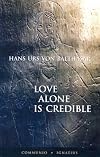
Logic looks for a place where it can pull everything together. That place can not be found in creation—even in the creation of humans. It can only be found in the revelation of God. The center of God's revelation is love: the only thing that is credible. This is the foundation of von Balthasar's dense little book.
This book is brilliant. Almost every page has some striking insight that makes you want to put the book down and meditate.
I'll be the first to admit that there were times when I show more felt like I was barely keeping my head above the water. Von Balthasar's a highly gifted philosopher as well as a theologian. Thankfully, there is a recapitulation at the end of the book: four pages that summarize the flow of his argument. You would do well to read that first, then keep referring back to it as you read through the book to constantly situate yourself in his logic.
This book will stand up to many readings. It's a treasure well worth the effort. show less
This book is brilliant. Almost every page has some striking insight that makes you want to put the book down and meditate.
I'll be the first to admit that there were times when I show more felt like I was barely keeping my head above the water. Von Balthasar's a highly gifted philosopher as well as a theologian. Thankfully, there is a recapitulation at the end of the book: four pages that summarize the flow of his argument. You would do well to read that first, then keep referring back to it as you read through the book to constantly situate yourself in his logic.
This book will stand up to many readings. It's a treasure well worth the effort. show less
Awards

You May Also Like


Associated Authors
Statistics
- Works
- 198
- Also by
- 8
- Members
- 9,745
- Popularity
- #2,449
- Rating
- 4.0
- Reviews
- 50
- ISBNs
- 477
- Languages
- 15
- Favorited
- 13