
Saul Steinberg (1914–1999)
Author of Saul Steinberg
About the Author
Romanian Saul Steinberg is best known for his drawings in The New Yorker. He has won various awards for his drawings and watercolors. He is the author of several books of drawings, including The Passport, and The New World. He died in 1999. (Bowker Author Biography)
Image credit: Art Card courtesy of Simon Fieldhouse
Series
Works by Saul Steinberg
The catalogue; [a selection of drawings reprinted from The art of living, The passport, and The labyrinth] (1962) 13 copies, 1 review
Steinberg 11 copies
Steinberg : drawing into being 5 copies
New Work by Saul Steinberg 2 copies
Dal vero 2 copies
Recent work 1 copy
Saul Steinberg - Recent Work 1 copy
Passaporto 1 copy
Saul Steinberg : zomer 1953 1 copy
Communications 1 copy
Ecritures 1 copy
Derrière le miroir. 192 1 copy
LSD 25 1 copy
Steinberg's Paperback 1 copy
Derrière le miroir. 53/54 1 copy
Design and paper 30 1 copy
Saul Steinberg: untitled 1 copy
Associated Works
An Anthology of Graphic Fiction, Cartoons, and True Stories: v. 2 (2008) — Contributor — 169 copies, 2 reviews
Community and Privacy: Toward a New Architecture of Humanism (1963) — Cover artist, some editions — 127 copies
Tagged
Common Knowledge
- Birthdate
- 1914-06-15
- Date of death
- 1999-05-12
- Gender
- male
- Education
- University of Bucharest
Polytechnic University of Milan - Occupations
- cartoonist
illustrator
artist - Organizations
- American Academy of Arts and Letters (Art, 1968)
- Relationships
- Sterne, Hedda (wife)
van Dalen, Anton (assistant) - Nationality
- Romania (birth)
USA (immigration) - Birthplace
- Râmnicu Sărat, Romania
- Place of death
- New York, New York, USA
- Associated Place (for map)
- New York, New York, USA
Members
Reviews
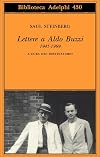
Tutto sommato, non è granché. Le lettere di un artista, uomo di grande cultura, curioso, depresso, al suo amico che vive dall’altra parte del mondo. Quasi 45 anni di lettere, il racconto di una vita sotto tutti gli aspetti. Le ultime lettere sono brevi e confuse, la depressione senile (oltre al rincoglionimento) sono chiare e devastanti.
Per il mio personale, una stilettata al cuore. Una valutazione totalmente non oggettiva, come tutte le valutazioni che vengono dal cuore.
Per il mio personale, una stilettata al cuore. Una valutazione totalmente non oggettiva, come tutte le valutazioni che vengono dal cuore.

Published after his death in 1999, this is a meditation based on a series of interviews of Steinberg by Buzzi. Beginning with his childhood and youth in Romania, through his wartime experience in Italy and his maturity in the United States, Steinberg muses with an acute visual sense, appropriate for an artist. The book is illustrated with his drawings.
His ideas about influences on art are insightful. as he describes early photographers “inspired by the paintings of Delacroix and Ingres”, show more to his thorught that Bacon “clearly derives from the Polaroid”. I was intrigued by his suggestion that the use of industrial paints in American art occurred because of poor artists used cold-water flats as studios, “and to make them livable they had to scrape and paint the walls, doors and windows, and floors . . . and this led them to work on a large scale, to use industrial paints, such as gold or silver on radiators, new materials”. His description of the New York City taxi cab of the ‘40’s as created out of Cubist elements, of the automobile influenced by Constructivism, Cubism, and “Fernandlégerism” makes one look at cars in a whole new light.
The title, Reflections and Shadows, comes from a section in which he discusses how what one sees in reverse in a reflection (in a mirror, in water) or shadow is often better - sharper, more intense - than the original. “If ou look only at the reflection, and not at the reflecting part, you see a gratuitous reality that exists for you alone. For fun I throw a stone into the upside-down landscape, and seeing that the lower part moves I almost expect the upper part to move too.”
If I quoted all my favorite parts of this book, I’d be typing almost the entire thing, so you’ll have to go read it for yourself! show less
His ideas about influences on art are insightful. as he describes early photographers “inspired by the paintings of Delacroix and Ingres”, show more to his thorught that Bacon “clearly derives from the Polaroid”. I was intrigued by his suggestion that the use of industrial paints in American art occurred because of poor artists used cold-water flats as studios, “and to make them livable they had to scrape and paint the walls, doors and windows, and floors . . . and this led them to work on a large scale, to use industrial paints, such as gold or silver on radiators, new materials”. His description of the New York City taxi cab of the ‘40’s as created out of Cubist elements, of the automobile influenced by Constructivism, Cubism, and “Fernandlégerism” makes one look at cars in a whole new light.
The title, Reflections and Shadows, comes from a section in which he discusses how what one sees in reverse in a reflection (in a mirror, in water) or shadow is often better - sharper, more intense - than the original. “If ou look only at the reflection, and not at the reflecting part, you see a gratuitous reality that exists for you alone. For fun I throw a stone into the upside-down landscape, and seeing that the lower part moves I almost expect the upper part to move too.”
If I quoted all my favorite parts of this book, I’d be typing almost the entire thing, so you’ll have to go read it for yourself! show less
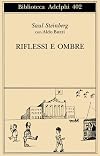
4 stelle sentimentali. Io amo Steinberg e sono rimasta folgorata dalla Squarzola (la follia architettonica di Buzzi).
Queste 70 pagine scritte larghe sono riflessioni e appunti di Steinberg che inquadrano ulteriormente il personaggio. Adesso sono in fremente attesa che mi arrivi l'epistolario.
Queste 70 pagine scritte larghe sono riflessioni e appunti di Steinberg che inquadrano ulteriormente il personaggio. Adesso sono in fremente attesa che mi arrivi l'epistolario.

The first part are conventional civilian cartoons, some clever and subtle, some not. The second part, overseas, is more interesting now, as the introduction to it explains "Steinberg saw most of the theaters of war as a Lieutenant in the Navy and the OSS. HIs overseas drawings reflect the G.I>'s unconscious viewpoint better than most of the books of the war correspondents." Some are essentially realistic with little or no humor; others are quite sardonic, as for instance one of a single show more sturdy but unburdened American soldier followed by two emaciated "native" porters piled high with his luggage, followed by a "native" child carrying one handbag on his head. I inherited this from my father's collection. He probably boughti t when it came out. show less
Lists
Awards

You May Also Like


Associated Authors
Statistics
- Works
- 78
- Also by
- 14
- Members
- 823
- Popularity
- #30,997
- Rating
- 4.2
- Reviews
- 13
- ISBNs
- 49
- Languages
- 6
- Favorited
- 3
