
William Steig (1907–2003)
Author of Sylvester and the Magic Pebble
About the Author
William Steig was born in Brooklyn, New York, on November 14, 1907, and spent his childhood in the Bronx. Steig found an outlet for his talent by creating cartoons for the high school newspaper. After high school graduation, Steig spent two years at City College, three years at the National show more Academy, and five days at the Yale School of Fine Arts before dropping out. During his early days as a free-lance artist, he supplemented his income with work in advertising, although he intensely disliked it. He illustrated for the The New Yorker, beginning in 1930. During the 1940s, Steig's creativity found a more agreeable outlet when he began carving figurines in wood; his sculptures are on display as part of the collection in the historic home of Franklin D. Roosevelt in Hyde Park, New York, and in several museums in New England. In 1967, Bob Kraus, a fellow cartoonist at The New Yorker, was in the process of organizing Windmill Books, an imprint for Harper & Row. Kraus suggested that Steig try writing and illustrating a book for a young audience. The result was Steig's letter-puzzle book entitled C D B!, published in 1968. Roland the Minstrel Pig, was published the same year. With his very next title, Sylvester and the Magic Pebble, he won the Caldecott Medal. The Amazing Bone was also a Caldecott Honor Book.In 1972, Steig published his first children's novel, Dominic, which won the Christopher Award. Abel's Island followed and was a Newberry Honor Book. William Steig died in October 3, 2003 in Boston Massachusettes. (Bowker Author Biography) show less
Series
Works by William Steig
When Everybody Wore a Hat (New York Times Best Illustrated Books (Awards)) (2003) 243 copies, 17 reviews
A Caldecott Celebration: Six Artists Share Their Paths to the Caldecott Medal (1998) — Illustrator — 149 copies, 6 reviews
Pete's a Pizza ... and More Great Kid Stories! (Scholastic Storybook Treasures) [2008 video] (2003) 14 copies
Shrek et autres histoires fabuleuses (Le Trésor de l'Heure des histoires) (French Edition) (2017) 2 copies
Where the Wild Things Are, Goldilocks and the Three Bears, Doctor De Soto, & Owl Moon (2006) 2 copies
YELLOW & PINK by William Steig (Hardcover in Dust Jacket. 2003 Farrar Straus Giroux publishers) (2003) 1 copy
Xiao lao shu piao liu ji 1 copy
Associated Works
The 20th-Century Children's Book Treasury: Picture Books and Stories to Read Aloud (1998) — Contributor — 1,828 copies, 14 reviews
The Decline and Fall of Practically Everybody (1950) — Illustrator, some editions — 1,113 copies, 17 reviews
An Anthology of Graphic Fiction, Cartoons, and True Stories: v. 2 (2008) — Cover artist, some editions — 169 copies, 2 reviews
The Art of Mickey Mouse: Artists Interpret The World's Favorite Mouse (Disney Miniature Series) (1991) — Illustrator, some editions — 96 copies, 3 reviews
Tagged
Common Knowledge
- Birthdate
- 1907-11-14
- Date of death
- 2003-10-03
- Gender
- male
- Education
- City College of New York
National School of Design - Occupations
- cartoonist
sculptor - Awards and honors
- Society of Illustrators Lifetime Achievement Award (Posthumous ∙ 2008)
Caldecott Medal 1970 - Relationships
- Steig, Jeanne (wife)
- Nationality
- USA
- Birthplace
- Brooklyn, New York, New York, USA
- Places of residence
- The Bronx, New York, New York, USA
Connecticut, USA - Place of death
- Boston, Massachusetts, USA
- Associated Place (for map)
- USA
Members
Discussions
Kids book, 70s? in Name that Book (September 2013)
Children's book about shapeshifting bunny in Name that Book (November 2012)
Reviews
A Thoroughly Unpleasant Children's Book
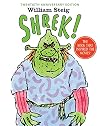
Picture book about a hideously ugly ogre who travels out into the world to find an ogress as ugly as he to marry. By 1990, when this was first published, author and illustrator William Steig had already been well-established for decades for such beloved children's classics as Sylvester and the Magic Pebble (1969), The Amazing Bone (1976) and Doctor De Soto (1982), which makes this utter misfire all the more inexplicable. The book's supposed message is show more of self-acceptance, and the line between that and being a complete sociopath is not a fine one, yet here Steig more than crosses it. Even in the grisliest folktales collected by the Grimm Brothers, there's a dearth of villains - let alone ostensible heroes - who make it a point to look their innocent victims in the eyes as they murder them, yet Shrek does precisely that to a hapless pheasant.
The writing is precisely as charming as the protagonist. The first section in verse reads:
It's difficult to imagine how a child might sing that meter and rhyming pattern.
That verse is sung by a witch, one of several "characters" (and I use that term generously) whom Shrek encounters on his quest who serve little purpose for the "story." The donkey, so memorable in the 2000 film adaptation, here is just... a donkey. Thanks to his doggerel introductory monologue, we know he lazes and spends his "days in the green,/A chewing, chomping rover." He takes Shrek to the castle, or more specifically, "To the nutty knight. Who guards the entrance. To the crazy castle. Where the repulsive princess. Waits." Why the donkey has this speech pattern - used only in this one line - is as much a mystery as is which children it would enchant.
As a picture book, what the writing lacks, the illustrations should be able to fill in, but once again, Steig fails to do so. His childlike drawing style familiar to those who have seen his earlier works is here employed to illustrate revolting subjects. If an actual child were to replicate this style, it would likely provoke a parent-teacher conference and perhaps some counseling sessions.
The only reason this book earns the star-and-a-half I gave it is because there were just enough elements to find a clear inspiration for the excellent film adaptation and the nearly equally excellent 2008 Broadway musical adaptation. It's also a tribute to the writers of those adaptations that they made it through all 28 fully-illustrated pages without being too nauseated to consider writing dozens of pages of script. For parents and educators looking to introduce young children to the joy of reading through this book, I'd recommend leaving the love of the superior versions unspoiled by this particular original source. show less
Picture book about a hideously ugly ogre who travels out into the world to find an ogress as ugly as he to marry. By 1990, when this was first published, author and illustrator William Steig had already been well-established for decades for such beloved children's classics as Sylvester and the Magic Pebble (1969), The Amazing Bone (1976) and Doctor De Soto (1982), which makes this utter misfire all the more inexplicable. The book's supposed message is show more of self-acceptance, and the line between that and being a complete sociopath is not a fine one, yet here Steig more than crosses it. Even in the grisliest folktales collected by the Grimm Brothers, there's a dearth of villains - let alone ostensible heroes - who make it a point to look their innocent victims in the eyes as they murder them, yet Shrek does precisely that to a hapless pheasant.
The writing is precisely as charming as the protagonist. The first section in verse reads:
"This is the way I cook my bats,
Stir my bats, taste my bats,
Season my bats in the morning;
Stew and brew and chew my bats
Diddle and fiddle and faddle my bats,
Early in the morning."
It's difficult to imagine how a child might sing that meter and rhyming pattern.
That verse is sung by a witch, one of several "characters" (and I use that term generously) whom Shrek encounters on his quest who serve little purpose for the "story." The donkey, so memorable in the 2000 film adaptation, here is just... a donkey. Thanks to his doggerel introductory monologue, we know he lazes and spends his "days in the green,/A chewing, chomping rover." He takes Shrek to the castle, or more specifically, "To the nutty knight. Who guards the entrance. To the crazy castle. Where the repulsive princess. Waits." Why the donkey has this speech pattern - used only in this one line - is as much a mystery as is which children it would enchant.
As a picture book, what the writing lacks, the illustrations should be able to fill in, but once again, Steig fails to do so. His childlike drawing style familiar to those who have seen his earlier works is here employed to illustrate revolting subjects. If an actual child were to replicate this style, it would likely provoke a parent-teacher conference and perhaps some counseling sessions.
The only reason this book earns the star-and-a-half I gave it is because there were just enough elements to find a clear inspiration for the excellent film adaptation and the nearly equally excellent 2008 Broadway musical adaptation. It's also a tribute to the writers of those adaptations that they made it through all 28 fully-illustrated pages without being too nauseated to consider writing dozens of pages of script. For parents and educators looking to introduce young children to the joy of reading through this book, I'd recommend leaving the love of the superior versions unspoiled by this particular original source. show less

Originally published in 1971, William Steig's Amos & Boris, which offers a delightful oceanic remake of the classic Aesopic fable of The Lion and the Mouse, is as close to perfect as a picture-book can be, pairing an engaging story about an unlikely friendship between a mouse and a whale, with charming illustrations that are all the more evocative for their simplicity. The text is intelligent, and its author assumes that his readers, young though they may be, are likewise intelligent. show more Describing his murine hero's voyage of discovery on the wide ocean, Steig writes: "One night, in a phosphorescent sea, he marveled at the sight of some whales spouting luminous water; and later, lying on the deck of his boat gazing at the immense, starry sky, the tiny mouse Amos, a little speck of a living thing in the vast living universe, felt thoroughly akin to it all."
That thrilling sense of connection, to the world around, and to the very cosmos; that feeling of being akin to all life; is one that comes to us all, from time to time (or so I have always imagined), an epiphanic experience made more powerful by the fact that it often remains inchoate - sensed, felt, but not fully conceptualized or expressed. That Steig so effortlessly evokes that kind of experience, using a sophisticated vocabulary that some might deem too advanced for picture-book fare, before blithely moving on with his narrative, makes for a brilliant storytelling episode - one of many in this little masterpiece of the genre! Poignant, without ever descending into any kind of overt emotional manipulation or tricksiness; heart-warming, though utterly lacking in sentimentality; and deeply satisfying, though the conclusion of the story is left somewhat open-ended, Amos & Boris is a superb picture-book, one I am very sorry not to have discovered earlier in life. I suspect I would have read it again and again, as a girl... show less
That thrilling sense of connection, to the world around, and to the very cosmos; that feeling of being akin to all life; is one that comes to us all, from time to time (or so I have always imagined), an epiphanic experience made more powerful by the fact that it often remains inchoate - sensed, felt, but not fully conceptualized or expressed. That Steig so effortlessly evokes that kind of experience, using a sophisticated vocabulary that some might deem too advanced for picture-book fare, before blithely moving on with his narrative, makes for a brilliant storytelling episode - one of many in this little masterpiece of the genre! Poignant, without ever descending into any kind of overt emotional manipulation or tricksiness; heart-warming, though utterly lacking in sentimentality; and deeply satisfying, though the conclusion of the story is left somewhat open-ended, Amos & Boris is a superb picture-book, one I am very sorry not to have discovered earlier in life. I suspect I would have read it again and again, as a girl... show less

When Sylvester finds a beautiful red pebble one day, the rock-collecting donkey is delighted. When that pebble turns out to be a magical stone that grants wishes, he is even more overjoyed, and rushes home to share the largess with his loving parents. Unfortunately, a chance encounter with a lion on his way, and a hastily made wish, see him transformed into an inanimate stone, with little prospect of ever being released from his self-inflicted enchantment. As Sylvester's parents begin their show more long search for him, he sits quietly in the meadow, unable to move. Will he ever become a donkey again, or be reunited with his parents...?
Apparently this charming picture-book - first published in 1969, and awarded a Caldecott Medal in 1970 - has been challenged in at least eleven states! Why you ask? Because its tale of a donkey who accidentally wishes himself into a stone, thereby causing grief to his loving parents, and to himself, is too disturbing for youngsters? No! Because it contains magic in the first place, and that might give impressionable young readers the 'wrong' idea? Again, no! This one was challenged because the police officers in the story - the helpful police officers who comfort Sylvester's parents, and try to help them find their son - are depicted as pigs! Of course, there's also a housewife depicted as a pig, but housewives aren't quite as organized as the police, who began challenging Sylvester and the Magic Pebble in 1977, in Indiana. That sound you hear is me rolling my eyes...
In any case, I'm glad I finally had a chance to read this classic of the picture-book genre, as I think it really is delightful, with an engrossing tale that treats childhood with the respect it deserves - no, children aren't all sweetness and light, and yes, they experience dark realities - and expressive artwork that captures both the humor and terror of Sylvester's predicament. show less
Apparently this charming picture-book - first published in 1969, and awarded a Caldecott Medal in 1970 - has been challenged in at least eleven states! Why you ask? Because its tale of a donkey who accidentally wishes himself into a stone, thereby causing grief to his loving parents, and to himself, is too disturbing for youngsters? No! Because it contains magic in the first place, and that might give impressionable young readers the 'wrong' idea? Again, no! This one was challenged because the police officers in the story - the helpful police officers who comfort Sylvester's parents, and try to help them find their son - are depicted as pigs! Of course, there's also a housewife depicted as a pig, but housewives aren't quite as organized as the police, who began challenging Sylvester and the Magic Pebble in 1977, in Indiana. That sound you hear is me rolling my eyes...
In any case, I'm glad I finally had a chance to read this classic of the picture-book genre, as I think it really is delightful, with an engrossing tale that treats childhood with the respect it deserves - no, children aren't all sweetness and light, and yes, they experience dark realities - and expressive artwork that captures both the humor and terror of Sylvester's predicament. show less

Articulating the affection of a multitude of fans--"Dr. Bernard De Soto was such a one-in-a-million, humdinger of a dentist that the whole world knew about him"--Steig reintroduces the debonair mouse-dentist and his beloved wife/assistant, Deborah. The dental dilemma of an elephant named Mudambo lead the duo on a pain relief mission to West Africa. No sooner are they ashore than Dr. De Soto is kidnapped by "a certain rhesus monkey, Honkitonk by name," sworn enemy of Mudambo--who considers show more his foe "an ill-bred pachyderm with a preposterous schnozzola." It's all here: the exuberant, Steigian phrases that somersault off the tongue, the nimble humour, the unflinching drama. Unfortunately, the rather complex plot doesn't utilise the dentist's by-now-legendary cunning for its resolution; it does, however, showcase the equally skilled, ever-faithful Deborah. Creatures of every stripe and feather populate this unique African jungle, evoking images and characters from previous works. Yet the vibrant, colourful illustrations exude a freshness and pizzazz that will leave readers wondering where the next world-class toothache will strike.
A telegram from an elephant desperately in need of dental attention is the impetus for Dr. and Mrs. De Soto's journey to Africa. But not all is smooth sailing for the couple, as a rhesus monkey bears a grudge against the elephant for a previous insult, and kidnaps the diminutive dentist as revenge. The illustrations are deftly drawn and nicely composed, with the agonized patient stealing the show. Steig takes full advantage of the size disparity between the grandiose elephants and their furnishings and the miniscule mice, and gets in some amusing touches. show less
A telegram from an elephant desperately in need of dental attention is the impetus for Dr. and Mrs. De Soto's journey to Africa. But not all is smooth sailing for the couple, as a rhesus monkey bears a grudge against the elephant for a previous insult, and kidnaps the diminutive dentist as revenge. The illustrations are deftly drawn and nicely composed, with the agonized patient stealing the show. Steig takes full advantage of the size disparity between the grandiose elephants and their furnishings and the miniscule mice, and gets in some amusing touches. show less
Lists
1960s (1)
Read in 2022 (1)
Children's Humor (1)
Winter Books (1)
Sonlight Books (2)
Reading Rainbow (2)
Newbery Adjacent (1)
Princess Tales (1)
4th Grade Books (1)
Awards


You May Also Like


Associated Authors
Statistics
- Works
- 72
- Also by
- 22
- Members
- 31,323
- Popularity
- #628
- Rating
- 4.0
- Reviews
- 682
- ISBNs
- 832
- Languages
- 16
- Favorited
- 24
